Large Capacity Compost Tumblers That Feed Raised Beds Fast
The FCMP Outdoor IM4000 is the top pick for raised bed gardeners who want a steady supply of compost. Its dual chamber design lets you fill one side while the other cures, and the 37 cubic foot capacity is generous for most home gardens. The main limitation is that assembly takes time and the crank can be stiff when fully loaded.
Raised bed gardeners know the struggle: you need a lot of compost to keep those beds fertile. Small bins just don’t cut it. Large capacity compost tumblers solve that by processing more material at once, giving you a steady supply of black gold.
We looked at tumblers that hold at least 30 gallons and are designed for easy turning. We considered features like dual chambers, sturdy frames, and weather resistance. Read on to find the right one for your garden.
Our top picks

FCMP Outdoor IM4000 Tumbling Composter, 37 Gallons
This dual chamber tumbler is a favorite among gardeners. Each side holds 18.5 gallons, allowing you to add new waste to one side while the other finishes. The hexagonal shape prevents clumping and improves aeration.
Pros
- Two chambers let one batch cure while you add to the other
- Hexagonal drum promotes better tumbling and aeration
- Sturdy steel frame with a large door for easy access
Cons
- Assembly can be time-consuming, about an hour
- Crank handle may feel stiff when fully loaded

Lifetime 60060 Earth Machine Compost Tumbler, 80 Gallons
The Lifetime 60060 offers an enormous 80-gallon capacity at a price that won’t break the bank. It features a single chamber with a large door for easy loading and unloading. The steel frame and UV-protected plastic promise durability.
Pros
- Huge capacity for large gardens or multiple raised beds
- Easy to load and unload with a wide door
- Value for money is excellent
Cons
- Single chamber means you must wait for the batch to finish
- Turning a full load requires some effort
Yimby Tumbler Composter, 37 Gallons
The Yimby tumbler stands out for its smooth operation. The crank handle turns easily even with a full load, thanks to a well-balanced design. Its square shape makes it look neat in the garden, and the high-quality plastic resists fading.
Pros
- Smooth turning mechanism with minimal effort
- Attractive design that blends into the garden
- No tools needed for quick assembly
Cons
- Single chamber limits continuous composting
- Door is a bit small for adding bulky materials
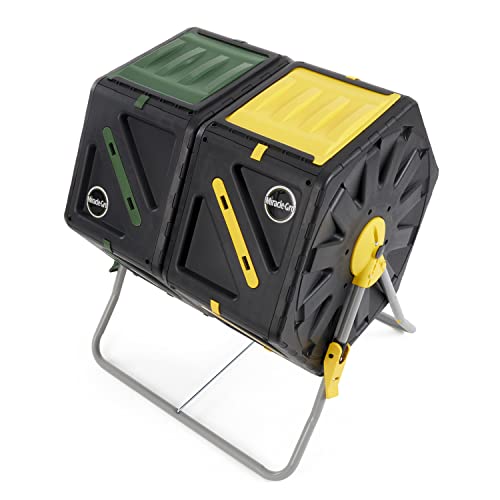
Miracle-Gro Large Dual Chamber Composter, 45 Gallons
Miracle-Gro’s dual chamber composter is designed to speed up decomposition. The black drum absorbs heat, and the internal fins mix air into the pile. Two chambers allow you to have two batches at different stages.
Pros
- Dual chambers for continuous processing
- Black color helps retain heat for faster breakdown
- Internal fins improve aeration
Cons
- Frame feels less sturdy than some other models
- Crank can be difficult to turn when both sides are full

Goplus 43 Gallon Dual Chamber Compost Tumbler
The Goplus composter features a heavy-duty steel frame and a 43-gallon split drum. It’s built to withstand rough weather and frequent turning. The galvanized steel legs provide extra stability on uneven ground.
Pros
- Robust construction with a durable steel frame
- Two chambers for versatility
- Stable even on soft soil
Cons
- Heavier than other models, making it hard to move
- Rust may develop on the frame over time if exposed to moisture

Vremi 42 Gallon Compost Tumbler
The Vremi composter offers a budget-friendly way to get dual chamber convenience. It has a 42-gallon capacity split between two compartments, each with its own door. The zinc-plated steel frame resists rust.
Pros
- Affordable dual chamber option
- Rust-resistant frame
- Compact footprint fits small gardens
Cons
- Plastic feels thinner than premium models
- Latch may wear out over time

Sungmor 35 Gallon Tumbling Composter
The Sungmor composter is a single chamber unit that suits gardeners with limited space. It holds 35 gallons and has a simple crank mechanism. The all-steel construction gives it a solid feel.
Pros
- Sturdy steel build
- Easy to assemble without tools
- Compact size fits tight spaces
Cons
- Single chamber limits continuous use
- Metal may heat up in direct sun
Side by side
| # | Model | Capacity | Best for | Score | Price |
|---|---|---|---|---|---|
| 1 | FCMP Outdoor IM4000 Tumbling Composter, 37 Gallons | 37 gallons total (2 x 18.5) | Best Overall for Dual Chamber Convenience | 9.4 | Check price |
| 2 | Lifetime 60060 Earth Machine Compost Tumbler, 80 Gallons | 80 gallons | Best for Maximum Capacity on a Budget | 8.9 | Check price |
| 3 | Yimby Tumbler Composter, 37 Gallons | 37 gallons | Best for Ease of Turning | 8.8 | Check price |
| 4 | Miracle-Gro Large Dual Chamber Composter, 45 Gallons | 45 gallons total (2 x 22.5) | Best for Rapid Composting | 8.6 | Check price |
| 5 | Goplus 43 Gallon Dual Chamber Compost Tumbler | 43 gallons total (2 x 21.5) | Best for Heavy Duty Use | 8.4 | Check price |
| 6 | Vremi 42 Gallon Compost Tumbler | 42 gallons total (2 x 21) | Best Value for Dual Chamber | 8.2 | Check price |
| 7 | Sungmor 35 Gallon Tumbling Composter | 35 gallons | Best for Small Raised Bed Gardens | 8.0 | Check price |
What to look for
Capacity and Raised Beds Raised beds typically need 1 to 2 inches of compost added annually. A 4×8 foot bed requires about 2 to 3 cubic feet of compost per inch. Larger capacity tumblers, like 37 to 80 gallons, allow you to produce enough to top dress several beds at once. Consider how many beds you maintain and how much kitchen waste you generate.
Dual vs Single Chambers Dual chamber tumblers let you start a new batch while another is finishing. This is ideal if you want a constant supply. Single chamber models are simpler and often cheaper, but you must wait for the entire compost to finish before adding new material. For most raised bed gardeners, dual chambers offer more flexibility.
Ease of Turning A full tumbler can be heavy. Look for models with a balanced design and a comfortable crank handle. Some tumblers have a hexagonal drum that helps mix contents, while others rely on internal fins. Read reviews to see if owners complain about difficult turning. Also consider the height of the unit to ensure you can reach the handle comfortably.
Durability and Weather Resistance Tumblers sit outside year round. UV-protected plastic or powder-coated steel resists fading and rust. Check the frame construction; a sturdy steel base prevents tipping in strong winds. Some models come with a warranty, which adds peace of mind.
Frequently asked questions
How much compost do raised beds need?
A general rule is to add 1 to 2 inches of compost to the top of your raised beds each year. For a 4×8 foot bed, that equals about 2 to 3 cubic feet per inch. A large capacity tumbler can provide this amount in a few months.
What is the best capacity for a compost tumbler for raised beds?
For most home gardeners with a few raised beds, a capacity of 37 to 45 gallons is ideal. If you have many beds or a large garden, consider an 80 gallon model. Larger capacities require more waste to fill, so ensure you have enough organic material.
How long does it take to make compost in a tumbler?
With regular turning and a good mix of greens and browns, compost can be ready in 4 to 8 weeks. Dual chamber models allow you to have a batch curing while you add to the other side, speeding up your overall production.
Can I put weeds in a compost tumbler?
Yes, but be aware that the heat in a tumbler may not be high enough to kill all weed seeds. To avoid spreading weeds, it’s safer to avoid adding weeds that have gone to seed, or use a hot compost method that reaches higher temperatures.
Do compost tumblers smell?
A well-maintained tumbler should not smell bad. If it does, the pile may be too wet or lack oxygen. Turn the tumbler more frequently and add dry browns like leaves or shredded paper to balance moisture.
How often should I turn my compost tumbler?
Most experts suggest turning every 2 to 3 days for best results. Some tumblers can be turned daily, but more frequent turning can speed up decomposition. With dual chambers, you can turn one each day.
Are compost tumblers worth the money for raised beds?
Yes, if you want a convenient and fast way to make compost. Tumblers are easier to turn than ground piles and keep pests out. The cost is offset by the benefit of free, nutrient-rich compost for your beds.
Can I use a compost tumbler in winter?
Yes, but the composting process slows down in cold weather. Insulating the tumbler or placing it in a sunny spot can help. Some models are black to absorb heat, which helps maintain internal temperatures.
What materials should I put in my compost tumbler?
A mix of green materials (kitchen scraps, grass clippings) and brown materials (dry leaves, straw, shredded paper) is essential. Aim for roughly 1 part green to 2 parts brown. Avoid meat, dairy, and oily foods to prevent odors and pests.
How do I know when compost is ready?
Finished compost is dark, crumbly, and has an earthy smell. The original materials should be unrecognizable. It should not heat up when turned. This usually takes a few months, depending on conditions.
Final word
For most raised bed gardeners, the FCMP Outdoor IM4000 is the best investment because its dual chamber design lets you keep a continuous supply of compost coming, and its build quality is reliable. If you have a larger garden and a tighter budget, the Lifetime 60060 offers immense capacity at a low cost, but you will need to wait between batches. Choose the FCMP for convenience and steady output, or the Lifetime if you only need compost a few times a year.
Sierra Daniels
Sierra's background is in landscape design and nursery retail. She focuses on lawn and garden equipment, outdoor furniture and gear durability, weighing published specs against how materials actually hold up outside.