Kitchen Knives Sold in Europe That Hold an Edge
The Wusthof Classic eight inch chef’s knife is the sturdiest all round European blade: forged, balanced and simple to keep sharp at home. Cooks who rock rather than push cut should look at the Zwilling Pro, while the Victorinox Fibrox Pro delivers professional performance for far less outlay.
Forged from a single billet with a full bolster, the Wusthof Classic eight inch chef’s knife anchors most European knife sets for good reason. Cooks who rock through herbs rather than push cut often prefer the curved profile on the Zwilling Pro, and the Victorinox Fibrox Pro brings professional capability at a fraction of the outlay.
Differences between European knives live in handle shape, bolster design and balance rather than headline steel specs, and those details decide whether a knife still feels right after twenty minutes of prep. We compared blade profiles, published hardness figures, handle materials and what owners report about edge retention through years of home use.
How to choose
What actually makes a European knife different Wider edge angles and slightly softer steel define the German Solingen tradition compared with Japanese blades. That produces a tougher edge that resists chipping and sharpens easily at home, at the cost of needing attention more often. Cooks who work through squash, bones or a busy household gain a real advantage from that toughness over a very hard, very thin Japanese edge.
Forged versus stamped: does it matter Shaping from a heated billet gives forged knives a bolster along with extra weight and stiffness. Stamped knives get cut from sheet steel instead, landing lighter and much cheaper. Victorinox proves how good a stamped knife can get, since the Fibrox Pro sees daily professional use across Europe. Forged blades feel more substantial and usually hold an edge longer, but the performance gap is smaller than the price gap suggests.
How bolster shape affects balance and grip Protecting the fingers and adding weight behind the heel is the job of a full bolster, but it also blocks the sharpener from reaching the last section of edge, which is why that spot often dulls first. Half bolster designs like the Zwilling Pro solve the problem. Balance stays personal, and the only reliable test is a pinch grip that reveals whether a knife feels blade heavy, handle heavy or neutral.
Care habits that actually extend knife life Hand washing and drying immediately beats every other maintenance step, since a good knife left in the sink or run through a dishwasher suffers heat, detergent and knocks against other items. Wooden or composite boards protect edges far better than glass or stone. Honing regularly with a steel and sharpening a few times a year keeps any knife on this list outlasting most of the kitchen around it.
Our top picks
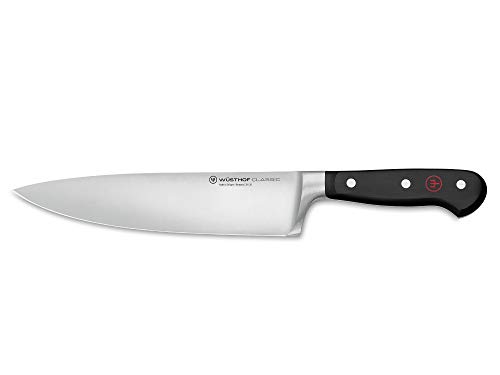
Wusthof Classic 8-Inch Chef’s Knife
Forged from a single billet, the Wusthof Classic pairs a full bolster with a riveted synthetic handle that survives decades of washing. Toughness rather than brittleness lets the blade forgive contact with bone or a frozen edge. Owners report it holds a working edge well and responds predictably to a honing steel between sharpenings.
Pros
- Tough steel forgives demanding kitchen tasks
- Full bolster gives a secure pinch grip
- Sharpens easily on any common system
Cons
- Full bolster makes the heel awkward to sharpen
- Heavier in hand than Japanese equivalents

Zwilling Pro 8-Inch Chef’s Knife
A broader curve toward the tip and a half bolster define the Pro line, leaving the full edge open for sharpening. Curved belly geometry suits cooks who rock through herbs rather than push cut. Owners report it feels more agile than older full bolster designs while keeping the same durability.
Pros
- Half bolster allows sharpening all the way to the heel
- Curved belly suits a rocking cutting motion
- Handle stays comfortable through long prep sessions
Cons
- Curved profile suits push cutting less well
- Heavier than lighter European alternatives

Victorinox Fibrox Pro 8-Inch Chef’s Knife
Stamped rather than forged, the Fibrox Pro trades some heft for a lighter, far cheaper blade that still cuts extremely well. Professional kitchens across Europe issue it standard for exactly that reason. Owners report it takes a keen edge quickly, though it needs sharpening more often than harder forged blades.
Pros
- Strong performance well beyond its price point
- Textured handle stays grippy with wet hands
- Light and agile through long prep sessions
Cons
- Needs sharpening more often than forged blades
- Plainer looks than forged rivals
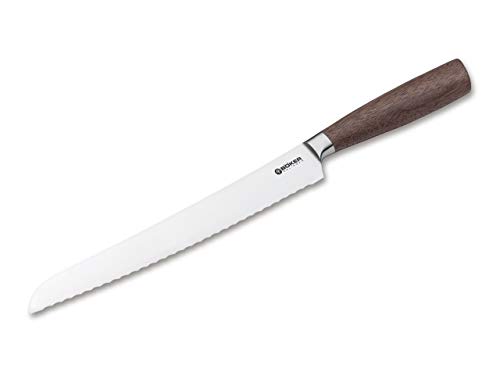
Boker Core Professional Chef’s Knife
A contoured handle fills the palm more than a traditional straight German grip, easing fatigue for cooks who find classic knives tiring. Forging gives the blade a profile that sits between German and Japanese in width. Owners report the ergonomics stand out and the edge holds up well in normal home use.
Pros
- Most comfortable handle in this group
- Blade profile suits both push and rock cutting
- Clean finish and solid overall construction
Cons
- Handle shape does not suit every hand size
- Less widely stocked than Wusthof or Zwilling

Arcos Riviera Chef’s Knife
Spain’s Arcos built the Riviera line lighter and slimmer than typical German knives, appealing to cooks who find forged Solingen blades heavy. Nitrum steel takes a fine edge readily. Owners report it feels agile and comfortable, with edge retention that lands between stamped and heavy forged alternatives.
Pros
- Light and agile for detailed knife work
- Takes a fine edge with little effort
- Handle material resists staining over time
Cons
- Less robust than heavy German forged blades
- Smaller support network outside Spain

Fiskars Functional Form Cook’s Knife
Finnish design sensibility shows in this light stamped knife, whose moulded handle feels unusually comfortable for the price. It suits a sensible first proper knife, or a second chef’s knife when two people cook at once. Owners report it cuts well and sharpens easily, trading some edge retention against forged blades.
Pros
- Comfortable handle at a low price point
- Light enough for extended chopping sessions
- Easy to bring back to a sharp edge
Cons
- Softer steel dulls faster than forged blades
- Handle cannot be repaired if it cracks

Opinel Les Forges 1890 Chef Knife
Best known for folding knives, Opinel brings that French heritage to the kitchen with beech handles and a slim forged profile. Lighter and more elegant than German standards, it looks the part on a magnetic rack. Owners report the wooden handle needs hand washing and occasional oiling in exchange for the appearance.
Pros
- Traditional French design with real visual appeal
- Slim profile cuts cleanly through produce
- Light and well balanced in the hand
Cons
- Wood handle demands hand washing and oiling
- Less robust than a full bolster German knife
How they compare
| # | Model | Blade | Best for | Score | Price |
|---|---|---|---|---|---|
| 1 | Wusthof Classic 8-Inch Chef’s Knife | Forged high carbon stainless steel | Best overall | 9.4 | Check price |
| 2 | Zwilling Pro 8-Inch Chef’s Knife | Forged stainless steel, curved profile | Best for rocking cuts | 9.1 | Check price |
| 3 | Victorinox Fibrox Pro 8-Inch Chef’s Knife | Stamped stainless steel | Best value | 8.9 | Check price |
| 4 | Boker Core Professional Chef’s Knife | Forged stainless steel | Best for grip comfort | 8.7 | Check price |
| 5 | Arcos Riviera Chef’s Knife | Nitrum stainless steel | Best lightweight European knife | 8.5 | Check price |
| 6 | Fiskars Functional Form Cook’s Knife | Stamped stainless steel | Best budget | 8.2 | Check price |
| 7 | Opinel Les Forges 1890 Chef Knife | Forged stainless steel | Best for design | 8.0 | Check price |
Good to know
Are European knives better than Japanese knives?
Neither wins outright, they solve different problems. European knives run tougher, more forgiving and easier to sharpen at home. Japanese knives run harder and thinner, holding a finer edge longer but chipping more easily. A busy general purpose kitchen usually finds a European knife like the Wusthof Classic the easier one to live with.
What is the best first chef’s knife to buy?
An eight inch chef’s knife covers the large majority of kitchen tasks on its own. Add a small paring knife and a serrated bread knife and nearly everything gets covered. Spending most of the budget on the chef’s knife is the sensible allocation.
Is a stamped knife worth buying over a forged one?
Yes, and the Victorinox Fibrox Pro proves it as the standard workhorse in many professional kitchens. It needs sharpening more often than a forged blade, but it cuts extremely well and its low cost leaves room in the budget for a proper sharpening setup.
Can European kitchen knives go in the dishwasher?
They should not, even where a manufacturer allows it. Dishwasher heat and detergent dull edges, corrode steel and damage handles, while knives knocking against other items chip. Hand washing and drying takes about fifteen seconds per knife.
How often do European knives need sharpening?
A few times a year covers typical home use, with honing on a steel far more frequently in between. Softer European steel dulls sooner than Japanese steel but comes back to sharp quickly. A blade slipping on tomato skin is the usual sign it is time.
What does a knife’s bolster actually do?
Weight and a barrier that stops the hand sliding onto the blade come from the bolster. A full bolster feels safer but blocks sharpening near the heel. Half bolster designs such as the Zwilling Pro keep the safety benefit without that maintenance drawback.
Are wooden knife handles a bad idea?
Not at all, though they demand hand washing, occasional oiling and never soaking. The Opinel Les Forges 1890 shows the style well. Synthetic handles like Wusthof’s forgive a busy household where knives sometimes sit unwashed for a while.
What cutting board protects a knife edge best?
End grain wood treats edges the kindest, while good plastic boards clean up the easiest. Glass, stone, marble and bamboo all dull knives fast and should be avoided. The board affects sharpening frequency more than most cooks realise.
Our take
Toughness and easy home sharpening make the Wusthof Classic eight inch chef’s knife the European blade that rewards the most cooks over years of use. Rockers who want full edge access should pick the Zwilling Pro, and anyone chasing professional capability on a smaller budget should choose the Victorinox Fibrox Pro.
Dana Whitfield
Dana spent eight years buying and merchandising for a regional kitchenware retailer before moving into editorial work. She has handled thousands of SKUs across cookware, small appliances and kitchen organization, and focuses on the practical differences that matter once a product is actually in daily use.


