What Kind of Kayak Fits Your Paddling Style Best?
Perception Pescador Pilot 12 leads for its pedal drive and fishing ready deck. Intex Explorer K2 is the value pick for casual paddling on calm water. Lifetime Tamarack Angler 100 is the best hard shell option for anglers wanting stability without a pedal system.
Perception Pescador Pilot 12 leads this ranking, with Intex Explorer K2 and Lifetime Tamarack Angler 100 following as the casual and hard shell fishing picks. All seven kayaks below are currently sold on Amazon and cover flat water touring, recreational paddling and fishing.
A ten foot inflatable and a twelve foot rotomoulded fishing platform share a name but behave nothing alike, which makes kayaks hard to compare on spec sheets alone. We weighed published dimensions, weight capacities, hull types and seating against what owners report about tracking, stability and how realistic each boat is to move and store.
How to choose
Sit-in or sit-on-top: which style fits you? A sit-on-top puts you above the deck with nothing enclosing your legs, making it easy to climb back on after a swim and forgiving in warm weather. A sit-inside puts you in a cockpit that blocks wind and spray, keeping you warmer and usually a little faster, but re-entry after a capsize takes practice. Anglers and warm climate paddlers tend toward sit-on-top; cool climate touring favors sit-inside.
What length kayak tracks best for your water? Longer hulls hold a straight line better and glide further per stroke, which is why a twelve foot boat feels dramatically less tiring on open water than a nine foot one. Shorter hulls turn quickly and suit twisting rivers and small ponds. Around ten feet is the common compromise, and a skeg or rudder can rescue tracking on a short boat when wind is the problem.
How heavy is too heavy to transport alone? The kayak you actually use is the one you can get to the water. A rotomoulded hull can weigh over fifty pounds before seat and gear go on, which becomes a two person lift onto a roof rack. Inflatables solve transport and storage at the cost of speed and setup time, a trade worth making for anyone without a lift or garage.
What weight capacity do you really need? Published weight capacity marks the point where a hull is fully loaded, not the point where it still performs well. Stay well under it once personal weight, gear, water and any catch are added. Overloading is the most common reason a stable kayak suddenly feels tippy and sits low enough to take on water.
The top picks, ranked
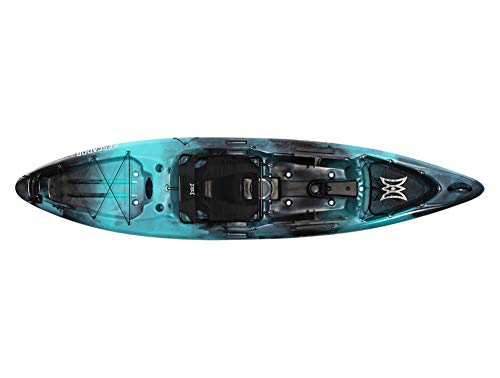
Perception Pescador Pilot 12
A pedal drive frees both hands for casting and makes holding position in wind far easier than paddling alone. At twelve feet five inches it tracks well while staying manageable on a roof rack. Owners report the raised, adjustable seat stays comfortable through long days on the water.
Pros
- Hands free pedal drive suits fishing
- Excellent tracking for its length
- Comfortable framed seat with height adjustment
Cons
- Heavy to load solo without a cart
- Pedal drive needs clearance in shallow water
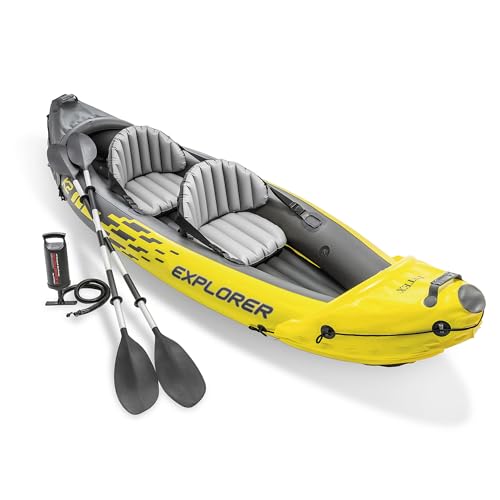
Intex Explorer K2 Kayak
This two person inflatable packs into a single bag, solving storage and transport for anyone without a garage or roof bars. It suits calm lakes and slow rivers rather than open water. Owners report a few minutes to inflate and enough stability for beginners who respect its limits.
Pros
- Packs down for apartment storage and car boots
- Paddles and pump included in the box
- Very approachable for first time paddlers
Cons
- Poor tracking in wind without a skeg
- Not suitable for rough or open water

Lifetime Tamarack Angler 100
Moulded rod holders and a flat bottomed hull give this ten foot sit-on-top real fishing stability. It hands anglers a hard shell platform without the cost of a pedal drive boat. Tracking runs average because of the short length, but stability in calm water stands out.
Pros
- Very stable for casting from a seated position
- Rod holders and storage moulded in
- Short enough for easy transport
Cons
- Tracks poorly compared with longer hulls
- Basic seat pad needs upgrading for long trips

Sea Eagle 370 Pro Inflatable Kayak
Reinforced polykrylar material makes this inflatable tougher than most budget rivals, rated for light whitewater and two or three paddlers. The thicker skin shows in puncture resistance. It still packs into a bag, which makes it the best compromise for storage-limited paddlers who want more capability.
Pros
- Much tougher material than entry level inflatables
- High load capacity for camping gear
- Packs into a carry bag for storage
Cons
- Slower than a hard shell of the same length
- Takes longer to inflate and dry properly

Pelican Sentinel 100X
Low weight is the headline feature on this sit-on-top, since many beginners give up on kayaking because loading the boat is harder than paddling it. Self bailing scupper holes clear water automatically. Performance stays recreational rather than fast.
Pros
- Light enough for one person to carry
- Self bailing scupper holes
- Forgiving stability for new paddlers
Cons
- Short hull wanders in wind
- Limited dry storage

Advanced Elements AdvancedFrame Inflatable Kayak
Aluminium ribs built into the bow and stern sharpen this inflatable’s ends, giving it noticeably better tracking than a rounded inflatable hull. It paddles closer to a hard shell than anything else here that still packs into a bag. Setup takes longer as a trade off.
Pros
- Tracks noticeably better than standard inflatables
- Multi layer hull resists punctures
- Still packs into a bag for storage
Cons
- Slower to set up than a simple inflatable
- Heavier than it looks when packed

Sun Dolphin Aruba 10 Sit-In Kayak
An open cockpit, adjustable footrests and a dry storage hatch outfit this basic sit-inside recreational kayak. The enclosed cockpit blocks wind, making it warmer than a sit-on-top in cool weather. It works as a simple entry point for lake and slow river paddling.
Pros
- Enclosed cockpit is warmer in cool conditions
- Adjustable footrests fit a range of heights
- Dry storage hatch included
Cons
- Harder to re-enter if it capsizes
- Modest weight capacity limits gear
How they compare
| # | Model | Length | Best for | Score | Price |
|---|---|---|---|---|---|
| 1 | Perception Pescador Pilot 12 | 12 feet 5 inches | Best overall | 9.4 | Check price |
| 2 | Intex Explorer K2 Kayak | Inflatable tandem | Best value | 9.2 | Check price |
| 3 | Lifetime Tamarack Angler 100 | 10 feet | Best for fishing on a budget | 9.0 | Check price |
| 4 | Sea Eagle 370 Pro Inflatable Kayak | Inflatable, two to three person | Best for packability | 8.8 | Check price |
| 5 | Pelican Sentinel 100X | 9 feet 6 inches | Best for beginners | 8.6 | Check price |
| 6 | Advanced Elements AdvancedFrame Inflatable Kayak | Inflatable with built in frame | Best for tracking in an inflatable | 8.3 | Check price |
| 7 | Sun Dolphin Aruba 10 Sit-In Kayak | 10 feet | Best budget sit-in | 8.0 | Check price |
Questions worth asking
Is a sit-on-top or sit-in kayak better for beginners?
Sit-on-top is the easier start for most people. Tip over and you simply climb back on, with nothing trapping your legs. A sit-inside is warmer and slightly faster, but learning to re-enter one in deep water takes instruction and practice.
Are inflatable kayaks any good?
Better than their reputation, provided the boat matches the water. Reinforced models such as the Sea Eagle 370 handle real use, and the AdvancedFrame tracks close to a hard shell. What you give up is speed, setup time and the ability to shrug off rocks and concrete ramps.
What length kayak should I buy?
Nine to ten feet turns easily and suits small lakes, ponds and winding rivers. Twelve feet and up glides further per stroke and holds a line on open water, at the cost of weight and storage space.
How much weight can a kayak hold?
Recreational models commonly rate around 250 to 300 pounds, while fishing kayaks with pedal drives often exceed 400. Treat the number as a maximum rather than a target, leaving margin for gear, water and clothing.
Do I need a rudder or skeg on a kayak?
Not for short trips on sheltered water. They earn their keep once you paddle in wind or current, where a short hull will otherwise weathercock and force constant correction. A drop down skeg is the simpler, cheaper of the two.
Can one person load a kayak alone?
With a lighter hull such as the Pelican Sentinel 100X, yes, especially with a roller bar or kayak cart. Heavier fishing kayaks are genuinely difficult solo without a lift assist rack or trailer, worth planning for before buying.
What safety gear should a kayaker carry?
A properly fitted buoyancy aid worn at all times, a whistle, a bilge pump or sponge, and a leash for the paddle. Tell someone your route and expected return time, since cold water is the real hazard rather than distance.
How should I store a kayak between trips?
Store hard shells on their side or upside down on padded supports, never resting flat on the hull for long periods, and keep them out of prolonged direct sun. Inflatables should dry fully before folding, then sit loosely stored in a cool place rather than compressed for months.
Pedal kayak versus paddle kayak: which is better for fishing?
A pedal drive like the Pescador Pilot 12 frees both hands for casting and holds position in wind better than paddling. A paddle kayak like the Tamarack Angler 100 costs less and has fewer moving parts to maintain.
Can a kayak tip over easily?
Wider, flatter hulls like the Tamarack Angler 100 resist tipping well in calm water. Narrower touring hulls feel less stable at rest but track and glide better once moving, so stability depends on hull shape as much as skill.
Our pick
Perception Pescador Pilot 12 remains the strongest all round boat here, the clear choice for anglers who want their hands free. Intex Explorer K2 suits casual lake paddling and anyone without storage space, while Lifetime Tamarack Angler 100 gives a stable hard shell fishing platform without the pedal drive cost.
Sierra Daniels
Sierra's background is in landscape design and nursery retail. She focuses on lawn and garden equipment, outdoor furniture and gear durability, weighing published specs against how materials actually hold up outside.


