Kayak Tie Down Straps That Hold Firm at Speed
NRS’s Super Strap Cam Buckle Tie-Downs are the best overall pick, using a plastic buckle and wide webbing that protect the hull while tensioning firmly for highway travel. YakAttack adds hull padding for long-term storage, and Rhino-Rack rates higher for heavier kayaks.
NRS’s Super Strap Cam Buckle Tie-Downs lead this list because the plastic buckle avoids scratching the hull or roof rack finish, and the wider webbing spreads tension across the kayak instead of pressing into the gel coat. YakAttack’s padded straps protect hulls better during long-term tied-down storage. Owners of heavier tandem or fishing kayaks should move up to Rhino-Rack’s higher-rated webbing instead.
Kayak straps mostly differ in buckle material, webbing width, and whether the design adds hull padding, so we compared tensioning strength, how well each strap avoids pressure marks on the hull, and fit across different roof rack brands.
How to choose
What to Look For in a Kayak Tie-Down Strap Buckle type, webbing width, and hull padding decide how securely a kayak rides at highway speed without pressure marks. A plastic cam buckle avoids scratching the hull, while padded contact points protect gel coat on longer trips.
Matching Straps to Your Roof Rack Brand Thule and Malone sell straps sized to their own crossbar spacing and buckle style, which integrate cleanly with an existing setup. Universal straps like NRS’s or SeaSense’s work across most rack widths without that brand-specific fit.
Best for Heavier Tandem and Fishing Kayaks Standard straps handle lightweight recreational kayaks fine, but heavier tandem or fishing kayaks loaded with gear need a higher load rating like Rhino-Rack’s thicker webbing provides.
Best for Occasional Trips on a Budget A basic multi-pack like CZC Auto’s or a simple pair like SeaSense’s covers weekend paddling trips without the added cost of padding or brand-matched hardware that frequent long-distance haulers benefit from.
The best picks, ranked

NRS Super Strap Cam Buckle Tie-Downs
NRS builds these straps with a plastic cam buckle rather than metal, removing the risk of a metal buckle scratching a kayak hull or roof rack finish during tensioning. The strap webbing is wider than most generic straps, spreading pressure across the hull instead of cutting into gel coat. NRS sells these in pairs sized for standard roof rack spans.
Pros
- Plastic buckle avoids scratching hull or rack finish
- Wide webbing spreads pressure across the hull
- Sold in matched pairs
Cons
- Plastic buckle may wear faster than metal under years of UV exposure
- Standard length may be short for very wide roof setups

YakAttack Mighty Straps
YakAttack adds a padded section where the strap crosses the kayak hull, reducing pressure marks on hulls left tied down for long storage periods. The strap length suits mid-size SUVs and trucks without needing an extension. Buckle hardware is metal, offering firmer long-term tension than plastic cam buckles.
Pros
- Padded section reduces hull pressure marks
- Metal buckle holds tension firmly over time
- Good length for mid-size vehicles
Cons
- Metal buckle carries more scratch risk if mishandled
- Shorter length than NRS for wider roof setups

Malone Auto Racks SecureGrip Tie-Down Straps
Malone designs this strap’s length around its own crossbar spacing, though it works on other brands’ racks of similar width. The webbing includes a grip texture that resists slipping once tensioned. Malone sells these as part of its kayak carrier kits, so the strap matches the padding and J-cradle hardware in that lineup.
Pros
- Textured grip resists slipping once tensioned
- Matches Malone’s kayak carrier kit hardware
- Works on similarly spaced crossbars from other brands
Cons
- Optimized specifically for Malone crossbar width
- Not sold with the padded hull contact point YakAttack includes

Thule Load Strap
Thule’s load strap is sized to pair with its own roof rack crossbars and kayak carriers, matching the buckle style used across that product line. It handles the same tensioning job as universal straps but integrates visually and functionally with an existing Thule setup. Owners without a Thule rack can still use it, since the buckle works like most other cam buckle straps.
Pros
- Matches existing Thule rack hardware and styling
- Works as a standalone universal strap too
- Reliable cam buckle tensioning
Cons
- Costs more than generic straps without added function
- No kayak-specific hull padding

Rhino-Rack Buckle Tie-Down Strap
Rhino-Rack rates this strap for a higher load than standard kayak straps, suited to heavier tandem or fishing kayaks loaded with gear mounts and coolers. The webbing runs thicker than NRS’s or YakAttack’s, adding some bulk but more margin against stretching under a heavier load. It still uses a standard cam buckle rather than a ratchet mechanism.
Pros
- Higher load rating suits heavier tandem and fishing kayaks
- Thicker webbing resists stretching under load
- Longer length covers wider roof setups
Cons
- Bulkier and heavier than standard straps
- Overkill for a single lightweight recreational kayak
SeaSense Cam Buckle Tie-Down Straps
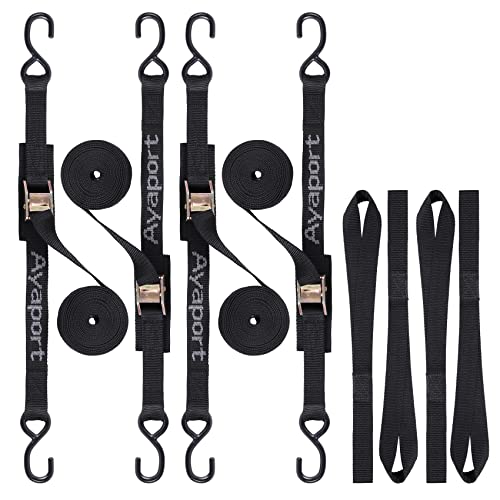
SeaSense sells a basic cam buckle strap pair at a lower price than the padded or brand-matched options above. The webbing is standard nylon without added texture or padding. It suits occasional kayak trips rather than straps left tensioned for long-term roof storage.
Pros
- Lower price than padded or brand-matched straps
- Adequate for occasional kayak trips
- Standard cam buckle is easy to use
Cons
- No hull padding or grip texture
- Shorter length may not fit wider roof racks

CZC Auto Cam Buckle Straps
CZC Auto sells these straps in packs of four or more, useful for owners tying down multiple kayaks or needing backup straps on hand. Individual strap quality sits below the kayak-specific brands above, without padding or reinforced webbing. They work fine as a spare set or for lighter single kayaks on short trips.
Pros
- Multi-pack covers several kayaks or provides spares
- Lowest price per strap in this lineup
- Standard cam buckle function
Cons
- No padding or reinforced webbing for hull protection
- Less suited to heavier kayaks or long-term tensioning
Compared at a glance
| # | Model | Material | Best for | Score | Price |
|---|---|---|---|---|---|
| 1 | NRS Super Strap Cam Buckle Tie-Downs | Polypropylene webbing, plastic cam buckle | Best overall | 9.4 | Check price |
| 2 | YakAttack Mighty Straps | Nylon webbing, metal buckle | Best for hull padding | 9.1 | Check price |
| 3 | Malone Auto Racks SecureGrip Tie-Down Straps | Nylon webbing, textured grip | Best for roof rack systems | 8.8 | Check price |
| 4 | Thule Load Strap | Nylon webbing | Best for Thule roof systems | 8.6 | Check price |
| 5 | Rhino-Rack Buckle Tie-Down Strap | Heavy nylon webbing | Best for heavy tandem and fishing kayaks | 8.4 | Check price |
| 6 | SeaSense Cam Buckle Tie-Down Straps | Nylon webbing | Best value | 8.1 | Check price |
| 7 | CZC Auto Cam Buckle Straps | Nylon webbing | Best budget multi-pack | 8.0 | Check price |
Good to know
What strap is best for tying down a kayak?
A padded cam buckle strap like NRS’s or YakAttack’s protects the hull from pressure marks better than a basic strap, especially on longer highway trips.
How many straps does it take to secure a kayak to a roof rack?
Most kayaks need two straps across the hull plus bow and stern lines for extra security at highway speed.
Can I use ratchet straps instead of cam buckle straps for a kayak?
Cam buckle straps are generally preferred, since a ratchet strap can overtighten and crack a kayak’s plastic or fiberglass hull if cranked down too hard.
Do kayak straps need padding?
Padding is not required but reduces pressure marks and gel coat wear on hulls left tied down for long trips or stored tensioned between uses.
What length strap is needed for a kayak roof rack?
Most setups use straps between 9 and 13 feet, depending on roof width and whether the strap needs to wrap fully around crossbars and the hull.
Can the same straps work for canoes as well as kayaks?
Yes, the same cam buckle tie-down straps used for kayaks work for canoes, since both need similar hull-crossing tension without a ratchet mechanism.
Are plastic or metal cam buckles better for kayak straps?
Plastic buckles reduce the risk of scratching a hull or rack finish, while metal buckles typically hold tension more firmly over long-term use.
How tight should kayak tie-down straps be?
Tight enough that the kayak does not shift side to side when pushed by hand, without so much tension that the hull visibly flexes or deforms.
Do kayak straps work on both SUV crossbars and truck bed racks?
Yes, standard cam buckle straps adapt to most mounting points, whether crossbars, truck bed rails, or a dedicated kayak carrier system.
Our pick
NRS’s Super Strap Cam Buckle Tie-Downs are the safest default for most kayak owners, since the plastic buckle and wide webbing protect the hull without sacrificing tensioning strength. Anyone storing a kayak tied down for extended periods should switch to YakAttack’s padded straps instead, since the foam contact points reduce pressure marks that NRS’s unpadded webbing does not address. Owners of heavier tandem or fishing kayaks loaded with gear get more margin from Rhino-Rack’s higher-rated, thicker webbing.
Sierra Daniels
Sierra's background is in landscape design and nursery retail. She focuses on lawn and garden equipment, outdoor furniture and gear durability, weighing published specs against how materials actually hold up outside.