Interfacing Types Explained: Which One Fits Your Project
Pellon SF101 Shape-Flex is the standard woven fusible for garment sewing, covering collars, cuffs and waistbands. Bag makers need Pellon Peltex for rigid structure. Quilters reach for Pellon Fusible Fleece for padded panels. Knit sewists should choose Pellon Easy-Knit instead of any woven interfacing.
Pellon SF101 Shape-Flex handles most garment interfacing needs, from collars to cuffs, without adding stiffness. Bag builders need something firmer like Peltex, and knit garments call for a stretch base like Easy-Knit instead. No single interfacing covers every project.
Sewists often grab whatever interfacing is in stock, then wonder why a collar goes limp or a bag base sags. We compared fusible versus sew-in application, weight, stretch behavior and the fabric each product targets, based on manufacturer specifications and sewing community feedback.
The top picks, ranked

Pellon SF101 Shape-Flex Woven Fusible Interfacing
This woven cotton blend fuses without adding a stiff, papery feel. Collars and cuffs keep their natural drape after repeated washing. Most sewists treat it as the default choice for shirts, soft bags and home decor trim.
Pros
- Keeps a natural drape instead of feeling stiff
- Fuses evenly with minimal bubbling
- Sold in narrow and wide bolts
Cons
- Not stiff enough for structured bag bases
- Woven grain will not stretch with knits

Pellon 71F Peltex Ultra Firm Stabilizer
Fusible glue coats both sides of this stabilizer, bonding two fabric layers into a bag base that stands up unsupported. It is far stiffer than any woven interfacing here, closer to thin buckram. Bag makers reach for it specifically where a piece needs to hold its shape alone.
Pros
- Holds a rigid shape without external support
- Bonds two fabric layers at once from both sides
- Cuts cleanly without fraying
Cons
- Too stiff for anything meant to fold softly
- Thick layers can bog down a home machine

Pellon 987F Fusible Fleece
Loft and padding, not stiffness, define this fusible batting for potholders and quilted bag panels. One fusible side bonds to fabric, so pieces stay put while quilting instead of shifting. Skipping pin basting on smaller projects is the main reason owners buy it.
Pros
- Fuses in place, skipping pin basting on small projects
- Adds padding without heavy bulk
- Machine quilts and washes without breaking down
Cons
- Too thin to substitute for full sized quilt batting
- Not stiff enough to replace a structural stabilizer

Pellon EK130 Easy-Knit Fusible Interfacing
A tricot knit base stretches with jersey instead of locking a section rigid. Woven interfacing on knits is the most common mistake this product fixes. Necklines and button plackets on t-shirt and swimwear fabric hold up better while the garment still moves.
Pros
- Stretches with the fabric instead of restricting movement
- Lightweight enough for t-shirt weight knits
- Reduces neckline stretch-out over repeated wear
Cons
- Not suitable for stiffening woven fabric projects
- Needs a press cloth so glue does not show through thin knits
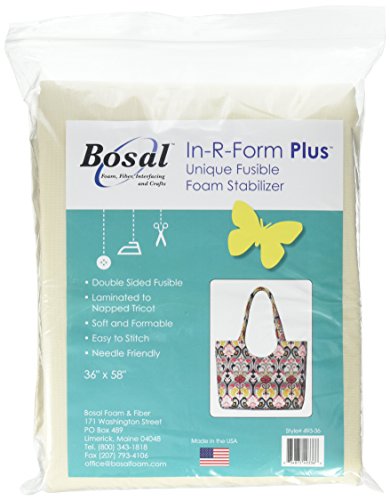
Bosal In-R-Form Plus Foam Stabilizer
A foam core sandwiched between two fusible layers gives bags soft, rounded structure instead of flat rigidity. It bends around curved seams and corners without creasing sharply. Many bag patterns name this stabilizer specifically for structured totes and boxy pouches.
Pros
- Rounds into curved seams without sharp creasing
- Named directly in many bag sewing patterns
- Softer hand than rigid stabilizers like Peltex
Cons
- Adds noticeable bulk at seam allowances
- Costs more per yard than woven interfacings

Pellon 809 Décor Bond Fusible Interfacing
Firmer than Shape-Flex yet still woven, Décor Bond suits placemats and table runners that need body without going rigid. Larger panels press flat and resist puckering, where a lighter interfacing would ripple. Crafters treat it as the middle ground between garment weight and stiff bag stabilizers.
Pros
- Firm enough to hold shape on flat decor pieces
- Wide 45 inch bolt covers larger projects
- Presses without puckering on big panels
Cons
- Too firm for garment collars or cuffs
- Not designed for curved or 3D shaping

Pellon 950F Fusible Featherweight Interfacing
Silk and chiffon call for this featherweight fusible, which adds barely any stiffness or shadow through sheer fabric. Blouse plackets and lightweight facings use it where standard weight interfacing would show through. A low iron setting matters here, since delicate fabric scorches easily.
Pros
- Nearly invisible through sheer and lightweight fabric
- Adds minimal stiffness for delicate garments
- Fuses at lower iron temperatures
Cons
- Provides little structure for anything heavier than lightweight fabric
- Easy to scorch if the iron runs too hot
What to look for
Fusible vs sew-in: which application to choose Fusible interfacing bonds with heat from a household iron, the easier route for most home sewing projects. Sew-in works better on heat-sensitive synthetics or on delicate silks, where fusible glue can show through. Test a scrap first whenever the fabric is unfamiliar.
Matching interfacing weight to your fabric A lightweight fabric needs a lightweight interfacing, or the finished piece turns stiff and board-like. Denim and canvas can carry a firmer interfacing without looking overbuilt. Match weight to weight instead of grabbing whatever is already open.
Woven, non-woven or knit: which base fits your project Woven interfacing has a grain and behaves like fabric, ideal for garment sewing on woven cloth. Non-woven versions have no grain and cut in any direction, useful for crafts and bag structure. Knit interfacing stretches with jersey, the only base that belongs on a knit garment.
Combining interfacing types in one project A structured bag often pairs a firm stabilizer like Peltex at the base with a lighter fusible along the sides, avoiding an entirely rigid finished piece. Garments sometimes use a lightweight interfacing on facings and a firmer one at button plackets for durability. Layering weights by section beats using one product throughout.
Compared at a glance
| # | Model | Application | Best for | Score | Price |
|---|---|---|---|---|---|
| 1 | Pellon SF101 Shape-Flex Woven Fusible Interfacing | Fusible, iron-on | Best overall | 9.4 | Check price |
| 2 | Pellon 71F Peltex Ultra Firm Stabilizer | Fusible on both sides | Best for bag structure | 9.1 | Check price |
| 3 | Pellon 987F Fusible Fleece | Fusible on one side | Best for quilted projects | 8.9 | Check price |
| 4 | Pellon EK130 Easy-Knit Fusible Interfacing | Fusible, iron-on | Best for knit fabrics | 8.7 | Check price |
| 5 | Bosal In-R-Form Plus Foam Stabilizer | Fusible on both sides | Best for 3D bag shaping | 8.5 | Check price |
| 6 | Pellon 809 Décor Bond Fusible Interfacing | Fusible, iron-on | Best for home decor crafts | 8.2 | Check price |
| 7 | Pellon 950F Fusible Featherweight Interfacing | Fusible, iron-on | Best for sheer and lightweight fabrics | 8.0 | Check price |
Frequently asked questions
What is the best all-purpose interfacing for garment sewing?
Pellon SF101 Shape-Flex is the most commonly recommended all-purpose choice. Its woven cotton blend base fuses smoothly and keeps a natural drape across collars, cuffs and waistbands.
Can you use interfacing on knit fabric?
Yes, but it needs to be a knit-based product like Pellon Easy-Knit, not a woven interfacing. A woven base locks the knit section rigid and stops it from stretching with the rest of the garment.
Which interfacing works best for bag making?
Pellon Peltex Ultra Firm gives a bag base rigid structure, while a foam stabilizer like Bosal In-R-Form Plus suits rounded, 3D bag shapes. Many bag patterns specify one or the other by name.
Is fusible or sew-in interfacing easier for beginners?
Fusible interfacing is generally easier since it bonds with a household iron and needs no extra stitching. Sew-in suits fabrics that cannot take direct heat, but it adds a hand-basting or machine-stitching step.
How do you stop interfacing from bubbling after ironing?
Bubbling usually comes from insufficient heat, pressing time or pressure, or the fabric shifting before the glue sets. Use a press cloth, hold the iron down without sliding it, and let the fused piece cool flat before moving it.
What is fusible fleece used for?
Fusible fleece is a low loft batting with an iron-on side, used to pad potholders, placemats and quilted bag panels. It replaces separate batting and basting on smaller, single-layer quilted projects.
Does Décor Bond do the same job as Shape-Flex?
No. Both are woven fusibles, but Décor Bond is firmer, aimed at home decor items like table runners. Shape-Flex is lighter and better suited to garment pieces that need to keep a soft drape.
How much interfacing do I need for a project?
Most patterns list required yardage, but as a rule buy slightly more than the pattern piece size to allow for grain alignment and test scraps. Interfacing is inexpensive enough that a little extra rarely goes to waste.
Can you sew a garment without interfacing at all?
You can on some casual patterns, but collars, cuffs, waistbands and buttonholes typically sag or stretch out of shape without it. Interfacing exists specifically to hold those stress points steady over repeated wear.
The bottom line
Pellon SF101 Shape-Flex remains the safest first purchase for anyone stocking a sewing room, since it handles most woven garment projects without adding unwanted stiffness. Bag makers should add Peltex or a foam stabilizer for structure that Shape-Flex cannot provide. Anyone sewing knits regularly needs Easy-Knit specifically, since no woven product substitutes for it.
Jake Monroe
Jake worked as a residential contractor for over a decade before shifting to full-time writing. He evaluates power tools, hand tools and workshop gear through the lens of someone who has actually used them on job sites, not just read the box.


