Industrial Pressure Washers Rated for Daily Commercial Use
The Simpson PowerShot PS60843 handles the broadest range of commercial cleaning jobs at 6,000 PSI, the Generac 6924 OneWash adds adjustable pressure zones for switching tasks without changing nozzles, and the Karcher HD 3.5/35 Ec suits indoor commercial use where gas exhaust is not allowed.
The Simpson PowerShot PS60843 covers the widest range of commercial cleaning jobs at 6,000 PSI and 5.0 GPM, running on a Honda engine known for commercial reliability, though its gas exhaust rules it out for enclosed indoor spaces.
Industrial pressure washers separate mainly on PSI and GPM output, engine or motor type, and whether the pump is designed for occasional commercial use or genuine daily duty, so we compared published flow rates, duty-cycle ratings, and engine or motor specs across seven current models.
The best picks, ranked
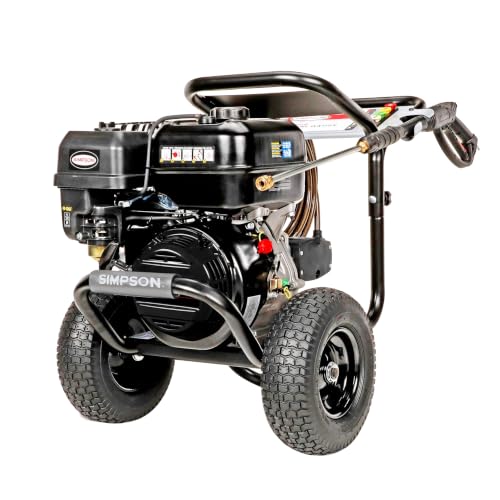
Simpson PowerShot PS60843 Gas Pressure Washer
Simpson rates this washer at 6,000 PSI and 5.0 GPM, a combination that clears heavy grease and caked dirt faster than lower-flow machines even at similar pressure. A Honda GX390 engine, widely used across commercial equipment, drives a Simpson-built triplex pump designed for daily professional use. The frame uses a full-size cart with pneumatic tires rather than small plastic wheels, meant to survive job-site transport.
Pros
- High GPM clears grease and heavy soil faster than low-flow machines
- Honda GX390 engine has a strong reliability record in commercial equipment
- Pneumatic-tired cart withstands repeated job-site transport
Cons
- Heavier overall unit than machines built for lighter commercial use
- Gas exhaust limits use to outdoor or well-ventilated spaces

Generac 6924 OneWash Pressure Washer
Generac’s OneWash system adjusts pressure through the nozzle itself rather than requiring a full nozzle swap, covering tasks from gentle rinsing to aggressive degreasing with one tool. The washer runs at 3,200 PSI and 2.7 GPM, lower than Simpson’s flagship but still rated for commercial duty cycles. An axial cam pump keeps the design more compact than a full triplex pump setup.
Pros
- OneWash nozzle adjusts pressure without swapping tips mid-job
- Compact axial cam pump keeps the unit easier to move
- Covers a wide range of cleaning tasks with one machine
Cons
- Lower PSI and GPM than flagship triplex-pump commercial machines
- Axial cam pumps generally wear faster under heavy daily use than triplex pumps

NorthStar 157114 Gas Cold Water Pressure Washer
NorthStar builds this washer around a belt-drive triplex pump, which runs cooler than direct-drive pumps during long, continuous commercial use. Rated at 4,000 PSI and 4.0 GPM, it sits between Simpson’s flagship output and Generac’s lighter-duty model. A Honda engine again supplies the power, and NorthStar mounts the whole unit on a steel frame cart built for repeated loading onto a truck bed.
Pros
- Belt-drive pump runs cooler during long continuous use
- Steel cart frame holds up to repeated truck loading
- Mid-range PSI and GPM suit most daily commercial jobs
Cons
- Belt-drive systems need periodic belt inspection and replacement
- Heavier than axial cam or direct-drive alternatives

Mi-T-M CW-3004-0MEH Pressure Washer
Mi-T-M sizes this washer for crews that move between job sites regularly, keeping the footprint smaller than NorthStar’s or Simpson’s larger carts. It runs at 3,000 PSI and 4.0 GPM on a Honda engine, with a direct-drive pump that trades some long-duty-cycle durability for lighter weight. Mi-T-M includes a 50-foot high-pressure hose as standard, longer than many competitors’ included hose length.
Pros
- Compact frame suits crews moving between multiple job sites
- Longer standard hose reaches further without an extension
- Good GPM for the unit’s relatively light overall weight
Cons
- Direct-drive pump wears faster under sustained heavy daily use than belt-drive
- Lower max PSI than Simpson’s or NorthStar’s flagship models
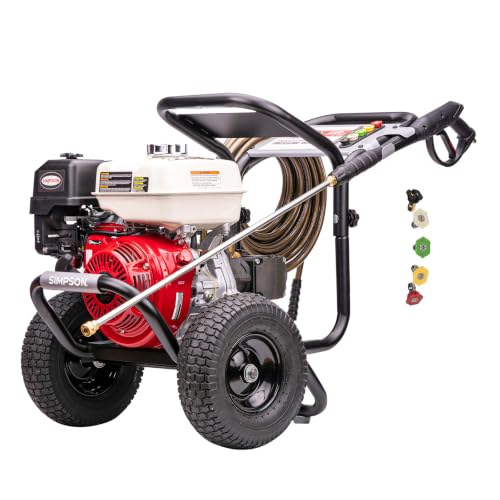
Simpson Trisuper TS-6080 Pressure Washer
Simpson’s Trisuper line pushes output to 6,000 PSI and a notable 6.0 GPM, the highest flow rate among the washers compared here, aimed squarely at heavy industrial cleaning like construction equipment or large fleet vehicles. A Vanguard commercial engine drives a cast-iron triplex pump built for extended continuous runtime. The larger engine and pump combination add considerable weight compared to lighter-duty machines.
Pros
- Highest flow rate among all washers compared here
- Cast-iron pump built for extended continuous industrial runtime
- Vanguard engine matches the pump’s heavy-duty rating
Cons
- Significant weight makes it harder to move without a cart winch or ramp
- Overkill for routine commercial cleaning that doesn’t need maximum flow

BE Pressure B4013HAMS Pressure Washer
BE Pressure reaches 4,000 PSI and 4.0 GPM at a price typically below NorthStar’s or Simpson’s comparable output, using a Honda engine paired with an AR triplex pump. The AR pump brand is widely used across budget-to-mid commercial washers and carries a solid service-part availability record. A simpler frame design without a full steel cart keeps the overall cost down.
Pros
- Commercial-grade PSI and GPM at a lower price than premium brands
- AR triplex pump parts are widely available for service
- Honda engine matches pricier competitors’ reliability
Cons
- Simpler frame lacks the heavy-duty cart found on NorthStar or Simpson models
- Fewer included accessories than higher-priced competitors

Karcher HD 3.5/35 Ec Cold Water Electric Pressure Washer
Karcher’s HD 3.5/35 Ec runs on electric power instead of gas, making it the only washer here suitable for enclosed indoor spaces without ventilation concerns. Output reaches 1,885 PSI and 3.5 GPM, lower pressure than the gas models but still rated for regular commercial use like parking garages or indoor equipment washdowns. The motor runs quieter than any gas engine in this comparison, which matters in noise-sensitive commercial settings.
Pros
- Safe for enclosed indoor spaces without gas exhaust concerns
- Quieter operation than any gas-powered washer in this comparison
- Electric motor needs less routine maintenance than a gas engine
Cons
- Lower max PSI than every gas model compared here
- Requires a 230V electrical supply, not standard household outlets
Compared at a glance
| # | Model | Max pressure | Best for | Score | Price |
|---|---|---|---|---|---|
| 1 | Simpson PowerShot PS60843 Gas Pressure Washer | 6,000 PSI | Best overall | 9.3 | Check price |
| 2 | Generac 6924 OneWash Pressure Washer | 3,200 PSI | Best for switching between cleaning tasks | 9.0 | Check price |
| 3 | NorthStar 157114 Gas Cold Water Pressure Washer | 4,000 PSI | Best for heavy daily duty cycles | 8.9 | Check price |
| 4 | Mi-T-M CW-3004-0MEH Pressure Washer | 3,000 PSI | Best for mobile commercial crews | 8.7 | Check price |
| 5 | Simpson Trisuper TS-6080 Pressure Washer | 6,000 PSI | Best for the most demanding industrial jobs | 9.1 | Check price |
| 6 | BE Pressure B4013HAMS Pressure Washer | 4,000 PSI | Best value for commercial-grade output | 8.5 | Check price |
| 7 | Karcher HD 3.5/35 Ec Cold Water Electric Pressure Washer | 1,885 PSI | Best for indoor commercial use | 8.6 | Check price |
Before you buy
PSI and GPM both matter, not just one number Pressure, measured in PSI, determines how forcefully water hits a surface, while flow rate, measured in GPM, determines how much water and how much dirt that pressure can move away per minute. A washer with high PSI but low GPM, like Generac’s OneWash, can still struggle to clear heavy grease compared to a lower-PSI machine with more flow, such as Karcher’s electric model for lighter jobs. Commercial cleaning tasks like stripping paint or removing caked grease benefit most from washers strong in both numbers, like the Simpson PowerShot PS60843 or Trisuper TS-6080. Buyers comparing specs sheet to specs sheet should multiply the two, not look at either alone, to estimate real cleaning power.
Gas engines versus electric motors for commercial duty Gas-powered washers, which make up most of this comparison, generally reach higher PSI and GPM than electric models and work anywhere without needing a nearby power outlet. Electric washers, like the Karcher HD 3.5/35 Ec, trade some of that output for indoor safety, since they produce no exhaust fumes and run quieter. Commercial settings like parking garages, warehouses, or any space without strong ventilation generally require electric or require venting for gas engines under local code. Outdoor fleet washing, construction sites, and agricultural use rarely face that restriction, which is why gas dominates those applications.
Belt-drive, direct-drive, and axial cam pumps Belt-drive triplex pumps, used in the NorthStar 157114, run cooler during long continuous sessions because the belt isolates the pump from engine vibration and heat somewhat. Direct-drive pumps, like Mi-T-M’s CW-3004-0MEH, connect the pump straight to the engine shaft, which keeps the unit lighter but runs hotter under sustained heavy use. Axial cam pumps, found in Generac’s OneWash, are typically the lightest-duty option of the three, suited to frequent but not all-day commercial use. Crews running a washer for hours every day benefit most from belt-drive or heavy triplex pumps, while occasional commercial use tolerates axial cam designs fine.
Matching output to the job, not the biggest number available A mobile detailing or pressure-washing crew moving between residential driveways rarely needs the Simpson Trisuper TS-6080’s 6.0 GPM output, where a more compact unit like the Mi-T-M CW-3004-0MEH handles the work with less weight to haul. Fleet maintenance yards or construction sites stripping heavy coatings benefit from the higher flow rate, since it clears material faster per pass. Buying more PSI and GPM than a job calls for mainly adds weight, fuel use, and cost without matching productivity gains. Matching the washer to the actual surface and soil type being cleaned saves money over defaulting to the highest-spec model on the shelf.
Frequently asked questions
What PSI is considered industrial grade for a pressure washer?
Most industrial-grade gas washers start around 3,000 PSI and range up to 6,000 PSI or higher, compared to residential electric washers that typically stay under 2,000 PSI.
Is GPM or PSI more important for commercial cleaning?
Both matter together. PSI drives the force of the spray while GPM determines how much dirty water and debris get carried away, so a washer strong in only one number cleans less efficiently than one balanced in both.
Can an electric pressure washer handle commercial cleaning jobs?
Yes, for lighter commercial tasks or indoor spaces where gas exhaust is not allowed, though electric models like the Karcher HD 3.5/35 Ec generally reach lower PSI than gas-powered commercial washers.
What is a duty cycle rating on a commercial pressure washer?
It describes how many hours per day or week the pump is designed to run continuously without excessive wear, which is why commercial-rated triplex pumps outlast consumer-grade axial pumps under daily use.
Do industrial pressure washers need a special water supply?
Most need a standard garden hose connection with adequate flow to match the washer’s GPM rating; a hose that cannot supply enough water will starve the pump and reduce pressure.
What is the difference between a triplex and axial cam pump?
Triplex pumps use three pistons and are generally built for longer continuous commercial duty, while axial cam pumps are lighter and more compact but typically rated for less sustained daily use.
Can a gas pressure washer be used indoors?
Generally no, since gas engines produce carbon monoxide exhaust that is unsafe in enclosed spaces without proper ventilation; electric models are the safer choice indoors.
How much maintenance does an industrial pressure washer need?
Gas models need regular oil changes and engine maintenance similar to other small engines, plus periodic pump oil checks, while electric models need less routine maintenance overall.
What hose length is typical for a commercial pressure washer?
Most commercial units include 25 to 50 feet of high-pressure hose, with models like the Mi-T-M CW-3004-0MEH including a longer 50-foot hose as standard.
Is a belt-drive pump better than a direct-drive pump?
For sustained daily commercial use, belt-drive pumps generally run cooler and last longer, while direct-drive pumps are lighter and suit lighter or more occasional commercial use.
The verdict
The Simpson PowerShot PS60843 is the strongest all-around pick for commercial cleaning crews, combining high PSI and GPM on a proven Honda engine without the extra bulk of the heaviest industrial machines. Crews handling the most demanding jobs, like fleet washdowns or construction equipment, should step up to the Simpson Trisuper TS-6080 for its higher flow rate. Anyone cleaning indoors or in noise-sensitive commercial spaces needs the Karcher HD 3.5/35 Ec instead, since gas exhaust rules out every other machine in this comparison.
Dana Whitfield
Dana spent eight years buying and merchandising for a regional kitchenware retailer before moving into editorial work. She has handled thousands of SKUs across cookware, small appliances and kitchen organization, and focuses on the practical differences that matter once a product is actually in daily use.