Induction Saucepans for Everyday Stovetop Cooking
Rachael Ray’s Create Delicious saucepan tops this list for an affordable nonstick interior paired with a confirmed magnetic induction base. GreenLife’s ceramic nonstick pan follows for buyers avoiding traditional nonstick coatings, and Anolon’s stainless pan suits anyone who prefers metal utensils.
Rachael Ray’s Create Delicious saucepan is an easy everyday pick, pairing a nonstick interior with a magnetic stainless base that heats reliably on induction without a premium price tag.
We compared interior coating type, confirmed induction compatibility, and owner reports on long-term coating wear to rank these seven saucepans, since nonstick durability varies more than base material does.
The top picks, ranked

Rachael Ray Create Delicious Nonstick Saucepan
This saucepan pairs a nonstick interior with a stainless induction base, making it an easy everyday pan for sauces, grains, and reheating. The handle includes a silicone grip that stays cool during stovetop use.
Pros
- Nonstick interior simplifies cleanup for sauces and grains
- Magnetic base confirmed reliable on induction cooktops
- Silicone handle grip stays cool during stovetop use
Cons
- Nonstick coating needs replacing sooner than bare stainless
- Not safe for metal utensils, unlike stainless alternatives

GreenLife Soft Grip Ceramic Nonstick Saucepan
GreenLife uses a ceramic-based nonstick coating rather than traditional nonstick chemistry, appealing to buyers who prefer to avoid certain coating types. The base beneath the coating is confirmed magnetic for induction.
Pros
- Ceramic coating avoids traditional nonstick chemical compounds
- Magnetic base works reliably across induction cooktops
- Soft-grip handle adds comfort during longer cooking tasks
Cons
- Ceramic nonstick coatings often wear faster than traditional nonstick
- Lower heat tolerance than bare stainless surfaces

Anolon Nouvelle Stainless Saucepan
Anolon skips nonstick coating entirely in favor of a bare stainless interior, which tolerates metal utensils and higher searing temperatures. The tri-ply base is confirmed compatible with induction cooktops.
Pros
- Bare stainless tolerates metal utensils without damage
- Tri-ply base confirmed reliable on induction
- No coating to wear down or replace over time
Cons
- Requires more technique to prevent sticking than nonstick pans
- Heavier than most nonstick-coated alternatives

Cuisinart Chef’s Classic Nonstick Saucepan
Cuisinart’s Chef’s Classic line keeps the design straightforward, a dependable nonstick interior over a magnetic stainless base confirmed for induction use. It suits buyers who want a no-frills everyday saucepan.
Pros
- Straightforward design suits everyday cooking tasks
- Magnetic base confirmed compatible with induction
- Smaller capacity is easy to handle for quick sauces
Cons
- Smaller capacity limits use for larger batches
- Stainless handle without silicone grip heats up more

T-fal Platinum Nonstick Induction Saucepan
T-fal combines its heat indicator spot with a nonstick interior and a magnetic induction-ready base, useful for buyers still adjusting to how quickly induction heats compared to gas. The coating is rated for metal-free utensil use only.
Pros
- Heat indicator helps judge readiness on induction
- Magnetic base confirmed compatible with induction cooktops
- Nonstick interior simplifies everyday cleanup
Cons
- Heat indicator becomes less useful with induction experience
- Nonstick coating still requires non-metal utensils

Circulon Premier Professional Saucepan
Circulon builds this saucepan on a hard-anodized base with a magnetic layer added for induction compatibility, pairing that durability with a nonstick interior. It holds up to more frequent use than lighter-gauge nonstick pans.
Pros
- Hard-anodized base adds durability over standard nonstick pans
- Magnetic layer confirmed compatible with induction
- Silicone grip handle stays cool during use
Cons
- Heavier than standard aluminum nonstick saucepans
- Costs more than basic nonstick alternatives
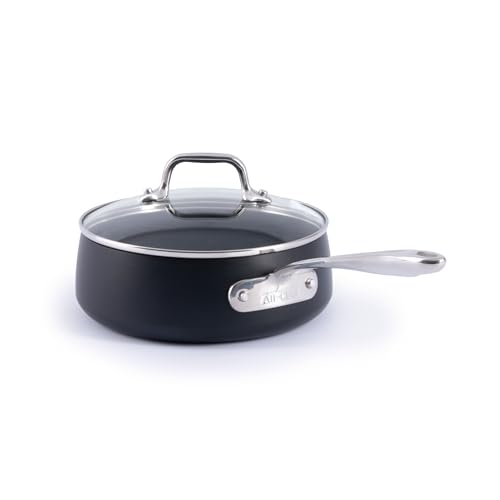
All-Clad HA1 Hard Anodized Nonstick Saucepan
All-Clad’s HA1 line pairs hard-anodized construction with a nonstick interior and a magnetic base confirmed for induction, aimed at buyers who want premium build quality without stepping up to bare tri-ply stainless.
Pros
- Hard-anodized construction resists warping better than thin aluminum
- Magnetic base confirmed reliable on induction cooktops
- Premium brand build quality at a lower tier than full tri-ply lines
Cons
- Costs more than most nonstick competitors on this list
- Still requires non-metal utensils to protect the coating
How to choose
What makes a saucepan induction ready Induction cooktops need a magnetic base to generate heat, so the saucepan’s bottom layer must contain enough magnetic stainless steel or an added magnetic plate. Nonstick, ceramic, and bare stainless interiors can all sit above that same compatible base.
Nonstick versus bare stainless for everyday sauces Nonstick and ceramic coatings make cleanup easier and reduce sticking for delicate sauces, but wear down over years of use and cannot handle metal utensils. Bare stainless lasts indefinitely and tolerates metal tools, at the cost of more careful technique to avoid sticking.
Hard-anodized construction and durability Hard-anodized aluminum resists warping and scratching better than standard nonstick aluminum pans, which is why premium nonstick lines like All-Clad’s HA1 and Circulon’s Premier use it as a base layer. That durability adds cost and weight compared to basic nonstick pans.
Choosing based on how you actually cook Someone making delicate sauces or eggs regularly benefits most from a quality nonstick or ceramic interior. Someone searing, deglazing, or using metal utensils often should lean toward bare stainless instead, since coatings do not hold up well to that kind of use.
Compared at a glance
| # | Model | Interior | Best for | Score | Price |
|---|---|---|---|---|---|
| 1 | Rachael Ray Create Delicious Nonstick Saucepan | Nonstick coating | Best overall | 9.0 | Check price |
| 2 | GreenLife Soft Grip Ceramic Nonstick Saucepan | Ceramic nonstick coating | Best ceramic nonstick alternative | 8.8 | Check price |
| 3 | Anolon Nouvelle Stainless Saucepan | Bare stainless steel | Best for metal utensil use | 8.9 | Check price |
| 4 | Cuisinart Chef’s Classic Nonstick Saucepan | Nonstick coating | Best for simple everyday cooking | 8.7 | Check price |
| 5 | T-fal Platinum Nonstick Induction Saucepan | Nonstick coating | Best heat indicator feature | 8.6 | Check price |
| 6 | Circulon Premier Professional Saucepan | Hard-anodized nonstick | Best hybrid durability | 8.8 | Check price |
| 7 | All-Clad HA1 Hard Anodized Nonstick Saucepan | Hard-anodized nonstick | Best premium nonstick pick | 9.1 | Check price |
Questions worth asking
Do all nonstick saucepans work on induction?
No, only ones with a confirmed magnetic base beneath the coating; check the listing for explicit induction compatibility.
Is ceramic nonstick better than traditional nonstick for induction use?
Both can be induction compatible if the base is magnetic; the coating type affects cleanup and durability, not induction performance.
Can you use metal utensils on an induction saucepan?
Only if the interior is bare stainless; nonstick and ceramic coatings should be used with non-metal utensils.
Why does my nonstick saucepan not heat on my induction stove?
The base likely lacks a magnetic layer; some lighter nonstick pans use non-magnetic aluminum bases without added stainless.
How long does nonstick coating last on an induction saucepan?
Typically a few years with careful use; metal utensils and high heat shorten that lifespan considerably.
Is hard-anodized construction worth the extra cost?
It adds durability and warp resistance, which matters more for frequent daily cooking than occasional use.
Can induction saucepans be used on other stove types?
Yes, pans compatible with induction generally work on gas, electric coil, and glass-top stoves as well.
What size saucepan is best for everyday sauces?
A 2 to 2.5 quart saucepan covers most everyday sauce, grain, and reheating tasks for one to two people.
Do heat indicator spots actually help with induction cooking?
They can help while learning how quickly induction heats compared to gas, though they matter less with experience.
The bottom line
Rachael Ray’s Create Delicious saucepan is the easiest everyday pick, since it pairs reliable induction compatibility with an affordable nonstick interior for routine cooking. Anyone who cooks with metal utensils regularly should choose Anolon’s bare stainless pan instead, and buyers wanting more durability from their nonstick coating should step up to All-Clad’s HA1 line.
Dana Whitfield
Dana spent eight years buying and merchandising for a regional kitchenware retailer before moving into editorial work. She has handled thousands of SKUs across cookware, small appliances and kitchen organization, and focuses on the practical differences that matter once a product is actually in daily use.

