Grow Tent Sizes and Fabric Weights Compared for Any Room
AC Infinity’s Advance 4×4 tent leads on build quality and airflow. Vivosun’s 4×4 GIY tent offers the best value with a removable floor tray. Gorilla Grow Tent’s Lite Line 4×4 blocks light most completely through thick 1680D fabric and an optional height extension.
Seven grow tents here split across small closets, standard 4×4 rooms and multi-plant 8×4 layouts, each built around 1680D or 600D fabric with a reflective mylar interior.
We compared published specifications and owner feedback on seam quality rather than a single lab test, since fabric weight and vent count need to match plant count more than any one spec alone.
What matters most
What to look for in an indoor grow tent Fabric denier, mylar reflectivity and vent count separate grow tents more than any other spec. Heavier 1680D fabric resists tears from repeated folding better than 600D fabric. Mylar interiors range from about 95% to 98% reflective, which changes how evenly light spreads across the canopy. Pole diameter runs from 16mm on smaller tents up to 20mm on frames built for heavier fixtures. Vent port counts span two on compact tents to eight on multi-row setups, setting the ceiling on exhaust fan and filter size.
Which tent size fits a small space or a multi-plant grow A 2×2 footprint like TopoGrow’s or Spider Farmer’s fits a closet or under a desk and suits one to two plants in 3-gallon pots. Standard 4×4 tents, roughly 48 by 48 inches, hold four to six containers depending on pot size. Eight or more plants call for a footprint closer to Yield Lab’s 8×4 layout, spanning 96 by 48 inches across two rows. Height matters too, since taller tents like Spider Farmer’s 63 inch model leave clearance for ducting and clip fans above the canopy.
How fabric weight and seams affect light-proofing Fabric denier measures thread thickness, and 1680D fabric resists abrasion and puncture better than 600D fabric across repeated setup and teardown. Double-stitched seams matter as much as denier, since light escapes through loose stitching before it escapes through thin fabric. Mylar reflectivity above 95% keeps light bouncing evenly across the canopy instead of concentrating near the light source. Any light leak during a plant’s dark cycle can disrupt flowering, so seam quality gets as much attention as fabric weight.
Setting up ventilation for airflow and odor control Vent port count sets how many intake and exhaust fans a tent can run at once. A single 4×4 tent with four ports typically runs one passive intake fan and one exhaust fan connected to a carbon filter. Larger tents with six to eight ports, like Gorilla Grow Tent’s Lite Line or Yield Lab’s 8×4, support a bigger inline fan and filter pair needed for heat and odor across a wider footprint. Cable ports separate power cords from the main vent openings, cutting down on stray light leaking through gaps.
What we recommend

AC Infinity Advance Grow Tent 4×4
1680D oxford fabric pairs with a tool-free steel frame rated for heavier LED fixtures. Four vent ports plus dedicated cable ports keep ducting and wiring away from the main zipper doors. Owners report the double-stitched seams hold up after repeated folding.
Pros
- Tool-free 19mm poles assemble without extra hardware
- Diamond mylar interior reflects 96% of light back onto the canopy
- Separate cable ports reduce light leaks around cords
Cons
- Costs more than similarly sized tents from other brands
- Steel corner feet can mark hardwood or vinyl flooring

Vivosun 4×4 GIY Grow Tent
A removable floor tray catches runoff from drip irrigation on this 4×4 tent. Six mesh vent ports outnumber most tents in this size class, useful for dual-fan setups. A clear viewing window lets growers check plants without opening the main door.
Pros
- Removable floor tray simplifies cleanup after watering
- Six vent ports support both an intake and exhaust fan
- Viewing window reduces light exposure from door checks
Cons
- Plastic corner connectors feel less rigid than steel-braced tents
- Zipper pulls have snagged on the fabric according to some owners

TopoGrow 2×2 Grow Tent
This 2×2 tent fits inside a standard closet or under a desk. Color-coded poles and clip connectors cut assembly time to under ten minutes. 600D fabric costs less than heavier deniers but still blocks most ambient light.
Pros
- Compact footprint suits closets and small apartments
- Color-coded poles speed up first-time assembly
- Lowest price point among tents in this comparison
Cons
- 600D fabric shows wear faster than 1680D options under repeated handling
- Only two vent ports limit airflow for heat-heavy lights

Spider Farmer 2×2 Grow Tent
Standing 63 inches tall, this 2×2 tent leaves more headroom than most tents its footprint for ducting and clip fans. Spring-loaded pole connectors pull the fabric taut at the corners, closing gaps that let light escape. Reinforced corner patches carry the weight of a small inline fan bracket.
Pros
- Extra height clears ducting and fans without cramping plants
- Spring-loaded poles tighten fabric seams at every corner
- Reinforced corners support mounted fan brackets
Cons
- 27 inch footprint limits growers to one or two containers
- Costs more than similarly sized tents from budget brands

iPower 4×4 Grow Tent
A simplified two-pole clip design lets first-time growers assemble this 4×4 tent without written instructions. A waterproof floor tray comes standard for catching spills. Four vent socks cover the basic intake and exhaust needs for a single setup.
Pros
- Two-pole clip assembly suits first-time tent owners
- Waterproof floor tray included at no extra cost
- Straightforward layout with one door and four vents
Cons
- Plastic zipper teeth wear faster than metal zippers
- Some owners report light leaking through floor corner seams

Gorilla Grow Tent Lite Line 4×4
This 4×4 tent ships at 72 inches tall with an optional extension kit that adds 12 inches for taller plants. 1680D fabric ranks among the thickest in this comparison, and double-stitched seams close off light gaps at every panel. Interlocking corner joints keep the frame square under heavier fixtures.
Pros
- Height extension kit accommodates taller plants without a new tent
- 1680D fabric is thicker than most competing 4×4 tents
- Interlocking joints keep the frame rigid under heavier lights
Cons
- Extension kit for extra height sells separately from the base tent
- Heavier fabric and frame add shipping weight over lighter models
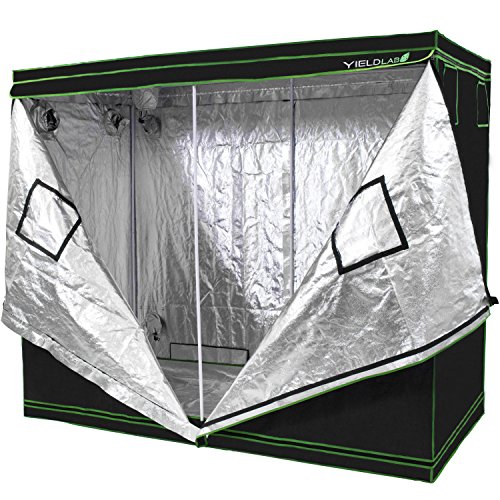
Yield Lab 8×4 Grow Tent
Multi-plant growers get room for up to eight 3-gallon containers across two rows in this 8×4 tent. Eight vent ports support a larger inline fan and carbon filter combination than a single 4×4 tent needs. Center support crossbars stop the horizontal bars from sagging under multiple light fixtures.
Pros
- Floor space fits up to eight 3-gallon containers in two rows
- Eight vent ports handle a larger fan and filter combination
- Center crossbars support the weight of multiple light fixtures
Cons
- Assembly generally requires two people due to the tent’s size
- Needs roughly 8 feet of clearance along the tent’s long side
How they stack up
| # | Model | Dimensions | Best for | Score | Price |
|---|---|---|---|---|---|
| 1 | AC Infinity Advance Grow Tent 4×4 | 48 x 48 x 80 in | Best overall | 9.4 | Check price |
| 2 | Vivosun 4×4 GIY Grow Tent | 48 x 48 x 80 in | Best value | 9.1 | Check price |
| 3 | TopoGrow 2×2 Grow Tent | 24 x 24 x 48 in | Best budget | 8.0 | Check price |
| 4 | Spider Farmer 2×2 Grow Tent | 27 x 27 x 63 in | Best for small spaces | 8.5 | Check price |
| 5 | iPower 4×4 Grow Tent | 48 x 48 x 80 in | Best for beginners | 8.3 | Check price |
| 6 | Gorilla Grow Tent Lite Line 4×4 | 48 x 48 x 72 in, extendable to 80 in | Best for light-proofing and durability | 8.9 | Check price |
| 7 | Yield Lab 8×4 Grow Tent | 96 x 48 x 80 in | Best for multi-plant grows | 8.7 | Check price |
Good to know
What size grow tent do I need for four plants?
A standard 48 by 48 inch, 4×4 footprint fits four to six containers in 3 to 5 gallon pots, depending on spacing between plants.
How many vent ports does a grow tent need?
Most 4×4 tents include four vent ports, enough for one intake and one exhaust fan connected to a carbon filter. Larger multi-plant tents use six to eight ports for bigger fan and filter combinations.
Is 600D or 1680D fabric better for a grow tent?
1680D fabric resists tears and abrasion better across repeated folding and setup. 600D fabric costs less and still blocks most ambient light for smaller or budget builds.
Can a grow tent fit in a closet?
Compact 2×2 tents, around 24 by 24 inches, fit inside a standard closet or under a desk and suit one to two plants in smaller containers.
What is the best indoor grow tent for beginners?
Tents with simplified two-pole clip assembly, like iPower’s 4×4 model, let first-time growers set up without written instructions or extra tools.
How reflective does a grow tent’s mylar interior need to be?
Reflectivity above 95% keeps light spread evenly across the canopy instead of concentrating near the light source, improving consistency across multiple plants.
Grow tent vs grow box, which is better for small spaces?
A soft-sided grow tent folds flat for storage and costs less per square foot than a rigid grow box, though a grow box offers sturdier built-in shelving for smaller countertop setups.
Do grow tents need a carbon filter for odor control?
Most tents include vent ports sized for a carbon filter and inline fan pair. Growers with odor-sensitive plants generally add one even though the tent itself doesn’t filter air.
Which grow tent works best for eight or more plants?
Yield Lab’s 8×4 tent spans 96 by 48 inches across two rows and fits up to eight 3-gallon containers with room for a larger fan and filter setup.
Do taller grow tents help with ducting and fans?
Yes, extra height like Spider Farmer’s 63 inch 2×2 tent or Gorilla Grow Tent’s extendable Lite Line clears room for ducting and clip fans above the canopy without cramping plants.
The bottom line
AC Infinity’s Advance 4×4 tent offers the strongest overall build for a standard grow room, while Vivosun’s 4×4 GIY tent covers the same footprint at a lower cost. Growers with tighter space or bigger plant counts fit better with the Spider Farmer 2×2 or Yield Lab 8×4, since size and vent count matter more than any single feature.
Sierra Daniels
Sierra's background is in landscape design and nursery retail. She focuses on lawn and garden equipment, outdoor furniture and gear durability, weighing published specs against how materials actually hold up outside.
You might also need

Which Grow Light Actually Fits Your Tent or Windowsill?

Large Yard Cordless Cultivators: Power and Runtime Compared
Outdoor Blankets Compared for Camping, Picnics and Beach Trips
