In-Ceiling Speakers for Home Theater and Whole Home Audio
Polk Audio’s RC60i is the best overall in-ceiling speaker, offering a swiveling tweeter and easy wiring for most living rooms. Klipsch’s CDT-5650-C II suits home theater surround channels specifically, while Yamaha’s NS-IC800 adds stronger bass for rooms using ceiling speakers as the main sound source.
Polk Audio’s RC60i is the strongest overall in-ceiling speaker for most installs, pairing a swiveling tweeter with easy quick connect wiring, though it needs a second unit for stereo coverage. Home theater builders adding surround or height channels get better results from the Klipsch CDT-5650-C II and its horn loaded tweeter. Anyone outfitting a living room where ceiling speakers serve as the main sound source should look at Yamaha’s 8 inch NS-IC800 instead.
In-ceiling speakers split by use case more than any single spec, since a home theater surround channel and a background music speaker in a bathroom have very different priorities. We compared woofer size, tweeter design and adjustability, power handling and owner feedback on installation difficulty across these seven speakers before ranking them.
Before you buy
What to look for in an in-ceiling speaker Woofer size drives bass output more than any other single spec, with 6.5 inch woofers suiting smaller rooms and 8 inch woofers giving more low end for larger spaces or main listening rooms. Power handling should match your amplifier or receiver’s output per channel to avoid distortion at higher volumes. A swiveling or adjustable tweeter helps aim sound toward the actual seating area, which matters since the speaker itself cannot be repositioned once installed. Mounting hardware and a paintable grille affect how invisible the install looks once finished.
In-ceiling speakers for home theater surround sound Surround and height channels benefit from a speaker tuned for dialogue clarity and dynamic range, which is where the Klipsch CDT-5650-C II’s horn tweeter design stands out. An adjustable baffle angle matters more here than in background music rooms, since surround speakers often sit off to the side of the main seating area. Pairing ceiling surrounds with a dedicated front stage of floor or bookshelf speakers generally sounds more balanced than an all ceiling speaker setup.
In-ceiling speakers for whole home and multi room audio Multi room installs typically run several ceiling speakers off a central multi zone amplifier, which is the use case JBL built the Stage 2 80IC line around. Sonos takes a different approach with its Sonance built ceiling speaker, tuning it specifically for the Sonos Amp and app based multi room grouping instead of a traditional receiver. Either approach works, but mixing speaker brands across zones fed by the same amplifier can create noticeably different tonal balance room to room.
Budget in-ceiling speakers for secondary rooms Rooms like a home office, garage or spare bedroom rarely need reference grade sound, which is where budget options like the Micca M-8C or Pyle PDIC80 make sense. Both still include a reasonably sized woofer for the price, even if detail and bass extension trail pricier brands. Saving money on secondary room speakers frees up budget for a stronger setup in the main living room or home theater.
The top picks, ranked

Polk Audio RC60i In-Ceiling Speaker
Polk’s RC60i uses a 6.5 inch woofer paired with a swiveling tweeter that aims sound toward the listening area even though the speaker mounts flat in the ceiling. Quick connect spring terminals speed up wiring during installation compared to screw terminals. The paintable grille blends into most ceiling colors without a visible speaker cutout standing out.
Pros
- Swiveling tweeter aims sound toward the room below
- Quick connect terminals speed up wiring
- Paintable grille blends into ceiling color
Cons
- Sold as a single speaker, requiring two for stereo coverage
- 6.5 inch woofer has less bass than larger 8 inch models

Klipsch CDT-5650-C II In-Ceiling Speaker
Klipsch brings its signature horn loaded tweeter design down into a ceiling speaker with the CDT-5650-C II, which improves dialogue clarity for a home theater surround channel. An adjustable baffle lets the tweeter angle toward the seating area even when the speaker sits directly above a different spot. It fits best as a surround or height channel alongside a dedicated front stage rather than as a standalone music speaker.
Pros
- Horn tweeter improves dialogue clarity for home theater use
- Adjustable baffle angles sound toward seating
- Strong fit as a surround or height channel
Cons
- Costs more than standard dome tweeter ceiling speakers
- Overkill for simple background music in a kitchen or bathroom

Sonos In-Ceiling Speaker by Sonance
Sonos partnered with architectural speaker maker Sonance to tune this ceiling speaker specifically for use with the Sonos Amp, rather than a generic receiver. That pairing lets the speaker work inside the Sonos app for multi room grouping and streaming alongside other Sonos speakers in the house. It is priced as a system component rather than a standalone budget speaker.
Pros
- Tuned specifically for pairing with the Sonos Amp
- Integrates into Sonos app multi room grouping
- Simplifies streaming control compared to a standard receiver setup
Cons
- Requires a Sonos Amp to use as designed
- Higher price than generic in ceiling speakers of similar size

Yamaha NS-IC800 In-Ceiling Speaker
Yamaha steps up to an 8 inch woofer on the NS-IC800, giving noticeably more bass than typical 6.5 inch ceiling speakers without adding a subwoofer. It suits a living room or den where ceiling speakers serve as the main sound source rather than background music. The larger cutout size needs checking against ceiling joist spacing before installation.
Pros
- 8 inch woofer delivers more bass than smaller ceiling speakers
- Works well as a main sound source without a subwoofer
- Priced reasonably for the woofer size included
Cons
- Larger cutout requires more careful joist spacing checks
- Bulkier housing takes up more space above the ceiling

JBL Stage 2 80IC In-Ceiling Speaker
JBL designed the Stage 2 80IC line for whole home audio installs where multiple rooms connect to a central multi zone amplifier. Quick mount clips speed up installation across several rooms compared to screw mounted alternatives. It pairs well with a receiver or amp that already splits audio into separate zones by room.
Pros
- Quick mount clips speed up multi room installation
- 8 inch woofer handles background music volume well
- Designed specifically for multi zone amplifier setups
Cons
- Needs a separate multi zone amplifier or receiver to use fully
- Not built with a wireless streaming option on its own
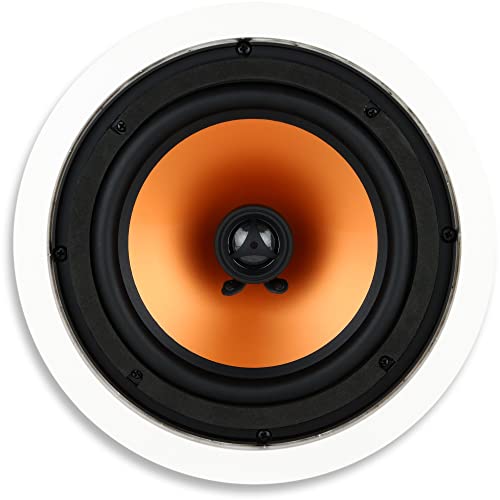
Micca M-8C In-Ceiling Speaker
Micca keeps cost down on the M-8C while still including an 8 inch woofer and a swiveling tweeter, features often reserved for pricier ceiling speakers. It is a common pick for bathrooms, kitchens or home offices where budget matters more than reference grade sound. Owners frequently buy these in pairs or larger sets to cover several rooms affordably.
Pros
- 8 inch woofer and swivel tweeter at a budget price
- Good fit for secondary rooms like kitchens or offices
- Affordable enough to outfit several rooms at once
Cons
- Build materials feel less premium than Polk or Klipsch
- Bass extension trails pricier 8 inch competitors

Pyle PDIC80 In-Ceiling Speaker
Pyle’s PDIC80 covers basic background audio needs in a spare bedroom, garage or workshop without a big budget commitment. The 8 inch woofer provides reasonable volume for casual listening, though detail and bass extension trail more established audio brands. It works as an affordable way to add sound to a room that does not need reference quality.
Pros
- Low price for an 8 inch ceiling speaker
- Suitable for casual background audio in extra rooms
- Simple installation with standard mounting clips
Cons
- Sound detail trails established audio brands at this size
- Not recommended as a primary home theater speaker
Side by side
| # | Model | Woofer size | Best for | Score | Price |
|---|---|---|---|---|---|
| 1 | Polk Audio RC60i In-Ceiling Speaker | 6.5 inch | Best overall | 9.2 | Check price |
| 2 | Klipsch CDT-5650-C II In-Ceiling Speaker | 6.5 inch | Best for home theater surround sound | 9.1 | Check price |
| 3 | Sonos In-Ceiling Speaker by Sonance | 6.5 inch | Best for smart multi room streaming | 8.9 | Check price |
| 4 | Yamaha NS-IC800 In-Ceiling Speaker | 8 inch | Best value | 8.8 | Check price |
| 5 | JBL Stage 2 80IC In-Ceiling Speaker | 8 inch | Best for whole home multi room audio | 8.7 | Check price |
| 6 | Micca M-8C In-Ceiling Speaker | 8 inch | Best budget | 8.4 | Check price |
| 7 | Pyle PDIC80 In-Ceiling Speaker | 8 inch | Best for simple background audio in secondary rooms | 8.1 | Check price |
Frequently asked questions
How many in-ceiling speakers do I need per room?
Most rooms use at least two speakers for stereo separation, though larger or irregularly shaped rooms sometimes add a third or fourth speaker for even coverage.
Do in-ceiling speakers need a special amplifier?
They need a standard speaker level amplifier or receiver channel like any passive speaker, though the Sonos ceiling speaker is tuned specifically to pair with the Sonos Amp.
Can in-ceiling speakers work with Sonos?
Yes, through the Sonos Amp, which powers passive speakers including Sonos’s own Sonance built ceiling speaker as well as many third party in ceiling models.
What size ceiling cutout do in-ceiling speakers need?
Cutout size varies by woofer diameter and housing, typically a few inches wider than the woofer itself, so always check the manufacturer’s template against your ceiling joist spacing before cutting.
Are in-ceiling speakers good for surround sound in a home theater?
Yes, particularly for surround or height channels, where a speaker like the Klipsch CDT-5650-C II with an adjustable tweeter angle performs well even when mounted off to the side.
Can I paint an in-ceiling speaker grille to match my ceiling?
Most in-ceiling speakers, including every model on this list, include a paintable grille designed to blend into the ceiling color after installation.
What is the difference between a 6.5 inch and 8 inch ceiling speaker?
An 8 inch woofer generally produces more bass and can play louder without distortion than a 6.5 inch woofer, at the cost of a larger ceiling cutout and housing depth.
Do in-ceiling speakers work well in bathrooms with moisture?
Standard in-ceiling speakers are not moisture rated, so a bathroom install should use a speaker specifically listed as humidity or moisture resistant rather than a standard indoor model.
Our pick
Polk Audio’s RC60i is the right pick for most whole home or living room installs thanks to its adjustable tweeter and straightforward wiring. Home theater builders should direct their surround channel budget toward the Klipsch CDT-5650-C II instead for its dialogue focused tuning. Anyone outfitting a secondary room on a tight budget can rely on the Micca M-8C or Pyle PDIC80 without overspending on rooms that do not need reference sound.
Marcus Chen
Marcus covered consumer electronics for enthusiast tech publications for six years before joining ChoiceCrest. He specializes in translating manufacturer spec sheets into plain-language buying advice, with a focus on audio, computing accessories and smart-home gear.

