6 Hydration Packs Built for Long Trail Days
CamelBak’s M.U.L.E. 12 leads as the most versatile trail pack, with real cargo space for tools and layers. Salomon’s Active Skin 8 vest suits runners who need a bounce-free fit. TETON’s Oasis 1100 delivers a large reservoir and pockets for far less money.
CamelBak’s M.U.L.E. 12 handles mountain biking and day hikes equally well, backed by Salomon’s Active Skin 8 for running and TETON’s Oasis 1100 for value. Choosing between them comes down to how much gear you carry and how much bounce you can tolerate. Bike packs prioritize cargo and stability, while running vests trade capacity for a snug, low-bounce fit.
Reservoir size and pack volume often get quoted together, so a pack that sounds roomy may be mostly water, and a harness that feels fine in a shop can chafe after ten miles. We compared reservoir capacities, cargo volumes, strap layouts, and ventilation designs, then weighed what owners report about bite valve leaks, cleaning, and long-term durability.
Our top picks

CamelBak M.U.L.E. 12 Hydration Pack
A three-liter reservoir shares space with tools, a shell, and food without swaying much on descents, which explains its reputation as the reference mountain bike pack. The ventilated back panel keeps some air moving, and a magnetic tube trap holds the bite valve in reach. Hikers use it just as often as riders for its compact, stable carry.
Pros
- Stable on rough descents
- Genuinely useful cargo space
- Fast flowing reservoir and easy fill port
Cons
- Too much pack for short runs
- Back panel still gets warm on hot days

Salomon Active Skin 8 Hydration Vest
Weight sits across the chest instead of the shoulders, which is why this vest barely moves at running pace. Two soft flasks sit up front for drinking without breaking stride, and there is still room for a jacket and gels. Mesh across the harness breathes better than most packs here, cutting down on sweat.
Pros
- Almost no bounce at running pace
- Front flasks are quick to refill and drink from
- Breathable mesh across the whole harness
Cons
- Soft flasks hold less than a bladder
- Sizing must be right or it rides oddly

Osprey Raptor 14 Hydration Pack
A suspended mesh back panel lifts this pack off the spine, which matters on long summer rides. A dedicated tool roll keeps a multi-tool and levers out of the main compartment, and the hip belt carries weight properly once the pack is full. Osprey backs it with a lifetime repair guarantee.
Pros
- Best back ventilation in this group
- Tool roll keeps gear organised
- Covered by a lifetime repair guarantee
Cons
- Larger and heavier than a trail minimum
- Reservoir is slightly smaller than rivals

Gregory Nano 18 H2O Hydration Pack
Eighteen liters puts this closer to a day pack that happens to carry water, suited to hikers packing lunch, layers, and a first aid kit. A frameless design keeps weight down while padded shoulder straps handle a loaded pack fine. It trades bike-specific stability for everyday usefulness on foot.
Pros
- Enough volume for a full day on foot
- Comfortable under a heavier load
- Good value for the capacity offered
Cons
- Sways more than a bike specific pack
- No hip belt pockets

Nathan Pinnacle 12L Hydration Vest
Long races drive this design, with flasks up front, a bladder sleeve at the back, and pockets reachable without stopping. Adjustable sternum straps tune the fit as layers change through the night. Twelve liters carries more than a minimalist vest without turning into a full pack.
Pros
- Lots of reachable pockets for a vest
- Fit adjusts easily over changing layers
- Pole carry works well on climbs
Cons
- Bladder sold separately in some versions
- Busier layout than simpler vests
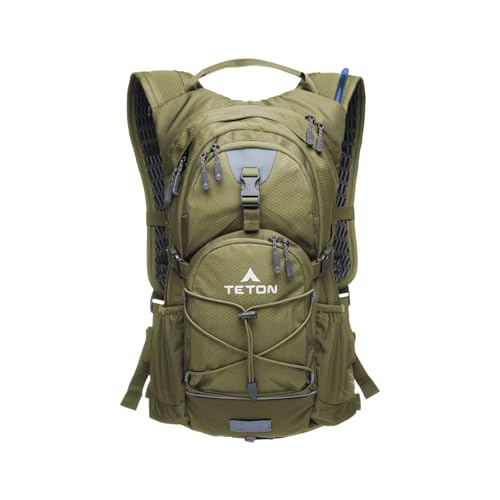
TETON Sports Oasis 1100 Hydration Pack
A two-liter reservoir, a proper hip belt, and eighteen liters of storage come at a fraction of what premium brands charge. Suspension is simpler and the reservoir is less slick to fill, but the fundamentals hold up. Families equipping several people at once tend to land here first.
Pros
- Most capacity per pound spent
- Rain cover and hip pockets included
- Adjustable torso fits a range of users
Cons
- Reservoir is fiddlier to fill and dry
- Materials are heavier than premium packs

Unigear Hydration Pack with 2L Bladder
A slim profile wraps a two-liter bladder with just enough pocket space for keys, a phone, and a snack. Casual hikes, festivals, and bike commutes suit it better than serious mileage. Owners report the bladder benefits from a thorough rinse before first use.
Pros
- Cheapest complete setup here
- Light and slim against the back
- Fine for casual day use
Cons
- Minimal storage beyond essentials
- Bite valve is less refined than premium brands
Compared at a glance
| # | Model | Reservoir | Best for | Score | Price |
|---|---|---|---|---|---|
| 1 | CamelBak M.U.L.E. 12 Hydration Pack | 3 L Crux | Best overall | 9.4 | Check price |
| 2 | Salomon Active Skin 8 Hydration Vest | 2 x 500 ml soft flasks included | Best for running | 9.2 | Check price |
| 3 | Osprey Raptor 14 Hydration Pack | 2.5 L Hydraulics LT | Best for long rides | 9.0 | Check price |
| 4 | Gregory Nano 18 H2O Hydration Pack | 3 L included | Best for day hiking | 8.8 | Check price |
| 5 | Nathan Pinnacle 12L Hydration Vest | 2 x 20 oz flasks, bladder compatible | Best for ultra distance | 8.6 | Check price |
| 6 | TETON Sports Oasis 1100 Hydration Pack | 2 L included | Best value | 8.3 | Check price |
| 7 | Unigear Hydration Pack with 2L Bladder | 2 L included | Best budget | 8.0 | Check price |
How to choose
How much reservoir size do you actually need Two liters covers most two- to three-hour outings in mild weather, three liters suits full days or hot climates, and running vests trade capacity for the ability to drink without slowing down. Water weighs about a kilogram per liter, so hauling three liters on a short outing burns energy for nothing. Check where refills exist on your usual routes before assuming bigger always wins.
Vest vs pack, which harness design fits your activity Vest-style harnesses spread load across the chest and stay put at running cadence, while shoulder straps paired with a hip belt carry heavier loads better on foot. Bike packs sit higher and shorter so they clear the saddle on a descent. Any load past a few kilograms needs a hip belt, since shoulders alone ache long before the water runs out.
Back ventilation and staying cool in hot weather Every pack traps some heat against the back, and the real fixes are a suspended mesh panel that holds the pack away from you or a vest that covers less surface area. Foam channels help a little but do not remove a sweat patch entirely. Riders and hikers in genuine heat should prioritize back panel design over an extra liter of storage, since comfort decides whether the pack actually gets used.
Cleaning and caring for a hydration reservoir Bladders grow mold quickly when stored damp, so rinse after every use and dry with the reservoir propped open or hung upside down. A wide fill port makes this far easier than a narrow screw cap. Freeze the bladder between uses if drying fully is not an option, and replace the bite valve rather than the whole reservoir once it starts to dribble.
Common questions
What size hydration pack do I need?
Runs under two hours are fine with a vest and flasks. Day hikes and mountain bike rides work best with a two- to three-liter reservoir plus roughly ten to eighteen liters of storage for layers, food, and tools.
How do I stop a hydration pack from bouncing?
Fill the reservoir fully or nearly empty so water does not slosh, then tighten the sternum and side straps. Pack heavy items close to the back. If it still moves at running pace, the pack is too large or the harness is the wrong size.
Can I put electrolyte drinks in the bladder?
Yes, though sugary mixes need thorough cleaning afterward or they leave a film that turns sour. Many riders keep water in the bladder and carry mix in a bottle instead, just to keep cleaning simple.
How do I clean a hydration bladder properly?
Rinse with warm water right after use, scrub the reservoir and tube weekly with a dedicated brush kit, and dry it fully with the opening propped apart. Cleaning tablets help with stubborn residue but do not replace drying.
Are hydration vests better than packs for running?
For running, yes. Vests hug the torso, sit lower, and put flasks within reach, which nearly eliminates bounce. Conventional packs win once you need to carry meaningful weight.
Will a hydration pack fit under a bike jersey or over a jacket?
Over a jacket works fine, and most straps adjust enough for winter layers. Wearing one under clothing is not practical, since you cannot reach the fill port or adjust the straps.
How long does the water stay cool in a hydration pack?
Uninsulated reservoirs warm to ambient temperature within an hour or two. Freezing part of the water before leaving, or using an insulated tube sleeve, keeps it drinkable much longer in summer.
Can I use a hydration pack without the reservoir?
Yes, and larger models such as the Osprey Raptor and Gregory Nano work fine as small day packs. Removing the bladder frees up the sleeve for a laptop or a hydration-free commute.
CamelBak vs Osprey hydration pack, which is better for mountain biking?
CamelBak’s M.U.L.E. 12 favors a compact, stable carry with tool storage built in. Osprey’s Raptor 14 adds more back ventilation and a larger 14-liter capacity for longer summer rides.
The bottom line
CamelBak’s M.U.L.E. 12 remains the most versatile hydration pack here, carrying enough gear for a full day without swaying on technical terrain. Runners should choose Salomon’s Active Skin 8 instead, and anyone equipping several people at once will find TETON’s Oasis 1100 hard to beat for the money. Reservoir care matters more than brand for how long any of them lasts.
Sierra Daniels
Sierra's background is in landscape design and nursery retail. She focuses on lawn and garden equipment, outdoor furniture and gear durability, weighing published specs against how materials actually hold up outside.


