Lab Hot Plates for Precise, Repeatable Heating
The IKA C-MAG HS 7 leads this list for precise digital temperature control up to 500C and a chemical-resistant ceramic plate. The Corning PC-420D suits buyers who need stronger stirring torque, while the VEVOR Lab Hot Plate Stirrer offers similar core function at a lower cost.
The IKA C-MAG HS 7 stands out for digital temperature control that holds steady near its 500C ceiling, paired with a ceramic-coated aluminum plate that resists acid and solvent spills. It suits labs running repeated heating and stirring cycles, though its stirring torque trails the Corning PC-420D on viscous solutions. The rest of this list spans a mid-range Thermo Scientific unit, a DLAB digital model, and three budget options for teaching labs or home chemistry setups.
We compared listed max temperature, stirring speed range, plate material and load capacity across seven laboratory hot plates rather than running them in a controlled lab test.
The top picks, ranked

IKA C-MAG HS 7 Digital Hot Plate Stirrer
Digital control holds set temperatures within a tight margin up to 500C, useful for reflux and extraction work. The ceramic-coated aluminum plate resists most acids and organic solvents without pitting. A 135mm diameter plate fits standard 1 to 2 liter flasks without crowding other glassware.
Pros
- Digital display holds set temperature within a tight margin
- Ceramic-coated plate resists acid and solvent spills
- 135mm plate fits most 1 to 2 liter flasks easily
Cons
- Stirring torque trails heavier-duty models on thick solutions
- Higher price than basic analog hot plate stirrers

Corning PC-420D Stirring Hot Plate
A stronger motor keeps the stir bar spinning through viscous or dense solutions that stall weaker units. The plate reaches 540C, higher than most comparable benchtop models. Corning’s ceramic glass surface cleans easily after spills but costs more to replace if cracked than an aluminum plate.
Pros
- Strong motor maintains stirring through viscous solutions
- 540C max temperature exceeds most comparable units
- Ceramic glass surface wipes clean after spills quickly
Cons
- Ceramic glass plate costs more to replace if cracked
- Bulkier footprint than compact digital alternatives

Thermo Scientific Cimarec+ Stirring Hot Plate
An analog dial trades digital precision for a simpler interface that survives years of daily lab turnover. The aluminum alloy top plate spreads heat evenly across its surface, reducing hot spots near the edges. Lower resolution control makes exact temperature holds harder than on the IKA or DLAB digital units.
Pros
- Simple analog controls hold up well under heavy daily use
- Aluminum alloy plate spreads heat evenly, limiting hot spots
- Reliable brand reputation in teaching and research labs
Cons
- Analog dial gives less precise temperature control than digital
- No programmable ramp or hold functions
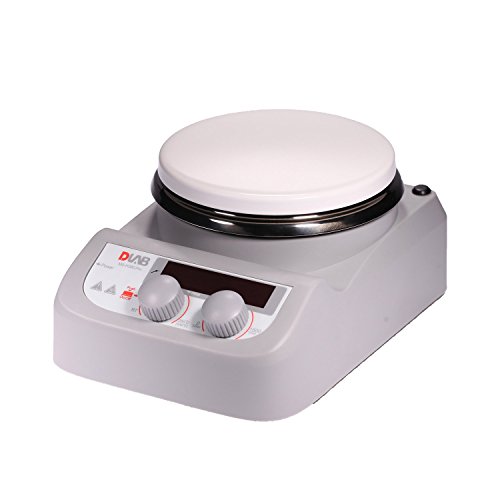
DLAB MS-H-S Digital Magnetic Hot Plate Stirrer
Digital readouts for both temperature and stirring speed cost less here than on premium European brands. The plate reaches 340C, enough for most aqueous and low-boiling solvent work but short of reflux-heavy applications. An external temperature probe port adds closed-loop control that basic analog units skip.
Pros
- Digital display costs less than premium European-brand units
- External probe port enables closed-loop temperature control
- Wide stirring range suits both gentle and fast mixing
Cons
- 340C ceiling falls short of high-temperature reflux needs
- Build feels lighter than the Corning or Thermo units

VEVOR Lab Hot Plate Magnetic Stirrer
This unit undercuts most branded lab hot plates on price while still offering a digital display and 300C ceiling. A smaller 130mm plate limits flask size compared to the IKA or Corning. Stirring tops out lower than premium models, enough for routine dissolution but not heavy-bar mixing.
Pros
- Lower price than most branded laboratory hot plate stirrers
- Digital display still shows set and actual temperature
- Compact size suits benches with limited space
Cons
- Lower stirring ceiling than premium branded models
- Smaller 130mm plate limits larger flask setups

Benchmark Scientific H4000-HS HotPlate Stirrer
A wider 180mm plate holds larger beakers and multi-flask setups that crowd smaller units. Load capacity rates up to 15kg, higher than most compact digital models. The larger footprint takes up more bench space, a tradeoff for labs tight on counter room.
Pros
- Wider 180mm plate fits larger beakers and multi-flask setups
- 15kg load capacity exceeds most compact digital hot plates
- Stable base resists tipping under heavier glassware
Cons
- Larger footprint takes up more bench space
- Heavier unit is harder to relocate between benches

MTOPS MS300HS Digital Hot Plate Magnetic Stirrer
A smaller footprint suits teaching labs running several units side by side on one bench. Stirring speed and temperature both show on a shared digital display, simplifying student use. Its 350C ceiling covers common aqueous and buffer work without reaching the reflux range of pricier units.
Pros
- Compact size fits several units on one teaching bench
- Shared digital display simplifies readings for students
- Wide stirring range covers gentle to fast mixing needs
Cons
- 350C ceiling falls short of reflux-heavy research work
- Smaller 120mm plate limits flask size options
How they stack up
| # | Model | Max Temperature | Best for | Score | Price |
|---|---|---|---|---|---|
| 1 | IKA C-MAG HS 7 Digital Hot Plate Stirrer | 500C | Best Overall | 9.2 | Check price |
| 2 | Corning PC-420D Stirring Hot Plate | 540C | Best Stirring Torque | 9.0 | Check price |
| 3 | Thermo Scientific Cimarec+ Stirring Hot Plate | 480C | Best for Continuous Daily Use | 8.8 | Check price |
| 4 | DLAB MS-H-S Digital Magnetic Hot Plate Stirrer | 340C | Best Value Digital Model | 8.6 | Check price |
| 5 | VEVOR Lab Hot Plate Magnetic Stirrer | 300C | Best Budget Digital | 8.2 | Check price |
| 6 | Benchmark Scientific H4000-HS HotPlate Stirrer | 450C | Best for Larger Vessel Loads | 8.7 | Check price |
| 7 | MTOPS MS300HS Digital Hot Plate Magnetic Stirrer | 350C | Best Compact Teaching Lab Model | 8.3 | Check price |
Before you buy
What to check before buying a lab hot plate Max temperature sets the ceiling for reflux and extraction work, so match it to the actual solvents in use rather than buying the highest number available. Stirring speed range matters just as much, since a stall under a viscous solution wastes a run. Plate material affects chemical resistance, with ceramic-coated and ceramic glass surfaces holding up better against acids than bare aluminum. Load capacity and plate diameter decide whether larger flasks or multi-vessel setups will actually fit.
Digital versus analog control Digital models like the IKA and DLAB units show exact set and actual temperatures, useful for repeatable protocols. Analog dials, like the one on the Thermo Scientific Cimarec+, trade that precision for a simpler interface that survives heavy daily turnover in teaching labs. Neither approach is wrong, since analog controls often cost less to repair when a dial wears out.
Matching stirring torque to the task Thin aqueous solutions stir fine on most of these units, including budget picks like the VEVOR model. Viscous or dense solutions need stronger torque, where the Corning PC-420D and Benchmark Scientific H4000-HS pull ahead of lighter digital stirrers. Running a stir bar that keeps stalling usually points to a torque mismatch rather than a bad bar.
Choosing by lab size and budget A single research bench running demanding protocols benefits from the IKA or Corning’s higher temperature ceilings and stronger stirring. Teaching labs running several units at once often do better with compact, lower-cost models like the MTOPS MS300HS or VEVOR stirrer. Larger multi-flask setups should prioritize plate diameter and load capacity over raw temperature range.
Questions worth asking
What temperature range does a laboratory hot plate need?
Most routine aqueous and buffer work stays under 350C, while reflux and higher-boiling solvent work benefits from a unit rated to 450C or above, like the Corning PC-420D.
Is a digital or analog hot plate stirrer better for a lab?
Digital units give more precise, repeatable temperature control, while analog dials like the Thermo Scientific Cimarec+ often hold up longer under constant daily turnover.
Can a laboratory hot plate replace a standard kitchen hot plate?
No, lab hot plates use chemical-resistant plate materials and precise digital or dial controls that standard kitchen hot plates do not offer.
How much stirring speed do I need for a lab hot plate stirrer?
Thin solutions stir fine around 600 rpm, while viscous solutions often need a unit rated closer to 1500 rpm, like the IKA C-MAG HS 7 or DLAB MS-H-S.
What plate material resists acid spills best?
Ceramic-coated aluminum and ceramic glass plates, used on the IKA and Corning units, resist acid and solvent spills better than bare aluminum alloy plates.
Do laboratory hot plates need an external temperature probe?
An external probe, like the one on the DLAB MS-H-S, enables closed-loop control that holds a solution at a set temperature rather than just the plate surface.
How big a flask can a lab hot plate stirrer hold?
Plate diameter decides this directly, with 120 to 135mm plates fitting 1 to 2 liter flasks and wider 180mm plates, like the Benchmark Scientific H4000-HS, handling larger vessels.
Are budget lab hot plates reliable for teaching labs?
Budget digital models like the VEVOR and MTOPS units cover routine teaching lab needs well, though they fall short of premium brands on stirring torque and temperature ceiling.
What load capacity should a lab hot plate stirrer support?
Standard single-flask setups need little load capacity, but multi-vessel benches should look for 10kg or higher, like the 15kg rating on the Benchmark Scientific H4000-HS.
Our take
The IKA C-MAG HS 7 is the strongest overall pick for most labs, combining precise digital temperature control with a chemical-resistant ceramic plate. Anyone stirring viscous or dense solutions regularly should choose the Corning PC-420D instead, since its stronger motor avoids the stalling that lighter digital units risk. Teaching labs running several units at once will get more value from the compact MTOPS MS300HS or budget VEVOR stirrer.
Dana Whitfield
Dana spent eight years buying and merchandising for a regional kitchenware retailer before moving into editorial work. She has handled thousands of SKUs across cookware, small appliances and kitchen organization, and focuses on the practical differences that matter once a product is actually in daily use.


