Home Audio Gear That Fills a Room Without a Wall of Boxes
Sonos’ Arc soundbar is the best overall pick for a simple home theater upgrade without running speaker wire through a room. Sony’s STR-DH790 receiver suits anyone building a full surround system with separate speakers, and Edifier’s R1280T bookshelf speakers cover a budget stereo setup for music alone.
Sonos’ Arc soundbar earns the top spot for anyone upgrading TV sound without committing to a full receiver and speaker setup, though it costs more than a basic soundbar without the same room filling output. Sony’s STR-DH790 receiver suits a household ready to run a real surround system with separate speakers. Edifier’s R1280T bookshelf speakers cover a simple, affordable stereo setup for anyone who just wants better music playback at a desk or in a small room.
Home audio gets confusing fast once soundbars, receivers, powered speakers and smart speakers all claim to solve the same problem of better sound. We compared power output, connection types, owner feedback on sound balance, and which specific listening setup each product actually fits before narrowing this list to seven.
Our top picks

Sonos Arc Soundbar
Sonos’ Arc uses multiple upward and side firing drivers inside one bar to simulate a wider surround field without separate speakers. It joins Sonos’ app controlled ecosystem, so adding more Sonos speakers later expands the system without new wiring. Dialogue enhancement features help with quieter TV speech over background music or effects.
Pros
- Wide simulated surround from a single bar
- Expands into a full system without rewiring
- Strong dialogue clarity for TV and movies
Cons
- No physical remote buttons beyond basic volume
- Full surround expansion adds significant cost

Sony STR-DH790 7.2-Channel AV Receiver
This Sony receiver powers up to seven speakers plus two subwoofer outputs, aimed at a dedicated home theater room rather than a simple TV upgrade. Multiple HDMI inputs support 4K passthrough for a game console and streaming box at once. Built in calibration helps balance speaker volume for the actual room layout.
Pros
- Powers a full seven speaker surround system
- Multiple HDMI inputs cover several devices
- Automatic calibration simplifies speaker setup
Cons
- Requires separate speakers, which adds to total system cost
- More complex setup than a single soundbar

Edifier R1280T Powered Bookshelf Speakers
Edifier builds these as a self powered stereo pair, so no separate amplifier or receiver is needed to start listening. Front mounted volume, bass and treble controls keep adjustments within reach without a remote. Wood cabinet construction cuts down on vibration compared to plastic enclosures at this size.
Pros
- No separate amplifier or receiver required
- Front controls are easy to reach without a remote
- Wood cabinet reduces unwanted vibration
Cons
- No Bluetooth on the base model
- Limited bass extension compared to a system with a subwoofer

Audio-Technica AT-LP120XUSB Turntable
Audio-Technica’s AT-LP120XUSB uses a direct drive motor rather than belt drive, which holds speed more consistently under light hand pressure on the platter. A built in USB output lets owners digitize vinyl without a separate audio interface. A switchable preamp allows connection to either a phono input or a standard auxiliary input.
Pros
- Direct drive holds speed better than belt drive models
- Switchable preamp works with speakers that lack a phono input
- USB output simplifies digitizing a record collection
Cons
- Heavier and bulkier than a basic belt drive turntable
- Some owners upgrade the stock cartridge over time
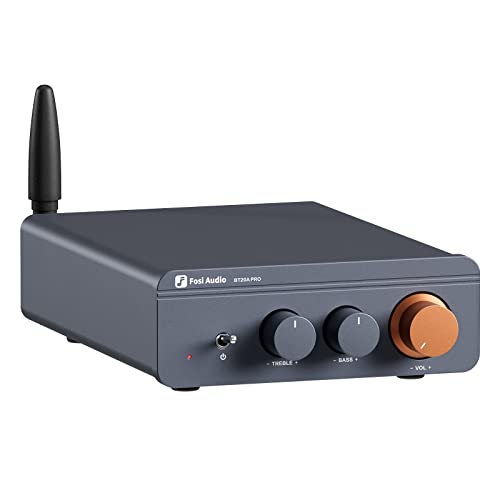
Fosi Audio BT20A Pro Bluetooth Stereo Amplifier
This compact amplifier pairs Bluetooth streaming with wired inputs, aimed at powering a set of passive bookshelf or stereo speakers without a bulky receiver. A small footprint fits on a shelf or desk rather than a dedicated equipment rack. Bass and treble controls allow basic tone shaping without a full equalizer.
Pros
- Small size fits a shelf or desk easily
- Bluetooth streaming alongside wired inputs
- Lower cost than a full stereo receiver
Cons
- Not built for a full surround sound setup
- Output power is modest compared to a dedicated receiver

dbx 231s Dual 31-Band Graphic Equalizer
dbx’s 231s splits the audio spectrum into 31 adjustable bands per channel, which allows much finer correction than the bass and treble knobs on a typical amplifier. It sits between a source and amplifier in the signal chain, often used to tame a specific room’s bass buildup or harsh frequencies. The rack mount design suits a dedicated equipment stack rather than a simple shelf system.
Pros
- Much finer control than basic bass and treble knobs
- Can correct a specific room’s bass buildup
- Rack mount fits a dedicated equipment stack
Cons
- Overkill for a simple soundbar or Bluetooth speaker setup
- Requires some trial and error to dial in correctly

Amazon Echo Studio Smart Speaker
Echo Studio uses multiple drivers aimed in different directions to create a wider sense of space than a typical single speaker. Built in voice control handles music playback and smart home commands without a phone or remote. Room calibration on setup adjusts output based on nearby walls and furniture.
Pros
- Wider sense of space than a typical single speaker
- Built in voice control for hands free use
- Automatic room calibration on first setup
Cons
- Not a replacement for a true multi speaker surround system
- Best spatial effect depends on room shape and speaker placement
How to choose
What to decide before buying home audio gear Start with whether the goal is better TV sound, better music playback, or both, since a soundbar and a stereo bookshelf pair solve different problems. A receiver and separate speakers, like Sony’s STR-DH790 setup, cost more and take longer to install than a single soundbar but scale further for a dedicated theater room. Connection types matter too, since HDMI eARC, Bluetooth and RCA inputs are not interchangeable across every source device.
Soundbars versus full receiver and speaker systems A soundbar like Sonos’ Arc solves TV sound in one box without running wire through a room, which fits most living rooms without a full renovation. A receiver and separate speaker system, by contrast, gives more total power and true discrete surround channels for anyone building a dedicated home theater. The jump from soundbar to receiver is less about sound quality alone and more about how much setup time and wiring a household is willing to take on.
Building a simple stereo or vinyl based system A powered bookshelf pair like Edifier’s R1280T needs no separate amplifier, which keeps a first stereo setup simple. Adding a turntable like Audio-Technica’s AT-LP120XUSB brings vinyl into that same setup through its switchable preamp, without needing a dedicated phono stage. A compact amplifier like Fosi Audio’s BT20A Pro bridges the gap for anyone who already owns passive speakers but needs Bluetooth streaming added.
Fine tuning sound and smart speaker options An equalizer like dbx’s 231s matters mainly for a dedicated listening room with a specific bass or treble problem, not a casual living room setup. A smart speaker like Amazon’s Echo Studio fits a different use case entirely, prioritizing voice control and multi room convenience over the raw output of a receiver driven system. Matching the gear to the actual room and daily use matters more than chasing the highest spec on paper.
How they stack up
| # | Model | Channel layout | Best for | Score | Price |
|---|---|---|---|---|---|
| 1 | Sonos Arc Soundbar | 11 driver array, simulated surround | Best overall soundbar | 9.2 | Check price |
| 2 | Sony STR-DH790 7.2-Channel AV Receiver | 7.2 channel | Best AV receiver for a full surround setup | 8.9 | Check price |
| 3 | Edifier R1280T Powered Bookshelf Speakers | Self powered, no separate amp needed | Best budget stereo speakers | 8.6 | Check price |
| 4 | Audio-Technica AT-LP120XUSB Turntable | Direct drive | Best for a vinyl based setup | 8.5 | Check price |
| 5 | Fosi Audio BT20A Pro Bluetooth Stereo Amplifier | Bluetooth and wired RCA inputs | Best compact amplifier for passive speakers | 8.3 | Check price |
| 6 | dbx 231s Dual 31-Band Graphic Equalizer | 31 bands per channel, dual channel | Best for fine tuning room acoustics | 8.2 | Check price |
| 7 | Amazon Echo Studio Smart Speaker | Multiple drivers, spatial audio processing | Best smart speaker with spatial audio | 8.4 | Check price |
Questions worth asking
Is a soundbar as good as a full surround sound receiver setup?
A soundbar like Sonos’ Arc simulates a wider sound field from one bar, which works well for most living rooms, but a true receiver and discrete speaker setup like Sony’s STR-DH790 system still produces more accurate separation between channels.
Do I need a receiver if I just want to listen to music on bookshelf speakers?
No. Self powered bookshelf speakers like Edifier’s R1280T include their own amplifier, so no separate receiver is needed for basic stereo music listening.
What is the difference between a direct drive and belt drive turntable?
A direct drive turntable, like Audio-Technica’s AT-LP120XUSB, spins the platter directly from the motor and holds speed more consistently under light pressure. A belt drive turntable uses a belt between motor and platter, which can isolate motor vibration but is more sensitive to touch during play.
Can a Bluetooth amplifier power passive speakers without a receiver?
Yes, a compact amplifier like Fosi Audio’s BT20A Pro is built to power a pair of passive speakers directly, without needing a full stereo receiver.
What does a graphic equalizer actually do for home audio?
A graphic equalizer, like dbx’s 231s, splits sound into multiple frequency bands so a listener can boost or reduce specific ranges, which helps correct bass buildup or harshness caused by a room’s shape and furniture.
Do smart speakers sound as good as dedicated stereo speakers?
A smart speaker like Amazon’s Echo Studio uses multiple drivers for a wider sense of space, but a dedicated stereo pair or receiver driven system still generally outperforms it in raw sound quality and separation.
Does a soundbar need a subwoofer to sound complete?
Many soundbars, including Sonos’ Arc, work fine without an added subwoofer for everyday TV and movie watching, though a separate subwoofer adds noticeably more low end for action heavy content.
What cables do I need to connect a turntable to speakers?
It depends on the turntable’s preamp. A turntable with a switchable preamp, like the AT-LP120XUSB, can connect through a standard RCA or auxiliary cable directly to a powered speaker or amplifier without needing a separate phono preamp.
How many speakers does a true surround sound system need?
A common setup uses five main speakers and one subwoofer, often called 5.1, though receivers like Sony’s STR-DH790 support up to seven main speakers plus two subwoofers for a larger room.
Is it worth buying an equalizer for a basic home audio setup?
A dedicated equalizer mainly helps a room with a specific, identifiable sound problem. A basic soundbar or Bluetooth speaker setup with built in tone controls usually does not need one.
The verdict
Sonos’ Arc earns the overall recommendation for most households upgrading TV sound without taking on a full receiver install. Anyone building a dedicated home theater room should invest in Sony’s STR-DH790 receiver with separate speakers instead, since it scales further than any single soundbar. Music focused listeners get more value from Edifier’s bookshelf speakers or Audio-Technica’s turntable, while a smart speaker like the Echo Studio fits best as a casual, voice controlled addition rather than a primary system.
Marcus Chen
Marcus covered consumer electronics for enthusiast tech publications for six years before joining ChoiceCrest. He specializes in translating manufacturer spec sheets into plain-language buying advice, with a focus on audio, computing accessories and smart-home gear.


