Which RV Water Pump Handles a Shower and Sink at Once?
SEAFLO’s 33-Series pump delivers 5.5 GPM at a 60 PSI cutout, enough for a shower and sink running together. Aquatec’s 8800 Series carries a continuous-duty rating for full-time RVers cycling fixtures all day. SEAFLO’s 42-Series raises cutout pressure to 70 PSI for households running multiple fixtures at once.
SEAFLO’s 33-Series suits most travel trailers and Class C rigs running a shower and sink together, since it holds 45 to 60 PSI at 5.5 GPM. Self-priming lift reaches 6 vertical feet. Rigs adding a third fixture at the same time may still want more pressure headroom.
We compared manufacturer flow and pressure specs against owner reports on noise, amp draw, and long-term reliability. Pumps matching only a garden-hose flow rate, or skipping thermal overload protection, were left off this list.
The best picks, ranked

SEAFLO 33-Series 12V DC 5.5 GPM 60 PSI Diaphragm Water Pressure Pump
This diaphragm pump moves 5.5 GPM and cuts out at 60 PSI, enough for a shower and sink run without stalling. A built-in pulse dampener keeps faucets from chattering under variable flow. Owners report years of service once a strainer sits ahead of the intake.
Pros
- Self-primes up to 6 vertical feet
- Pulse dampener reduces faucet chatter
- Internal check valve blocks backflow
Cons
- Draws more amperage than smaller 3 GPM pumps
- Needs an inline strainer to avoid clogging

Aquatec 8800 Series 5.7 GPM 45 PSI Self-Priming RV Water Pump
Aquatec rates this pump for continuous duty rather than short intermittent bursts. Flow tops out at 5.7 GPM, the highest in this lineup. Full-time RVers running back-to-back showers report fewer thermal shutoffs than intermittent-duty models deliver.
Pros
- Highest flow rate in this comparison
- Built for continuous rather than intermittent duty
- Handles back-to-back fixture use without overheating
Cons
- 45 PSI cutout runs lower than 60 to 70 PSI rivals
- Housing sits larger than compact single-diaphragm pumps

SEAFLO 42-Series 12V DC 5.5 GPM 70 PSI Self-Priming Diaphragm Pump
Flow matches the 33-Series, but pressure cutout climbs to 70 PSI here. That extra headroom keeps pressure steady when a shower and outdoor rinse run together. A santoprene diaphragm resists cracking from mineral-heavy fill water.
Pros
- 70 PSI cutout supports multiple fixtures at once
- Santoprene diaphragm resists mineral wear
- Permanent magnet motor runs cooler under load
Cons
- Runs louder than lower-pressure 45 PSI models
- Needs heavier gauge wiring for the higher amp draw
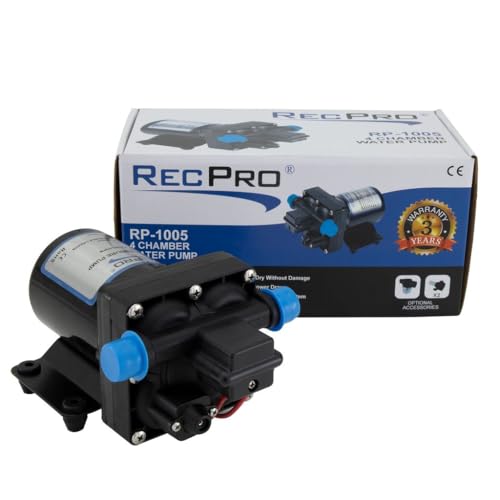
SHURFLO 4008-101-A65 Revolution 3.5 GPM 55 PSI Water Pump
Shurflo built this Revolution-series pump around a pulse-dampening chamber that owners describe as noticeably quieter. Flow caps at 3.5 GPM, below the SEAFLO and Aquatec units above. Thermal overload protection cuts motor power before it burns out.
Pros
- Pulse-dampening design lowers pump noise
- Thermal overload protection prevents motor burnout
- Compact size fits tight cabinet spaces
Cons
- 3.5 GPM trails the higher-flow pumps in this list
- Mounting bolt pattern differs from older Shurflo models

Flojet 03526-144A Triplex 4.3 GPM 35 PSI RV Water Pump
Three staggered piston strokes smooth out flow, so faucet output feels steadier than single-diaphragm pumps deliver. Current draw stops at 6 amps under full output, less than most diaphragm rivals. Maximum pressure tops out at a 35 PSI cutout.
Pros
- Triplex strokes reduce pulsation for steadier flow
- Lower amp draw than comparable diaphragm pumps
- Runs quieter under continuous flow
Cons
- 35 PSI cutout limits use with long fixture runs
- Motor is not user-serviceable if it fails

VEVOR 12V 5.5 GPM 70 PSI Self-Priming Diaphragm Water Pump
VEVOR matches the SEAFLO 42-Series on paper, with 5.5 GPM flow and a 70 PSI cutout. A mounting bracket and hardware ship in the box. Owners note it works well as a direct swap for a failed factory pump.
Pros
- Matches name-brand pumps on flow and pressure specs
- Mounting bracket and hardware included
- Straightforward swap for a failed OEM pump
Cons
- Fewer years of owner reliability data than established brands
- Replacement parts are harder to source

Remco Aquajet WM 4.5 GPM 60 PSI RV and Marine Washdown Pump
Remco built the Aquajet WM around a corrosion-resistant composite housing meant for marine and washdown duty. It handles 4.5 GPM at a 60 PSI cutout, enough for an exterior rinse hose alongside interior fixtures. Saltwater and road grime wear on this housing less than on standard interior-only pumps.
Pros
- Corrosion-resistant housing suits exterior washdown use
- Doubles as interior fixture and outdoor rinse supply
- 60 PSI cutout handles simultaneous demand
Cons
- Heavier than dedicated interior-only pumps
- Higher current draw calls for a dedicated fused circuit
Compared at a glance
| # | Model | Flow Rate | Best for | Score | Price |
|---|---|---|---|---|---|
| 1 | SEAFLO 33-Series 12V DC 5.5 GPM 60 PSI Diaphragm Water Pressure Pump | 5.5 GPM | Best overall | 9.4 | Check price |
| 2 | Aquatec 8800 Series 5.7 GPM 45 PSI Self-Priming RV Water Pump | 5.7 GPM | Best for full-time and large-family use | 9.2 | Check price |
| 3 | SEAFLO 42-Series 12V DC 5.5 GPM 70 PSI Self-Priming Diaphragm Pump | 5.5 GPM | Best for high-pressure multi-fixture use | 9.0 | Check price |
| 4 | SHURFLO 4008-101-A65 Revolution 3.5 GPM 55 PSI Water Pump | 3.5 GPM | Best for quiet operation | 8.8 | Check price |
| 5 | Flojet 03526-144A Triplex 4.3 GPM 35 PSI RV Water Pump | 4.3 GPM | Best for smooth, pulse-free flow | 8.6 | Check price |
| 6 | VEVOR 12V 5.5 GPM 70 PSI Self-Priming Diaphragm Water Pump | 5.5 GPM | Best budget high-capacity pump | 8.4 | Check price |
| 7 | Remco Aquajet WM 4.5 GPM 60 PSI RV and Marine Washdown Pump | 4.5 GPM | Best for washdown and exterior use | 8.2 | Check price |
How to choose
What Determines Pump Capacity GPM measures how much water a pump moves each minute. PSI cutout sets the pressure at which the motor stops running. Self-priming lift describes how far a pump draws water upward before losing suction. Amp draw affects wire gauge and fuse sizing, not just how long a battery lasts.
Matching Flow Rate to Fixture Count A single sink or shower head usually needs 2 to 3 GPM to feel adequate. Two fixtures running together, like a shower and kitchen faucet, call for 4.5 GPM or more to avoid a pressure drop. Rigs with an outdoor shower or washdown hose should look at pumps rated 5 GPM and up.
Best for Full-Time and Large-Family Use Full-time RVers cycle fixtures more often than weekend campers, which shortens the life of intermittent-duty pumps. A continuous-duty rating, like the one Aquatec’s 8800 Series carries, matters more here than peak GPM alone. Families running back-to-back showers should weigh duty cycle above marginal flow gains.
Wiring and Amp Draw Considerations Pumps drawing 7 to 8 amps need 12-gauge wire on longer runs to avoid voltage drop. Undersized wiring shows up as slow pressure buildup, even on a correctly rated pump. Match the fuse to the pump’s rated max amp draw, not the wire gauge already in place.
Questions worth asking
What GPM counts as high capacity for an RV water pump?
Most factory pumps ship at 2.9 to 3.5 GPM. Pumps rated 4.5 GPM or higher are generally marketed as high capacity, built to handle multiple fixtures running at once.
How many GPM does a shower and sink need running together?
Plan for at least 4.5 to 5 GPM combined. A shower head alone typically draws 2 to 2.5 GPM, and a sink faucet adds another 1.5 to 2 GPM.
Can a 5.5 GPM pump fit in a small travel trailer?
Yes, as long as existing plumbing lines and fittings match the pump’s port size. Check that the 12V circuit and fuse can handle the higher amp draw before swapping in a larger pump.
Is a diaphragm pump better than a piston pump for RVs?
Diaphragm pumps like the SEAFLO and Shurflo models dominate RV use because they self-prime and handle intermittent runs well. Triplex piston pumps like the Flojet cut pulsation but often top out at lower max pressure.
Do high-capacity RV water pumps need a bigger fuse?
Pumps drawing 7 to 8 amps typically need a 10 to 15 amp fuse, higher than the 5 amp fuse common on stock 3 GPM pumps. Check the rated max draw before wiring one in.
How long do 12V RV water pumps usually last?
Owner reports commonly cite 3 to 7 years of service, depending on water quality and whether a strainer protects the intake. Sediment and mineral buildup shorten diaphragm life faster than normal wear.
What PSI is too high for RV plumbing?
Most RV plumbing and fittings handle pressure up to 60 to 80 PSI. A cutout above that range risks stressing fittings not built for higher pressure.
Why does self-priming lift matter for a replacement pump?
Most RV pumps sit above the fresh tank and need to draw water upward. Without adequate lift, a pump can run dry or lose suction once the tank drops below the intake line.
Does a higher-GPM pump drain the RV battery faster?
A pump rated 7 to 8 amps draws more than a stock 5 amp unit, but only while running. Total drain still depends on how long fixtures stay open, not the pump rating alone.
The bottom line
SEAFLO’s 33-Series remains the strongest all-around pick for most towable and drivable RVs, pairing 5.5 GPM flow with a 60 PSI cutout and consistent owner reliability. Full-time RVers cycling multiple fixtures back to back should step up to the Aquatec 8800 Series for its continuous-duty rating instead. Anyone replacing a failed factory pump on a tighter budget can start with the VEVOR model, though parts availability still lags established brands.
Tony Russo
Tony trained as an automotive technician and spent years in service and parts retail before moving into writing. He focuses on garage tools, car care products and accessories from a hands-on maintenance perspective.