Cool a hot camper fast with a high-capacity vent fan
Maxxair MaxxFan Deluxe 7500K tops this list. Ten speeds, reversible airflow and a moulded rain shield keep it running mid storm. Dometic Fan-Tastic Vent Model 7350 automates the job with a thermostat and rain sensor. Heng’s Vortex II suits a straight swap into an existing housing.
Maxxair’s MaxxFan Deluxe 7500K is the fan most van and trailer owners settle on. Ten speeds, intake and exhaust modes and a built in rain shield keep air moving when weather rolls in. Its raised lid does add roof height, which matters if you park in a garage or under low branches.
Listing CFM figures come from an unobstructed bench, so a fan quoted at 900 CFM moves less once screen and lid sit in the path. We compared rated airflow, speed count, whether the lid can stay open in rain, current draw against a typical 12 volt house battery, and owner reports of noise on low. Fitment to the standard 14 by 14 inch cutout counted as a baseline, not a feature.
What matters most
What to look for in a high-capacity roof fan Five things separate these models. Rated CFM sets the ceiling, though a screen and a partly open lid cut real output below the listing figure. Reversible blades matter if you cook inside or camp where evenings cool quickly. Speed count decides how finely you can trade noise against airflow. Lid design comes next, since it determines whether rain ends ventilation or not. Every fan here fits the standard 14 by 14 inch cutout, so fitment rarely decides the choice.
How much airflow a van, trailer or fifth wheel needs Interior volume sets the target. A short wheelbase van holds a few hundred cubic feet, so a 900 CFM fan turns that air over many times per minute. Travel trailers usually run happily on one strong vent placed near the bed or galley. Fifth wheels and Class A coaches do better with two vents working as a pair, one on intake and one on exhaust. Cross flow like that beats a single oversized fan fighting a sealed cabin.
Rain shields vs rain sensors Two brands answer the same problem in opposite ways. Maxxair moulds a shield above the lid, so air keeps moving through a downpour. Fan-Tastic fits a sensor that shuts the dome instead, protecting the interior but stopping ventilation until skies clear. Full timers in Florida or the Pacific Northwest generally want the shield. Owners who leave a rig parked for weeks lean toward the sensor, because a forgotten open vent during a storm costs far more than one stuffy afternoon.
Battery draw and running a fan overnight Roof fans sit among the heaviest steady 12 volt loads after a compressor fridge. Current climbs steeply with speed, so dropping two steps saves more capacity than buying a smaller fan. That is the real argument for the ten speed Deluxe and the fourteen speed 7350. Thermostats help again, because the motor only spins when cabin temperature calls for it. Campers who stay on shore power can skip those controls entirely and put the saving toward a second vent.
The top picks, ranked

Maxxair MaxxFan Deluxe 7500K
Ten speeds cover everything from a whisper over the bed to a full cabin purge. A moulded shield arcs above the lid, so the vent keeps pulling air while rain falls. Remote and thermostat handle overnight cycling without anyone climbing out of bed.
Pros
- Keeps ventilating through a storm thanks to the lid shield
- Intake mode draws cool evening air down into the cabin
- Thermostat cycles the motor while you sleep
Cons
- Raised lid adds height for garage and low clearance parking
- Top speeds pull hard on a single house battery
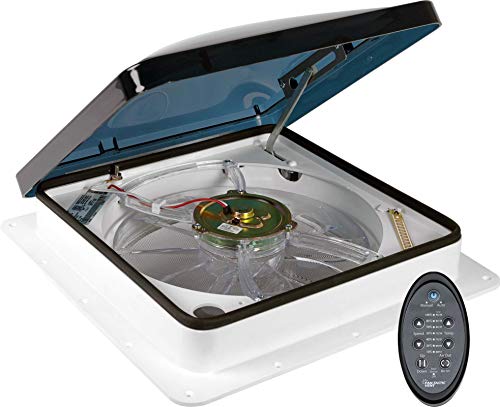
Dometic Fan-Tastic Vent Model 7350
Fourteen speed steps let you park the fan exactly where noise and airflow balance out. Its rain sensor drops the dome shut at the first drops, which protects an unattended rig. Blades reverse on command, so cooking smells clear in a couple of minutes.
Pros
- Closes its own dome when weather arrives
- Fine speed steps make quiet night running easy
- Reverse mode clears galley odours quickly
Cons
- Dome must sit open to run, so rain halts airflow
- Sensor needs wiping clean to keep reacting

Maxxair MaxxFan Plus 5100K
Rain shield geometry carries over from the Deluxe, minus the remote and thermostat. A ceiling keypad sets speed and direction, while the lid cranks open by hand. Fewer electronics mean fewer failure points on washboard forest roads.
Pros
- Ventilates through rain like the flagship Deluxe
- Nothing to misplace, since controls live on the ceiling
- Anyone in the rig can work the keypad
Cons
- No thermostat, so it runs until somebody switches it off
- Manual crank is a reach in a tall trailer

Heng’s Vortex II Roof Vent Fan
Built to drop into an existing 14 by 14 inch housing, which leaves the roof sealant untouched. Quoted airflow sits at the top of this group on paper. Exhaust only operation keeps the wiring down to two leads.
Pros
- Highest quoted CFM figure in this lineup
- Reuses the existing housing, flange and butyl seal
- Light enough to lift into place from inside
Cons
- No intake mode for drawing cool air down
- Noisier than either Maxxair at full speed

Fan-Tastic Vent Model 1250
Three speeds, a rotary knob and a crank handle make up the entire interface. Ten blades move honest air for a fan with no circuit board inside. Its staying power in older trailers comes down to how little can break.
Pros
- Almost nothing electronic to fail over the years
- Low setting stays quiet enough to sleep under
- Two wire hookup suits a simple 12 volt system
Cons
- Exhaust only, with no reverse setting
- Lid has to be cranked open by hand every time

RVGUARD 14 Inch RV Roof Vent Fan
One roof cutout handles ventilation and cabin lighting here, thanks to an integrated LED panel. Speed, direction and the light all answer to a remote from the bunk. Makes most sense as a second vent rather than the main one over the galley.
Pros
- LED panel saves fitting a separate ceiling fixture
- Reversible airflow in an entry level unit
- Remote reaches speed, direction and lighting
Cons
- Lid plastic feels thinner than a Maxxair dome
- Wiring instructions skip useful detail

Leisure Coachworks 14 Inch RV Roof Vent Fan
Owners single this fan out for how little it intrudes on the lowest settings. Sleeping directly beneath a vent is exactly where that matters. Remote and manual controls both ship in the box, alongside an LED ring set into the trim.
Pros
- Quietest of this group at the lowest setting
- Remote and manual control both included
- Retrofits into a standard cutout without modification
Cons
- Peak airflow trails both Maxxair fans
- Crank handle feels light in the hand
Compared at a glance
| # | Model | Rated airflow | Best for | Score | Price |
|---|---|---|---|---|---|
| 1 | Maxxair MaxxFan Deluxe 7500K | About 900 CFM on high | Best overall | 9.4 | Check price |
| 2 | Dometic Fan-Tastic Vent Model 7350 | 14, reversible | Best for hands off automation | 9.2 | Check price |
| 3 | Maxxair MaxxFan Plus 5100K | 14 by 14 inch roof cutout | Best rain ventilation without a remote | 9.0 | Check price |
| 4 | Heng’s Vortex II Roof Vent Fan | Around 950 CFM | Best value high airflow | 8.7 | Check price |
| 5 | Fan-Tastic Vent Model 1250 | 3 | Best budget | 8.5 | Check price |
| 6 | RVGUARD 14 Inch RV Roof Vent Fan | Multiple, reversible | Best fan and light in one opening | 8.3 | Check price |
| 7 | Leisure Coachworks 14 Inch RV Roof Vent Fan | 14 by 14 inch roof cutout | Best for quiet overnight running | 8.0 | Check price |
Frequently asked questions
How many CFM do you need in an RV vent fan?
A fan in the 900 CFM class handles most vans and travel trailers. Bigger motorhomes do better with two vents, one on intake and one on exhaust. Rated figures assume nothing blocks the blades, so expect less once screen and lid are counted.
What size is a standard RV roof vent opening?
Fourteen by fourteen inches is the industry standard. Every fan listed here is built for that cutout. Measure before ordering anyway, since a handful of older rigs used non standard frames.
Can you run an RV vent fan while it is raining?
Only with a protected lid. Maxxair models place a shield above the dome, so they keep running with the vent open. Fan-Tastic units rely on a sensor that closes the dome, which pauses airflow until the shower passes.
How much battery does an RV roof fan use overnight?
Draw scales steeply with speed, so the top setting can pull several times the current of the lowest. Running on low, or letting a thermostat cycle the fan, stretches a house battery through the night. One fan is easy for a modest solar setup to support.
Is a reversible RV vent fan worth it?
Yes if you cook inside or camp somewhere evenings cool off fast. Exhaust mode clears heat and smells, intake mode brings cooler outside air down. Exhaust only fans such as the Heng’s Vortex II still work fine as a single main vent.
MaxxFan Deluxe vs Fan-Tastic Vent 7350: which should you buy?
Pick the MaxxFan for wet climates, because the shield keeps ventilation going in rain. Choose the 7350 for automation, with fourteen speeds and a dome that closes itself. Both drop into the same opening, so the decision really comes down to rain strategy.
Can you install an RV roof vent fan yourself?
Swapping a fan into an existing housing, as the Heng’s Vortex II allows, takes hand tools and an afternoon. Replacing the whole unit adds butyl tape, self levelling lap sealant and a dry weather window. Cutting a brand new opening is a much larger job worth planning first.
Do RV vent fans work while driving?
Most run normally on 12 volt house power at speed. An open dome is exposed to wind gusts and low branches, though. Fans with a rain shield sit lower than a fully raised lid, and many owners close the vent for transit out of habit.
Which RV vent fan is quietest for sleeping?
Low speed noise, not peak airflow, decides that. Owners rate the Leisure Coachworks unit as the softest of this group on its lowest setting. Fans with ten or fourteen steps also help, since you can sit just above silence instead of jumping to medium.
Our take
Fit the MaxxFan Deluxe 7500K if you only fit one fan. Its shield turns a rainy night from a shutdown into a non event, and the thermostat manages cycling while you sleep. Owners who park a rig unattended for weeks should take the Fan-Tastic Vent 7350 and let the dome close itself. Anyone swapping a tired fan into a sound existing housing gets the most airflow per hour of work from the Heng’s Vortex II.
Tony Russo
Tony trained as an automotive technician and spent years in service and parts retail before moving into writing. He focuses on garage tools, car care products and accessories from a hands-on maintenance perspective.


