High-capacity RV TPMS kits for coaches and toads
TST 507 Series leads for long coaches. It scales past 20 positions, and its flow-through sensors accept an air chuck directly. TireMinder A1AS matches that capacity while hiding the booster inside the monitor. EEZTire TPMS10ATC covers a trailer and tow vehicle with room for 26 sensors.
TST 507 Series suits owners of a Class A coach towing a car. Capacity runs past 20 positions, so a tag axle and inner duals all get covered. Flow-through sensors let you add air without unscrewing anything. One catch: those sensor bodies sit tall, and some alloy wheels need a valve extender.
Car TPMS kits stop around six sensors and a passenger-car pressure ceiling, well short of a diesel pusher. We compared stated sensor ceilings, pressure ranges, temperature thresholds, repeater design and display types across each listing. Owner reports about rear-axle dropouts and coin-cell life broke the remaining ties.
Our top picks

TST 507 Series RV TPMS with Flow-Through Sensors
Flow-through sensors are why this kit wins. An air chuck threads onto the sensor body, so topping up never breaks the seal or drops the reading. Color display auto-scrolls every position and alarms on heat as well as pressure loss.
Pros
- Air chuck threads straight onto the sensor
- Covers coach, tag axle and towed car in one system
- Sensor batteries swap out instead of the whole sensor
Cons
- Taller sensor body needs a valve extender on some alloy wheels
- Rigs past 30 feet still want the separate repeater

TireMinder A1AS RV TPMS
Booster circuitry lives inside the monitor housing. That removes the usual hunt for a powered outlet halfway down a fifth wheel. Capacity reaches 22 tires, enough for a tag-axle coach pulling a dually, and the pressure range extends into heavy truck figures.
Pros
- Nothing extra to mount or wire mid-trailer
- Pressure ceiling reaches heavy truck tire figures
- Baselines set per tire instead of one global number
Cons
- Cap sensors must come off before adding air
- Monitor has to stay powered or the booster stops relaying

EEZTire TPMS10ATC
EEZ ships locking anti-theft rings and a long warranty with a mid-market kit. Ceiling sits at 26 sensors, so a trailer and tow vehicle leave plenty of room for a future upgrade. Sensors run on a common coin cell stocked by any hardware store.
Pros
- Highest stated sensor ceiling in this group
- Locking rings deter sensor theft at campgrounds
- Coin cells restock anywhere on the road
Cons
- Monochrome screen washes out in direct sun
- Sensor height fouls some alloy wheel pockets

TireMinder Smart TPMS
Readings travel over Bluetooth to a phone or tablet through a small transmitter, leaving the windshield clear. Logging is the real payoff, since pressure and temperature history shows how each tire behaved on a long climb. Push alerts land on whichever paired device is awake.
Pros
- Windshield stays clear of another mount
- Trend history exposes a slow leak early
- Passenger can check readings from any seat
Cons
- Alerts depend on a paired phone awake and in range
- App dependency adds a failure point on travel days
GUTA RV TPMS with Solar Charging
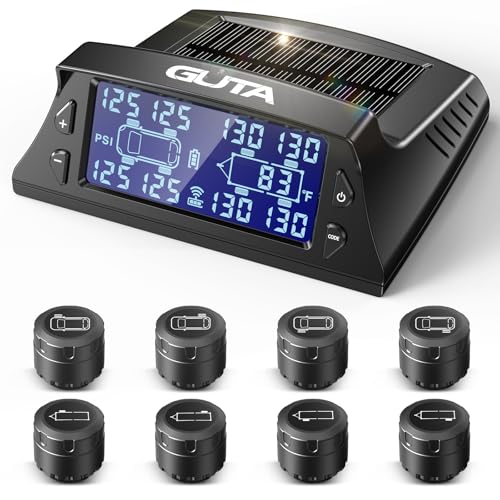
Small panel on the monitor lid trickle-charges the internal cell, which kills the cable running across the dash. GUTA sells four, six and eight sensor versions, so one kit can cover a truck and trailer. Thresholds set per axle group on a color screen.
Pros
- Solar charging removes the dash cable run
- Axle groups take different pressure targets
- Color screen stays readable in daylight
Cons
- Sensor ceiling falls short of big-rig systems
- Charging stalls when the monitor sits in shade
VESAFE RV TPMS with Repeater
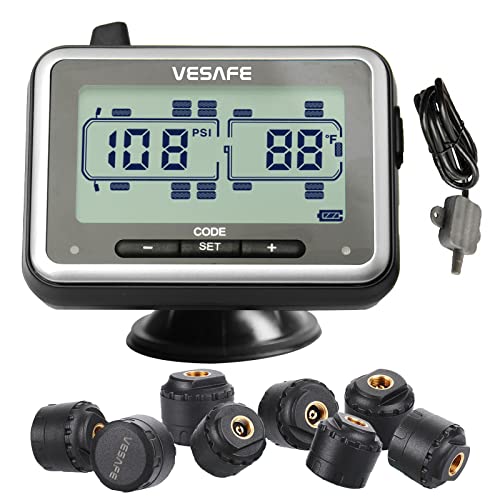
VESAFE bundles the repeater rather than selling it later, which fixes dropouts from the rear axle of a long fifth wheel. Cap sensors arrive with lock nuts and a spanner in the box. Fast leak alarms fire before pressure reaches the low threshold.
Pros
- Repeater comes in the box, not as an add-on
- Fast leak alarm beats the low-pressure threshold
- Lock nuts and spanner supplied for fitting
Cons
- Capacity stops below the TST and EEZTire systems
- Repeater needs its own 12 volt feed

Tymate RV TPMS
Four sensors and a compact color monitor cover a single-axle trailer or a van conversion. Expansion is the tradeoff, since nothing here scales toward a coach plus toad. Owners report steady readings on shorter rigs, where signal travels less distance to the cab.
Pros
- Cheapest route into RV tire monitoring
- Monitor takes up little dash space
- Sensors arrive pre-paired to wheel positions
Cons
- Little expansion past the four supplied sensors
- Signal weakens on trailers over about 30 feet
What matters most
What to look for in an RV TPMS Sensor count sets the ceiling, so tally every wheel you drive and tow. Tag axles, inner duals and the towed car each need a position. Compare the pressure ceiling against your tire placard next, because car-focused systems top out below coach cold inflation. Temperature alarms matter as much as pressure readings: a dragging brake shows as heat long before any air escapes. Repeater design then decides whether the rearmost axle reports at all.
How many sensors you need for your rig Six positions cover a single-axle trailer behind a pickup. Dual-axle fifth wheels pulled by a dually reach ten. Class A coaches with a tag axle and a toad pass eighteen, which is where the TST 507 and TireMinder A1AS stop looking excessive. Leave two spare positions for a mounted spare or a change of tow vehicle. Ceilings are stated per kit, so check yours before adding a second trailer.
Signal range on long fifth wheels and coaches Radio from a rear trailer sensor crosses metal, water tanks and axles on the way to the cab. That distance explains why long-rig kits either bundle a repeater or build one in. TireMinder hides the booster in the monitor; EEZTire and VESAFE ship a powered box you mount midway. One position dropping out intermittently usually points at the signal path, not a dead sensor. Mounting the repeater high and clear of the frame helps more than moving the monitor around the dash.
Cap sensors vs flow-through vs internal Cap sensors unscrew before you add air, which drags out a pre-trip check on ten tires. Flow-through bodies, as on the TST 507, take an air chuck while still transmitting. Internal sensors mount inside the wheel and dodge theft and balance complaints, though fitting them means dismounting every tire. Many owners settle on flow-through up front, where checks happen most, and capped sensors with locking rings elsewhere. Snap-in rubber stems flex under any external sensor, so metal stems are worth fitting at the same time.
How they compare
| # | Model | Sensor capacity | Best for | Score | Price |
|---|---|---|---|---|---|
| 1 | TST 507 Series RV TPMS with Flow-Through Sensors | Expandable past 20 positions | Best overall | 9.4 | Check price |
| 2 | TireMinder A1AS RV TPMS | Up to 22 tires | Best for the longest rigs | 9.2 | Check price |
| 3 | EEZTire TPMS10ATC | Up to 26 sensors | Best value | 9.0 | Check price |
| 4 | TireMinder Smart TPMS | Multi-axle kits for coach plus towed vehicle | Best app-based monitoring | 8.8 | Check price |
| 5 | GUTA RV TPMS with Solar Charging | Solar panel plus USB charging | Best solar-powered display | 8.5 | Check price |
| 6 | VESAFE RV TPMS with Repeater | Six to ten sensor kits | Best for long trailers | 8.3 | Check price |
| 7 | Tymate RV TPMS | Four sensors standard | Best budget | 8.0 | Check price |
Questions worth asking
How many tires can an RV TPMS monitor?
Capacity varies by kit. Tymate covers four, mid-range systems reach ten, and the TST 507 and EEZTire TPMS10ATC stretch past twenty. Count every towed wheel first, then add two positions of headroom.
Do I need a repeater for a fifth wheel?
Usually yes once the rig passes roughly 30 feet. Signal from the rear axle has to cross metal and full water tanks. TireMinder A1AS builds the booster into the monitor, while EEZTire and VESAFE supply a separate box.
Are external TPMS sensors accurate?
External sensors read the same air as the valve, so readings track a quality gauge closely. Compare each position against a manual gauge on fitting day and note any offset. Recheck after every coin-cell change.
Will TPMS sensors make a valve stem leak?
Rubber snap-in stems can flex under the extra weight, especially at highway speed on a dually. Metal stems or short rigid extenders stop that movement. Many owners swap stems during the same tire service.
What pressure should the low alarm be set to?
Enter your cold inflation figure from the tire placard as the baseline. Systems then apply their own low threshold, commonly a 15 to 25 percent drop. Air heats and expands while driving, so the high alarm needs headroom above cold pressure.
Can one TPMS cover a motorhome and a towed car?
That is the point of a high-capacity system. Assign sensors to separate vehicle groups so the toad reports under its own heading. Confirm the kit supports multiple axle groups before buying.
How long do TPMS sensor batteries last?
Roughly a year of regular use on a coin cell, and less on a rig that travels constantly. TST and EEZTire sensors take replaceable cells, so a flat battery does not mean a new sensor. Carry spares on long trips.
Which is better for RVs, flow-through or cap sensors?
Flow-through wins when you check ten or more tires by hand, since an air chuck fits without removing anything. Cap sensors sit lower and clear tight wheel pockets. Wheel design often makes the decision for you.
Is an RV tire pressure monitor worth it?
Trailer tire failures usually begin as a slow leak nobody can see from the driver seat. A monitor gives minutes of warning and flags heat from a dragging brake. Anyone towing regularly gains more safety from this than from most other RV add-ons.
The verdict
Fit the TST 507 Series on a long coach. Capacity covers every towed position, and flow-through sensors turn a ten-tire air check into a short job. Owners who refuse to mount and wire a separate repeater should take the TireMinder A1AS instead. Single-axle trailer owners can stop at the EEZTire TPMS10ATC and still hold 26 sensors of headroom.
Tony Russo
Tony trained as an automotive technician and spent years in service and parts retail before moving into writing. He focuses on garage tools, car care products and accessories from a hands-on maintenance perspective.