Which high-capacity RV extension cord fits your rig?
Camco PowerGrip 50 Amp, 30 ft tops the list. Its 6/3 plus 8/1 conductors move a full 12,500 watts to a two air conditioner coach. Valterra Mighty Cord does the same over 25 feet and stores easier. Travel trailers with a TT-30 inlet want the Conntek 10 gauge cord.
Camco PowerGrip in 50 amp, 30 foot form suits a big coach running two roof air conditioners from a far pedestal. Its 6 gauge power conductors pass the full 12,500 watts without heat building at the blades. Weight is the catch, since 30 feet of 6/3 cable takes both hands to coil.
Cords fail in two expensive ways: sagging voltage and melting ends. We compared conductor gauge, amp and voltage ratings, plug patterns, jacket compound and length, then read owner feedback on grip handles, winter stiffness and connector heat. Each pick had to match a real shore inlet without adapters.
What matters most
What to look for in an RV extension cord Start with the service your coach was built for. Fifty amp rigs use the four prong NEMA 14-50 pattern across two 125 volt legs, which totals 12,500 watts. Thirty amp rigs use the three prong TT-30 pattern at 125 volts for 3,750 watts. Gauge follows from that: 6 gauge power conductors for 50 amp, 10 gauge for 30 amp. Jacket type comes next, with STW rated for wet outdoor use. Molded ends and grip handles decide how long the plug survives daily use.
How long should an RV extension cord be? Buy the shortest cord that still reaches a typical pedestal, then keep a longer one in a bay. Resistance rises with every foot, and it shows up as lost voltage under load. Fifty feet of 10 gauge gives up roughly three volts at a full 30 amp draw. Compressors feel that first, because an air conditioner pulls hardest in the second it starts. Chaining two cords compounds the drop and adds another joint for water to sit in.
Adapters and mixed service pedestals Sites rarely offer exactly the service you want. A 50 amp coach on a 30 amp post needs a dogbone adapter, and the whole rig then lives inside 3,750 watts no matter what the cord can carry. Run one air conditioner in that situation and leave the water heater on propane. Keep adapters separate from the cord so either part can be replaced alone. Cutting a molded end off to fit a different pattern destroys the weather seal, so never do it.
Cold weather handling, storage and connector heat Winter separates jacket compounds. Cheap PVC sets into a stiff hoop near freezing, while the Southwire cord still bends. Coil loosely in figure eight loops to stop conductors work hardening at the same points. Inspect both ends after each trip for pitted or browned blades, since heat marks are the first sign of a loose pedestal connection. Retire any cord with melted plastic rather than filing the contacts clean. Store the coil off the ground so water does not pool in the female end.
The top picks, ranked

Camco PowerGrip 50 Amp RV Extension Cord, 30 ft
Six gauge power conductors and an 8 gauge ground carry 50 amps across two 125 volt legs. That covers two air conditioners plus a converter and a residential fridge on a hot afternoon. Molded grip handles let you pull the handle instead of the cable, which keeps blades seated and water out.
Pros
- Full 12,500 watt capacity with no derating
- Grip handles protect the terminals when unplugging
- STW jacket rated for outdoor sun and rain
Cons
- Needs both hands to coil and store
- Stiffens noticeably below freezing
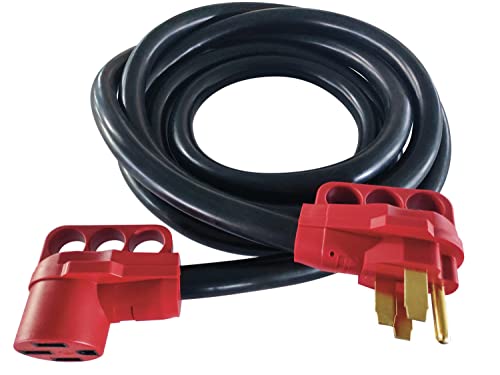
Valterra Mighty Cord 50 Amp RV Extension Cord, 25 ft
Valterra runs the same 14-50 pattern and 12,500 watt capacity over a 25 foot length. Both ends get a molded finger grip, and the bright jacket shows up when you are hunting for the plug under the coach at night. Five fewer feet drops enough weight to matter in a crowded pass through bay.
Pros
- Lighter coil than a 30 ft cord
- Molded finger grips on both ends
- High visibility jacket is easy to spot at night
Cons
- Twenty five feet falls short at awkward sites
- No storage bag included

Conntek 30 Amp RV Extension Cord, 25 ft
Ten gauge conductors and TT-30 ends match the inlet on most travel trailers and smaller motorhomes. Capacity lands at 3,750 watts, which runs one air conditioner alongside a converter and a fridge. Several versions add a lighted end, so you can confirm the pedestal is live before the coach is connected.
Pros
- Correct 10 gauge sizing for a full 30 amp draw
- Stows in less space than 50 amp cable
- Plugs straight into a TT-30 inlet
Cons
- Useless on a 50 amp coach without an adapter
- Ends lack the deep grip handles of Camco

Southwire 30 Amp RV Extension Cord, 30 ft
Jacket compound is the story here, staying pliable at temperatures that turn budget cords into a hoop. Thirty feet of 10 gauge gives five extra feet of reach while holding voltage drop near three volts at full load. Molded ends leave no screws or clamps to work loose after a season of travel.
Pros
- Jacket stays flexible in cold weather
- Extra five feet over a standard 25 ft cord
- Molded ends with nothing to retighten
Cons
- More voltage drop than a 25 ft cord
- Bulkier coil to store

Kohree 50 Amp RV Extension Cord, 25 ft
Full 6 gauge power conductors keep the 50 amp rating intact, and a carry strap comes in the box. Ends use a textured twist grip rather than a full handle, which works once the pedestal door is open. Owners report a thinner jacket than the Camco, so it coils willingly and scuffs sooner on gravel pads.
Pros
- Coils more willingly than heavier 50 amp cords
- Carry strap included for storage
- Keeps full 50 amp conductor sizing
Cons
- Thinner jacket scuffs on gravel
- Twist grips give less leverage than handles

Parkworld 50 Amp RV Extension Cord, 15 ft
Fifteen feet suits sites where the pedestal sits a few steps from the service door. No coiled surplus ends up under a tire, and voltage drop is barely measurable at that length. Conductors stay at 6 gauge, so the 12,500 watt rating holds even though the cord handles one handed.
Pros
- Almost no voltage drop over the run
- Light enough to handle one handed
- Fits a small bay or a bumper compartment
Cons
- Too short for many pull through sites
- Wants a longer cord as backup

Miady 30 Amp RV Extension Cord, 50 ft
Fifty feet reaches a post stuck behind the neighboring rig or across a wide back in site. Ten gauge copper holds the drop to roughly three volts at a full 30 amp load, which leaves thin headroom for air conditioner startup. A lighted end confirms power, and the jacket is rated for outdoor use.
Pros
- Reaches pedestals shorter cords cannot
- Lighted end confirms live power
- Correct gauge for the full 30 amp rating
Cons
- Voltage drop matters at full load
- Slow to coil and heavy to carry
How they compare
| # | Model | Rating | Best for | Score | Price |
|---|---|---|---|---|---|
| 1 | Camco PowerGrip 50 Amp RV Extension Cord, 30 ft | 50 amp, 125/250 volt | Best overall | 9.4 | Check price |
| 2 | Valterra Mighty Cord 50 Amp RV Extension Cord, 25 ft | 50 amp, 125/250 volt | Best value | 9.1 | Check price |
| 3 | Conntek 30 Amp RV Extension Cord, 25 ft | 30 amp, 125 volt | Best for 30 amp rigs | 9.0 | Check price |
| 4 | Southwire 30 Amp RV Extension Cord, 30 ft | 30 amp, 125 volt | Best for longer 30 amp runs | 8.8 | Check price |
| 5 | Kohree 50 Amp RV Extension Cord, 25 ft | 50 amp, 125/250 volt | Best budget 50 amp | 8.6 | Check price |
| 6 | Parkworld 50 Amp RV Extension Cord, 15 ft | 50 amp, 125/250 volt | Best short run | 8.4 | Check price |
| 7 | Miady 30 Amp RV Extension Cord, 50 ft | 30 amp, 125 volt | Best for distant pedestals | 8.0 | Check price |
Good to know
What gauge wire does a 50 amp RV extension cord need?
Six gauge for the two hot legs and the neutral, with an 8 gauge ground, written as 6/3 plus 8/1. That sizing supports the full 12,500 watts at 125 and 250 volts. Lighter copper heats at the blades once both air conditioners run.
30 amp vs 50 amp RV cords: what is the difference?
Thirty amp service is a single 125 volt leg through a three prong TT-30 plug, capped at 3,750 watts. Fifty amp service carries two 125 volt legs through a four prong 14-50 plug for 12,500 watts. Plug patterns are not interchangeable, so the cord has to match the inlet on the coach.
Can I use a regular extension cord for my RV?
No. Household cords use 14 or 12 gauge wire and a 5-15 plug that no shore inlet accepts. Current draw from a converter and an air conditioner will overheat that wire. Buy a cord built for TT-30 or 14-50 service.
How long can an RV extension cord be?
Fifteen to fifty feet covers real campground layouts, and shorter always delivers better voltage. Fifty feet of 10 gauge loses about three volts at a full 30 amp load. Past that length, air conditioner startup gets unreliable on a weak pedestal.
Is it safe to connect two RV extension cords together?
It works, but each joint adds resistance and one more place for rain to collect. Voltage drop adds up across the whole run rather than resetting at the joint. One longer cord is the safer answer.
Do I need a 50 amp cord if my rig is 30 amp?
No. A 30 amp coach has a TT-30 inlet that a 14-50 plug cannot enter. Match the cord to the inlet, then carry a dogbone adapter for pedestals that differ.
What does 125/250 volt mean on a 50 amp cord?
Fifty amp service delivers two 125 volt legs that measure 250 volts between each other. Appliances run on one leg at 125 volts while the panel splits the load across both. Capacity therefore works out at 12,500 watts instead of 6,250.
Why do RV cord plugs get hot?
Loose or corroded contacts at the pedestal or the inlet cause most heat. Undersized conductors add to it whenever the load is heavy. Check the blades for pitting, and stop using a cord once the plastic looks melted or browned.
Which RV extension cord is best for cold climates?
Judge the jacket rather than the copper. Southwire compounds stay workable where budget PVC sets hard near freezing. Loose figure eight coils also keep a cold cord from taking a permanent bend.
Is a high-capacity RV extension cord worth it on a small trailer?
A 10 gauge TT-30 cord is worth it, because thinner 12 gauge copper sags voltage on a hot day. Jumping to 50 amp cable on a trailer with a TT-30 inlet is not, since the adapters cancel the benefit. Spend the difference on length that actually reaches your usual pedestal.
The verdict
Buy the Camco PowerGrip 50 amp, 30 foot cord for a large coach. Full size conductors handle two air conditioners, and the grip handles survive daily plugging at a metal pedestal. Travel trailer owners should skip every 50 amp entry and take the Conntek 10 gauge cord, which fits a TT-30 inlet with no adapter stack. Add the Parkworld 15 foot cord if your regular sites put the post within a few steps of the service door.
Tony Russo
Tony trained as an automotive technician and spent years in service and parts retail before moving into writing. He focuses on garage tools, car care products and accessories from a hands-on maintenance perspective.


