RV Backup Cameras for Long Rigs: Wired vs Wireless
Furrion Vision S leads for overall reliability with a 90-foot digital wireless signal and support for 4 extra cameras. Rear View Safety RVS-770613 suits 5th-wheels over 30 feet through a wired 65-foot cable. AUTO-VOX Solar Wireless fits owners who want zero wiring, thanks to its solar-charged battery and 150-foot range.
Furrion Vision S tops this list on signal stability, since its digital wireless system holds a picture at up to 90 feet. Thick metal siding or a long 5th-wheel can still shorten that range. Routing power to the monitor also takes extra wiring on older rigs.
Trailer length and metal siding make wireless range unpredictable, so picking the right camera isn’t just about specs on a box. We compared wireless range, monitor resolution, waterproof ratings, and owner reports of signal drop-outs before ranking these seven systems.
The top picks, ranked

Furrion Vision S 7-Inch Wireless RV Backup Camera
A 7-inch LCD monitor pairs with a rear camera built into a license plate mount. Digital wireless signal reaches up to 90 feet in open conditions, and the IP69K housing withstands wash-downs. Owners report stable video on Class A and Class C motorhomes, and up to 4 more cameras can be added for side or interior views.
Pros
- Digital signal resists interference better than analog kits
- Expands to 4 cameras for side and interior views
- License plate mount fits most RV bumpers
Cons
- Metal siding or long 5th-wheels can shorten the 90-foot range
- No split-screen unless a second camera is added
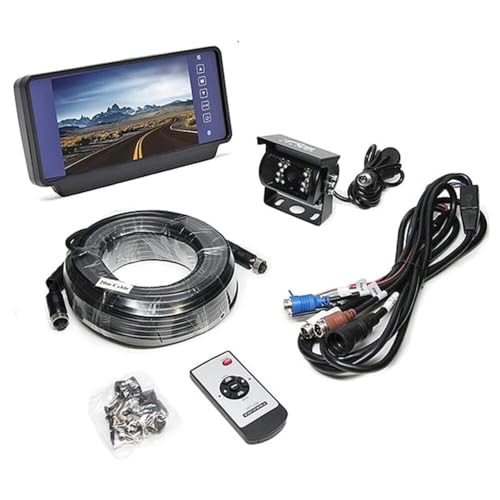
Rear View Safety RVS-770613 Backup Camera System
A 65-foot cable, extendable to 120 feet, replaces a wireless link entirely. That wired setup avoids the signal drop-outs that trailers over 30 feet can cause. The 7-inch monitor switches automatically between up to 4 camera inputs, and the rear camera carries an IP69K rating.
Pros
- Wired connection avoids interference on long 5th-wheels
- Automatic switching across up to 4 camera inputs
- IP69K housing suited to wash-downs and road spray
Cons
- Running cable the length of an RV takes real installation time
- Bulkier setup than plug-and-play wireless kits

AUTO-VOX Solar Wireless Backup Camera Kit
A solar panel trickle-charges the built-in battery, so no wire runs from the camera to the cab. Digital wireless range reaches 150 feet, the longest in this lineup, and the 5-inch monitor mounts to a dash or windshield with a suction cup. Battery life still depends on sun exposure, so RVs parked in shade may need manual charging.
Pros
- Longest wireless range in this lineup at 150 feet
- No cable routing between camera and monitor
- Magnetic or bracket mount installs in minutes
Cons
- Battery charging depends on consistent sunlight
- 5-inch screen is small for split-view use

LeeKooLuu LK1 Split Screen Wireless Backup Camera
Two cameras ship in the box, covering both the rear bumper and a trailer hitch. The 7-inch monitor splits into dual view automatically once both cameras connect, and wireless range is rated to 100 feet in open conditions. Night vision relies on infrared LEDs, so image quality fades past about 15 feet in full darkness.
Pros
- Rear and hitch cameras included at no extra cost
- Automatic split screen when both cameras connect
- Lower cost than most dual-camera kits
Cons
- Infrared night vision has limited effective range
- Split screen shrinks each camera’s usable image

Yakry Y28 Wireless Backup Camera
One rear camera, a 5-inch monitor, and a 100-foot digital wireless link keep this kit simple. Eight infrared LEDs handle basic night visibility, and the IP69K housing tolerates road spray. Split-screen and multi-camera support are left out, which keeps the price down for single-view use.
Pros
- Straightforward single-camera setup
- IP69K housing handles road spray and rain
- Lower price point than multi-camera kits
Cons
- No option to add a second camera
- 5-inch monitor is harder to read at a distance
Wolfbox 5 Inch Wireless Backup Camera
A wider-aperture lens works alongside IR LEDs, aiming for a clearer low-light image than IR-only cameras. Wireless range matches the AUTO-VOX at 150 feet, and the housing carries an IP68 rating. The 5-inch screen makes fine text and grid lines harder to read at highway speeds than 7-inch options here.
Pros
- Clearer low-light image than basic IR-only cameras
- 150-foot range ties for longest in this lineup
- Compact monitor fits tight dash space
Cons
- 5-inch screen limits visibility of fine detail
- No multi-camera switching support

HitchCam Wireless Hitch Camera
A magnetic mount and compact 4.3-inch monitor target one job: lining up a trailer hitch. Wireless range tops out around 32 feet, short next to full RV backup systems, but that covers the gap between tow vehicle and hitch ball. A rechargeable battery powers the camera, so there’s no permanent wiring to install.
Pros
- Built specifically for precise hitch alignment
- Magnetic mount moves between vehicles easily
- Compact monitor doesn’t clutter the dash
Cons
- 32-foot range is too short for general RV backing
- Battery needs regular recharging
How to pick the right one
What to check before buying an RV backup camera Wireless range, monitor size, and waterproof rating affect daily use more than extra features. Digital wireless systems resist interference better than older analog kits. Even digital signal can weaken through metal siding or across a long trailer. Wired systems trade a harder install for a steadier picture on longer rigs.
Wired vs wireless for long 5th-wheels Trailers over 30 feet with aluminum or steel siding lose wireless signal most often. A wired system like the Rear View Safety RVS-770613 sidesteps that problem since its cable runs the full length of the RV. Wireless kits rarely struggle on trailers under 25 feet. Rig length matters more than brand here.
Adding a second camera or split screen Many owners add a second camera later for a hitch view or a blind spot. LeeKooLuu’s LK1 ships two cameras out of the box, skipping that upgrade entirely. Furrion Vision S and the RVS-770613 both support extra cameras when needed. Single-camera kits like the Yakry Y28 can’t expand without a full replacement.
Night vision and low-light limits Standard infrared LEDs, the kind in most budget cameras, lose clarity past 15 to 20 feet in full darkness. Wolfbox pairs IR LEDs with a low-light sensor to hold detail a bit further out. Anyone backing into unlit campsites often should weigh this over a slightly longer wireless range.
How they compare
| # | Model | Wireless range | Best for | Score | Price |
|---|---|---|---|---|---|
| 1 | Furrion Vision S 7-Inch Wireless RV Backup Camera | 90 ft digital signal | Best overall | 9.4 | Check price |
| 2 | Rear View Safety RVS-770613 Backup Camera System | Wired, 65 ft cable, 120 ft max | Best for long RVs and 5th-wheels | 9.1 | Check price |
| 3 | AUTO-VOX Solar Wireless Backup Camera Kit | Solar panel plus rechargeable battery | Best wireless range | 8.8 | Check price |
| 4 | LeeKooLuu LK1 Split Screen Wireless Backup Camera | 100 ft digital signal | Best value | 8.5 | Check price |
| 5 | Yakry Y28 Wireless Backup Camera | 100 ft digital signal | Best budget | 8.3 | Check price |
| 6 | Wolfbox 5 Inch Wireless Backup Camera | 150 ft digital signal | Best night vision | 8.1 | Check price |
| 7 | HitchCam Wireless Hitch Camera | 32 ft digital signal | Best for towing and trailer hitching | 8.0 | Check price |
Good to know
How far can a wireless RV backup camera transmit?
Most digital wireless RV backup cameras reach 90 to 150 feet in open conditions. Metal siding, nearby RVs, or Wi-Fi networks can shorten that range in practice.
Is a wired or wireless backup camera better for a 5th-wheel?
Wired systems hold a steadier picture on 5th-wheels over 30 feet, since there’s no signal to lose along the way. Wireless kits install faster but can drop frames on longer rigs.
Can I add a second camera to a wireless RV backup camera system?
It depends on the model. Furrion Vision S and the Rear View Safety RVS-770613 both support extra cameras, while single-camera kits like the Yakry Y28 don’t expand.
What waterproof rating should an RV backup camera have?
Look for IP68 or IP69K, both of which handle rain, road spray, and pressurized wash-downs. Anything lower may not survive wet highway driving.
Which backup camera works best for aligning a trailer hitch?
HitchCam Wireless Hitch Camera is built for that job specifically, with a magnetic mount and a shorter 32-foot range suited to the gap between tow vehicle and hitch ball.
Do solar-powered RV backup cameras actually work?
Yes, though results depend on sun exposure. AUTO-VOX Solar Wireless trickle-charges its battery through a small panel, but RVs stored in shade may need occasional manual charging.
How big should an RV backup camera monitor be?
A 7-inch monitor reads easier at highway speed and handles split-screen multi-camera views better. 5-inch and 4.3-inch monitors save dash space but show less detail.
Furrion Vision S vs Yakry Y28, what’s the real difference?
Furrion uses a more robust wireless protocol and supports up to 4 cameras. Yakry Y28 is a simpler single-camera kit with shorter effective range and no expansion options.
What causes an RV backup camera to lose signal?
Metal trailer siding, long distances between camera and monitor, and interference from other wireless devices are the most common causes. Wired systems avoid this entirely.
The bottom line
Furrion Vision S is the strongest all-around pick, since its stable digital signal and 4-camera support suit most Class A and Class C motorhomes. Owners of 5th-wheels or trailers over 30 feet should choose the Rear View Safety RVS-770613 instead, because a wired connection avoids the drop-outs wireless systems face on bigger rigs. Buyers who only need a single rear view and want to keep cost down can go with the Yakry Y28.
Tony Russo
Tony trained as an automotive technician and spent years in service and parts retail before moving into writing. He focuses on garage tools, car care products and accessories from a hands-on maintenance perspective.