Heavy Duty Waterproof Marine Chargers That Keep You Afloat
The NOCO Genius GENPRO10X1 takes the top spot for most boaters because it pairs a fully sealed IP68 waterproof case with 10 amps of heavy duty charging power and smart battery management. Owners report it stands up to salt spray and rain without issue. Its main limitation is the single bank output, which means multi-battery setups need a different model.
A dead battery on the water is more than an inconvenience. It can turn a perfect day into a safety hazard. That is why a heavy duty waterproof marine battery charger belongs in every serious boater’s toolkit.
These chargers are built to shrug off moisture, salt, and vibration. They deliver reliable power to starting batteries, trolling motors, and house banks. Below are seven models that stand out for durability and performance.
The shortlist, ranked

NOCO Genius GENPRO10X1
The NOCO Genius GENPRO10X1 is a 10 amp, single bank charger with a fully sealed IP68 waterproof housing. It handles lead acid, AGM, and lithium batteries. It includes a built in thermal sensor and spark proof technology. Owners report it survives harsh marine environments without corrosion.
Pros
- Fully submersible case
- Smart charging with thermal compensation
- Works with lithium and lead acid
Cons
- Single bank only
- Higher price than basic models

Battery Tender Plus 021-0128
The Battery Tender Plus is a compact 1.25 amp charger that is not fully waterproof but is splash resistant. It is ideal for maintaining a single battery between trips. Its rugged case and alligator clips make it easy to use. Owners appreciate its simplicity and reliability for the price.
Pros
- Very affordable
- Compact and easy to store
- Long warranty
Cons
- Low amperage for charging large batteries
- Not fully submersible

ProMariner ProSport 12 8 Amp
The ProMariner ProSport 12 is a dual bank charger delivering 8 amps total (4 amps per bank). It has a waterproof aluminum housing and is designed for saltwater use. It features three stage charging and automatic temperature compensation. Owners report it keeps trolling batteries topped up and handles vibration well.
Pros
- Dual bank for two batteries
- Sealed aluminum case
- Automatic temperature compensation
Cons
- Lower amperage per bank
- No lithium support

Minn Kota MK-220D Precision Charger
The Minn Kota MK-220D is a 2 bank, 20 amp onboard charger designed specifically for trolling motor batteries. It is waterproof and built to mount in any compartment. It includes LED indicators for charge status. Owners say it is durable and charges 12 volt batteries quickly.
Pros
- High total amperage
- Designed for trolling motors
- Easy to mount
Cons
- No lithium compatibility
- Requires hardwiring

Guest 2610A ChargePro 10 Amp
The Guest 2610A ChargePro is a three bank charger with 10 amps total output. It is waterproof and has a rugged potted design to resist vibration. It uses a three stage charging algorithm and includes LED status lights. Owners report it handles house battery banks well in saltwater.
Pros
- Three bank capability
- Potted electronics for durability
- Clear LED indicators
Cons
- Not for lithium
- Some owners find installation tight
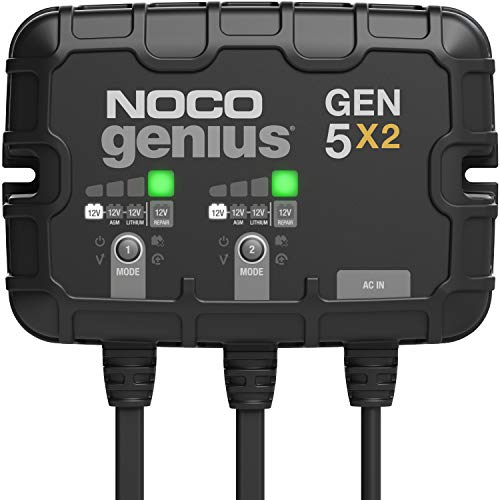
NOCO Genius GEN5X2 2 Bank
The NOCO Genius GEN5X2 is a 2 bank charger with 5 amps per bank. It is fully waterproof with an IP68 rating and supports lead acid and lithium. It includes a digital display and spark proof technology. Owners like its small footprint and dual bank flexibility.
Pros
- IP68 waterproof
- Lithium compatible
- Compact design
Cons
- Lower total amperage
- No mounting hardware included

ProMariner ProNautic 1230P
The ProMariner ProNautic 1230P is a 30 amp, three bank charger with a fully waterproof enclosure. It delivers robust power for large house banks and starting batteries. It features a digital display and programmable charge profiles. Owners report it is a workhorse for serious cruisers.
Pros
- High output for large banks
- Fully programmable
- Supports lithium
Cons
- Large and heavy
- Premium price
Side by side
| # | Model | Waterproof Rating | Best for | Score | Price |
|---|---|---|---|---|---|
| 1 | NOCO Genius GENPRO10X1 | IP68 | Best Overall for Single Battery | 9.4 | Check price |
| 2 | Battery Tender Plus 021-0128 | Splash resistant | Best Budget Simple Charger | 8.6 | Check price |
| 3 | ProMariner ProSport 12 8 Amp | IP67 | Best Dual Bank for Trolling Motors | 9.0 | Check price |
| 4 | Minn Kota MK-220D Precision Charger | IP67 | Best for Onboard Trolling Motors | 8.8 | Check price |
| 5 | Guest 2610A ChargePro 10 Amp | IP67 | Best for Three Bank House Systems | 8.9 | Check price |
| 6 | NOCO Genius GEN5X2 2 Bank | IP68 | Best Compact Dual Bank | 8.7 | Check price |
| 7 | ProMariner ProNautic 1230P | IP67 | Best for Large Marine Systems | 9.2 | Check price |
How to pick the right one
Good to know
What does IP68 mean on a marine charger?
IP68 means the charger is dust tight and can be submerged in water beyond one meter depth for a specified time. For marine chargers, it offers the highest level of protection against water ingress.
Can I use a regular battery charger on a boat?
You can, but it is not recommended. Regular chargers are not sealed against moisture and salt, which can lead to corrosion or electrical failure. Marine chargers are built with waterproof enclosures and coated circuit boards to withstand harsh conditions.
How many amps do I need for a marine battery charger?
The amperage depends on battery capacity. A good rule is to charge at 10 to 20 percent of the battery’s amp hour rating. For a 100 amp hour battery, use a 10 to 20 amp charger. Multiple batteries may require more total output.
What is the difference between a charger and a maintainer?
A charger delivers a higher current to recharge a depleted battery. A maintainer provides a low trickle charge to keep a battery topped off. Some chargers have a maintenance mode that automatically switches to float voltage.
Can these chargers charge lithium marine batteries?
Some models are specifically designed for lithium batteries, such as the NOCO Genius and ProMariner ProNautic. They have a lithium charge profile. Others only support lead acid, AGM, and gel. Always check the specs.
Is it safe to leave a waterproof marine charger connected all the time?
Yes, most smart chargers are safe to leave connected. They monitor the battery and switch to float mode. However, you should ensure the charger is properly installed and rated for continuous use. Check the manufacturer’s instructions.
How do I know if my charger is actually waterproof?
Look for an IP rating on the product label or in the specifications. The higher the number, the better the protection. Also check for sealed cases, gaskets, and conformal coated circuit boards. Some chargers are splash resistant but not fully submersible.
Can I charge multiple batteries with a single bank charger?
No, a single bank charger is designed to charge one battery. To charge multiple batteries separately, you need a multi bank charger. Parallel charging is not recommended unless the batteries are identical and properly connected.
What is the best way to mount a marine charger?
Mount it in a dry location, ideally above the bilge water level. Use corrosion resistant screws. Ensure proper ventilation to prevent overheating. Some chargers have mounting flanges. Others require an optional bracket.
Do I need a professional to install an onboard charger?
If you are comfortable working with DC wiring, you can install it yourself. However, for AC powered chargers, you must follow electrical codes. If you are unsure, have a marine electrician do the installation to avoid hazards.
The verdict
For most boaters, the NOCO Genius GENPRO10X1 is the clear winner. Its IP68 waterproof rating, smart features, and lithium support make it the most versatile and durable single bank charger. If you need to charge two batteries, the ProMariner ProSport 12 offers reliable dual bank performance at a reasonable cost. For large multi battery systems, the ProMariner ProNautic 1230P delivers the power and programmability you need. Choose based on your battery setup and charging demands.
Derek Holt
Derek has a background coaching recreational and amateur athletes and has worked the sales floor at specialty fitness retailers. He focuses on equipment durability, ergonomics and realistic use cases rather than marketing claims.