Ski Boots Built for Aggressive, Heavy Duty Skiers
Nordica Speedmachine 3 130 leads this comparison on shell rigidity and buckle durability for hard skiing. Narrow feet fit better in the Tecnica Mach1 MV 130. Backcountry days call for the Atomic Hawx Ultra XTD 130, which adds a walk mode without softening downhill flex.
Nordica Speedmachine 3 130 tops this list on shell durability alone. Tecnica Mach1 MV 130 suits a narrower foot better. Atomic Hawx Ultra XTD 130 crosses into backcountry territory without losing downhill stiffness.
Flex numbers do not predict how a boot holds up after forty days on hard pack. We compared shell material, buckle hardware and liner construction, then weighed that against owner reports of cracking, buckle failure and packed out liners.
The top picks, ranked

Nordica Speedmachine 3 130
Nordica built this boot around a Grilamid shell rated at a stiff 130 flex, aimed at skiers who load the front of the boot hard. A dual-core liner adds warmth without softening the ride. Metal buckles and a reinforced power strap survive repeated hard flexing.
Pros
- Shell resists cracking through repeated hard flexes
- Metal buckles hold adjustment across a full season
- Precise power transfer rewards aggressive turns
Cons
- Narrow last runs tight on wide feet
- Stiff flex needs a real break in period

Tecnica Mach1 MV 130
A 100mm last lets the Mach1 MV hug a narrow to medium foot without hot spots. Tecnica’s Custom Adaptive Shape liner molds around the ankle and heel for lockdown. Aluminum buckles resist bending better than the plastic hardware on lesser boots.
Pros
- Heat moldable liner improves heel hold
- Aluminum buckles resist bending under stress
- Flex stays consistent through cold temperatures
Cons
- Fit runs narrow for average to wide feet
- Weighs more than carbon reinforced competitors

Salomon S/Pro 120
Salomon widens the S/Pro’s last to 102mm, giving wider feet room without a custom punch. Coreframe construction and a single power strap balance flex response with day-long comfort. Skiers moving up from rental boots often call the fit noticeably roomier.
Pros
- Wide last fits high volume feet without modification
- Coreframe design cushions long days on snow
- Custom Shell option heat molds for a tailored fit
Cons
- Flex runs softer than true 130 rated race boots
- Buckles feel less premium than Tecnica or Nordica
Lange RX 130
Lange carries race heritage into the RX 130 through a dual-core shell tuned for high speed carving. A low volume fit keeps the foot close to the shell for direct edge feedback. Racers and former racers favor its predictable flex pattern.
Pros
- Direct energy transfer rewards hard snow days
- Flex stays predictable through the full range of motion
- Race pedigree shows up in edge hold
Cons
- Low volume fit punishes wide or high instep feet
- Firm ride tires out casual skiers on long days
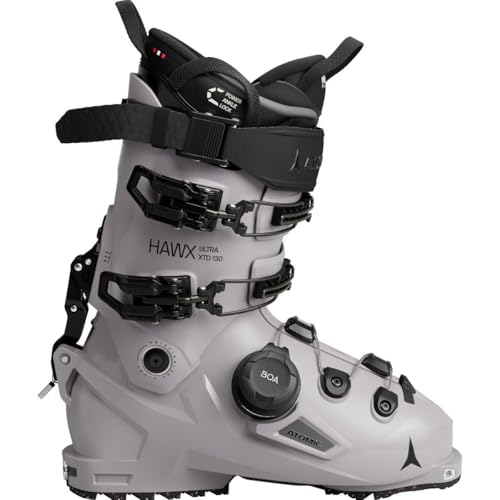
Atomic Hawx Ultra XTD 130
Atomic built the XTD 130 to ski like an alpine boot and hike like a touring boot. A walk mode lever unlocks about 54 degrees of cuff rotation for approaches. Tech inserts accept pin bindings while the shell still delivers 130 flex downhill.
Pros
- Tech inserts work with pin and alpine bindings
- Walk mode cuts the pain out of long approaches
- Downhill stiffness holds up despite the hybrid design
Cons
- Weighs more than a dedicated touring boot
- Walk mode lever adds one more part to fail over time

Head Formula 120
Head’s Formula line brings a race oriented 98mm last and 120 flex to a lower price than its top rivals. A triple injected shell balances stiffness with some forgiveness for less aggressive skiers. Aluminum buckles match the hardware on pricier boots.
Pros
- Aluminum buckles at a lower price than rivals
- Race oriented fit without the race level cost
- Triple injection reinforces the shell’s stress points
Cons
- Liner packs out faster than premium dual-core designs
- Warmth trails boots with thicker liners

Dalbello Panterra 120
Dalbello aims the Panterra 120 at all-mountain skiers who want durability without a race level price. A 100mm last suits average to slightly wide feet, and a three-piece-inspired cuff eases entry and exit. Owners report it holds buckle adjustment across multiple seasons.
Pros
- Entry and exit stay easier than tight race boots
- Buckle adjustment holds across multiple seasons
- Comfortable out of the box with less break in
Cons
- Flex feels softer than its 120 rating suggests
- Edge feedback trails the Lange or Nordica
What matters most
What makes a ski boot heavy duty Heavy duty usually means a stiffer flex rating, typically 120 to 130, paired with a reinforced shell like dual injected polyurethane or Grilamid. Metal buckles replace the plastic hardware that snaps in cold weather. Liners run thicker and often thermo mold to hold their shape through repeated hard use. Together these choices resist the cracking and packing out that budget boots show after one hard season.
How to choose the right flex rating and last width Flex rating should match skier weight, aggression and ability rather than ego. An overly stiff boot tires the legs before lunch. Last width, measured in millimeters at the forefoot, affects comfort more than any other spec. Narrow feet fit 96 to 98mm lasts, average feet suit 98 to 100mm, and wider feet need 100mm or more.
What should aggressive or expert skiers prioritize Expert and aggressive skiers benefit most from a race derived shell, dual-core construction and a low volume fit that keeps the foot close to the shell wall. Lange RX 130 and Nordica Speedmachine 3 130 favor direct energy transfer over cushioned comfort. Metal buckles and reinforced power straps matter more here, since hard flexing stresses hardware faster.
Are hybrid touring boots worth it for backcountry days A hybrid boot with a walk mode, like the Atomic Hawx Ultra XTD 130, suits skiers who split time between resort laps and backcountry approaches. Tech inserts pair the boot with pin bindings for uphill travel. Dedicated touring boots stay lighter, but a hybrid keeps downhill performance closer to a true alpine boot, which matters most for skiers who spend most days at the resort.
Compared at a glance
| # | Model | Flex rating | Best for | Score | Price |
|---|---|---|---|---|---|
| 1 | Nordica Speedmachine 3 130 | 130 | Best overall | 9.4 | Check price |
| 2 | Tecnica Mach1 MV 130 | 130 | Best for narrow feet | 9.1 | Check price |
| 3 | Salomon S/Pro 120 | 120 | Best for wide feet | 8.8 | Check price |
| 4 | Lange RX 130 | 130 | Best for aggressive skiers | 8.5 | Check price |
| 5 | Atomic Hawx Ultra XTD 130 | 130 | Best for backcountry crossover | 8.2 | Check price |
| 6 | Head Formula 120 | 120 | Best value | 8.0 | Check price |
| 7 | Dalbello Panterra 120 | 120 | Best budget | 8.0 | Check price |
Good to know
How long should heavy duty ski boots last with regular use?
A well built pair with a polyurethane or Grilamid shell typically lasts four to six seasons before flex noticeably softens or buckles wear out.
What flex rating counts as heavy duty?
Most heavy duty alpine boots fall between 120 and 130 flex, built for skiers over roughly 150 pounds who ski aggressively or at speed.
Can heavy duty ski boots be heat molded?
Most models here use a thermo moldable liner, and several offer heat moldable shells too, letting a bootfitter tailor the fit around pressure points.
Is a stiffer flex always better?
No. A flex rating beyond what a skier’s weight and technique can load does not transmit energy any better and tires the legs faster.
What is the difference between a 120 and 130 flex boot?
A 130 flex needs more force to bend forward and rewards a stronger, more forward stance. A 120 flex gives a touch more forgiveness for all-mountain skiing.
Do wide feet need a different boot than narrow feet?
Yes. Last width, measured at the forefoot, ranges from about 96mm for narrow fits to 102mm or more for wide fits across this group.
Are hybrid touring boots as stiff as alpine only boots?
Boots like the Atomic Hawx Ultra XTD 130 come close, rating 130 flex despite the added walk mode, though most riders still feel a slightly different flex underfoot.
How often should ski boot buckles be checked for wear?
Inspect buckles and the power strap at the start of each season. Repeated hard flexing loosens rivets and can crack plastic buckle housings over time.
Nordica Speedmachine 3 130 vs Tecnica Mach1 MV 130: which fits better?
Choose the Nordica for a narrower, race oriented 98mm last and maximum shell rigidity. Choose the Tecnica if your foot needs the slightly roomier 100mm last with the same 130 flex.
The verdict
Skiers loading the boot hard all season should reach for the Nordica Speedmachine 3 130, since its shell and buckles hold up best under repeated stress. Narrow feet fare better in the Tecnica Mach1 MV 130, while wide feet should look at the Salomon S/Pro 120. Anyone splitting time between resort and backcountry gets the most from the Atomic Hawx Ultra XTD 130.
Derek Holt
Derek has a background coaching recreational and amateur athletes and has worked the sales floor at specialty fitness retailers. He focuses on equipment durability, ergonomics and realistic use cases rather than marketing claims.