RV Inverters Heavy-Duty Enough to Run Your AC Unit
The Renogy 3000W 12V Pure Sine Wave Inverter Charger tops this list, combining 3000W continuous output with a built-in transfer switch and 50A charger. The Xantrex Freedom XC 2000 fits mixed loads on a tighter budget, and the BESTEK 3000W model delivers pure sine output at the lowest cost here.
Full-time RVers running a residential fridge, microwave, and CPAP machine off-grid get the most from the Renogy 3000W 12V Pure Sine Wave Inverter Charger. Its built-in transfer switch and 50A charger cut down on separate wiring for shore power and battery charging. Weight and size work against it in a camper van or truck bed setup, where a smaller standalone unit fits better.
Surge demands from compressors and motors rarely match the continuous wattage printed on the box, which trips up first-time buyers. We compared continuous and surge output, waveform type, input voltage, and owner feedback across seven current RV inverters to separate marketing numbers from usable capacity.
Before you buy
What to look for in a heavy-duty RV inverter Continuous wattage tells you what an inverter can run indefinitely, not what it can start. Surge or peak wattage matters more for compressors in air conditioners and refrigerators, since those spike briefly on startup. Battery bank voltage must match the input rating, almost always 12V DC in RV setups, while output stays at 120V AC for standard outlets. Digital displays and remote monitoring help owners catch a failing connection before it causes a shutdown, according to owner reports.
Pure sine wave vs modified sine wave Pure sine wave inverters, like the Victron Phoenix 12/3000, reproduce the same clean waveform utilities deliver to a house. Modified sine wave units cost less but distort power delivered to motors, medical devices, and audio equipment. Appliance manufacturers note that microwaves and CPAP machines can run hotter or noisier on modified sine power. Every model in this roundup uses pure sine output, reflecting how far RV electronics have shifted away from tolerating distortion.
Sizing continuous and surge wattage to your appliances Add up the running wattage of everything used at the same time, then check that total against the inverter’s continuous rating. A residential air conditioner alone can draw 1500 to 1800 running watts, plus a 3000 to 3500 watt surge at startup. That gap is why the AIMS Power PWRINV300012W, rated for 9000W surge, appeals to owners running larger rooftop units. Smaller inverters like the Xantrex Freedom XC 2000 suit rigs limited to microwaves, laptops, and phone chargers.
Installation, cooling, and battery bank sizing Heavy-duty inverters generate heat under sustained load, so the mounting location needs airflow on both sides of the chassis. Dual-fan designs, like the AIMS Power model, tolerate longer high-wattage runs than single-fan units. Battery bank capacity should scale with continuous wattage, since a 3000W inverter can pull well over 250 amps at 12V under full load. Hardwire-only models such as the Go Power! GP-SW3000-12 need a qualified installer familiar with DC wiring gauges and fusing.
What we recommend

Renogy 3000W 12V Pure Sine Wave Inverter Charger
Continuous output reaches 3000W, with a 6000W surge rating for starting compressors and motors. A built-in 50A charger and automatic transfer switch route shore power and battery charging through one unit. Live voltage, load, and charging status show on an integrated LCD display.
Pros
- Transfer switch wiring is built in, so shore power needs less setup
- LCD display tracks voltage, load, and charging status in real time
- 50A charger brings the battery bank back up quickly
Cons
- Size and weight suit a permanent mount better than portable use
- Fan noise rises noticeably under sustained heavy loads
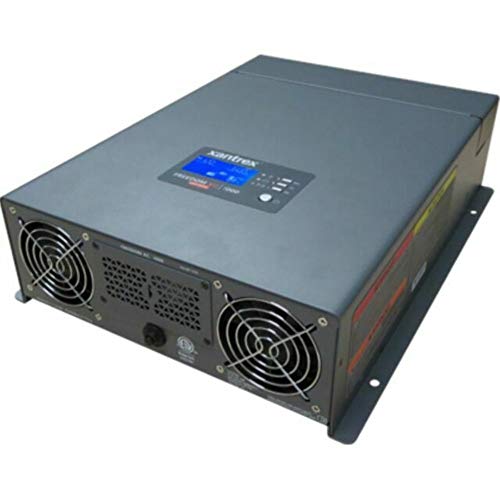
Xantrex Freedom XC 2000
A 2000W pure sine inverter pairs with a 100A charger inside one compact chassis. Continuous output covers most microwaves and power tools, and a 30A transfer switch manages shore connections without manual switching. Xantrex includes a remote monitoring panel that mounts on the dash or in a cabinet.
Pros
- 100A charger restores battery capacity faster than smaller chargers
- Compact chassis fits installation spaces too tight for larger units
- Remote panel puts monitoring within reach away from the unit
Cons
- 2000W continuous output rules out most large air conditioners
- Surge rating trails the 3000W-class models in this lineup
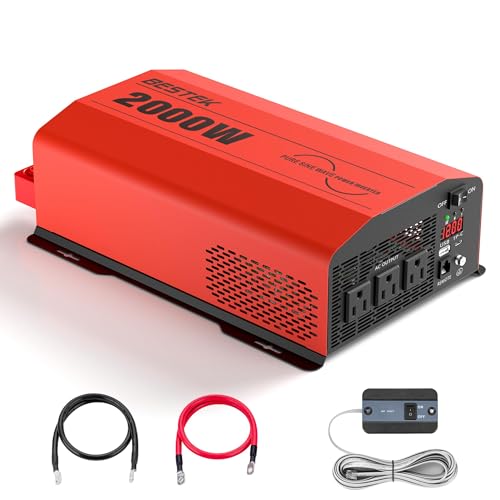
BESTEK 3000W Pure Sine Wave Power Inverter
This unit is rated at 3000W continuous with a 6000W peak surge from a 12V DC input. Two AC outlets and a USB port run laptops, chargers, and small appliances at the same time. A wired remote switches it on without a trip to the mounting location.
Pros
- Pure sine output comes at a lower entry cost than most rivals
- A wired remote control ships in the box
- Two AC outlets plus USB cover several small devices at once
Cons
- No built-in battery charger or transfer switch is included
- The cooling fan runs loud close to maximum load

Victron Energy Phoenix Inverter 12/3000
Continuous output sits at 2400W, with a 6000VA surge rating and under 5 percent total harmonic distortion. Owners cite its clean sine wave as reliable for CPAP machines, medical equipment, and audio gear. Output voltage and low-battery cutoffs adjust through Victron’s Connect app.
Pros
- Very low harmonic distortion protects sensitive electronics
- VictronConnect app enables remote configuration and monitoring
- Installers report consistent long-term reliability with this line
Cons
- Cost per watt runs higher than comparable models here
- This specific model skips an integrated battery charger

Go Power! GP-SW3000-12
Go Power! built this inverter for solar-equipped RVs, matching 3000W continuous output to a 12V DC input common on solar battery banks. Hardwire terminal blocks replace standard outlets for permanent installations. Go Power! designs it to pair with its own solar charge controllers and panels.
Pros
- Voltage and wiring match Go Power! solar kit conventions
- Hardwire terminals suit permanent off-grid installations
- 3000W continuous output covers most residential appliances
Cons
- Hardwire-only output means there are no plug-in outlets
- Installation calls for more electrical wiring knowledge

AIMS Power 3000 Watt Power Inverter (PWRINV300012W)
AIMS rates this model at 3000W continuous with a 9000W surge, among the highest surge headroom in this group. Dual internal cooling fans manage heat during sustained loads from air conditioners and compressors. A remote on/off port lets owners mount the control switch near the driver’s seat.
Pros
- 9000W surge handles hard-starting AC compressors with room to spare
- Dual fans manage heat through extended high-load runs
- Remote on/off port allows dashboard-accessible control
Cons
- The larger chassis needs more mounting clearance
- Higher surge draw pulls batteries down faster

Krieger KR3000 12V Power Inverter
This inverter delivers 3000W continuous and 6000W peak output from a 12V DC battery input, with two AC outlets and two USB ports. Krieger includes a hardwire kit alongside the standard outlets for flexible mounting. Lower idle draw suits boondockers who leave the inverter running overnight.
Pros
- Low idle power draw extends battery life while boondocking
- Both standard outlets and a hardwire kit are included
- Two USB ports charge devices without a separate adapter
Cons
- No built-in charger is available for shore power charging
- Remote control is sold as a separate accessory
Side by side
| # | Model | Continuous Output | Best for | Score | Price |
|---|---|---|---|---|---|
| 1 | Renogy 3000W 12V Pure Sine Wave Inverter Charger | 3000W | Best overall | 9.4 | Check price |
| 2 | Xantrex Freedom XC 2000 | 2000W | Best value | 9.2 | Check price |
| 3 | BESTEK 3000W Pure Sine Wave Power Inverter | 3000W | Best budget | 9.0 | Check price |
| 4 | Victron Energy Phoenix Inverter 12/3000 | 2400W | Best for pure sine wave and sensitive electronics | 8.8 | Check price |
| 5 | Go Power! GP-SW3000-12 | 3000W | Best for solar setups | 8.5 | Check price |
| 6 | AIMS Power 3000 Watt Power Inverter (PWRINV300012W) | 3000W | Best for large appliances and AC units | 8.2 | Check price |
| 7 | Krieger KR3000 12V Power Inverter | 3000W | Best for boondocking | 8.0 | Check price |
Common questions
What size inverter do I need to run RV air conditioning?
Most rooftop RV air conditioners need at least 2000W continuous and 3000 to 3500W surge capacity to start the compressor. A 3000W inverter like the Renogy or Krieger model here covers a single AC unit with headroom for smaller appliances running alongside it.
Is a pure sine wave inverter worth it for an RV?
Pure sine wave protects sensitive electronics, microwaves, and medical devices from the distortion modified sine units introduce. Owners running CPAP machines or audio equipment report fewer issues with pure sine models such as the Victron Phoenix 12/3000.
Pure sine wave vs modified sine wave inverter, which is better for RVs?
Pure sine wave suits modern RVs with variable-speed compressors, microwaves, and USB electronics that expect clean AC power. Modified sine wave still works for simple resistive loads like incandescent lights, but it shows up rarely in current RV inverter listings.
Can I run a microwave and AC at the same time on a 3000W inverter?
A microwave typically draws 1000 to 1200 running watts, leaving limited headroom on a 3000W unit if a 1500W air conditioner runs at the same time. Staggering appliance use, or choosing a higher-surge model like the AIMS Power PWRINV300012W, lowers the risk of tripping the inverter.
What’s the difference between an RV inverter and a converter?
A converter changes incoming 120V AC shore power into 12V DC to charge batteries and run DC circuits. An inverter does the reverse, turning stored 12V DC battery power into 120V AC for outlets, which is why boondockers need both working together.
How many batteries do I need for a 3000W inverter?
A 3000W inverter running at full continuous load can pull over 250 amps from a 12V bank, so most owners pair it with at least 200 to 400 amp-hours of lithium or AGM capacity. Actual runtime depends on which appliances draw power and for how long.
Do heavy-duty inverters drain RV batteries fast when idle?
Idle or standby draw varies by model, and units without automatic low-power modes can drain a battery bank over several days even with no load connected. Owners of models like the Krieger KR3000 report lower idle draw, which helps during extended boondocking.
What’s the best RV inverter for boondocking?
Boondockers benefit from low idle draw, solar compatibility, and enough surge capacity for occasional AC use without a shore connection. The Krieger KR3000 and Go Power! GP-SW3000-12 both suit that use case, though they differ in wiring, hardwire versus standard outlets.
How does surge wattage affect which inverter I should buy?
Surge wattage covers the brief spike a motor or compressor draws at startup, often double the continuous rating. A unit rated 3000W continuous but only 6000W surge may struggle with a hard-starting rooftop AC compared to the AIMS Power model at 9000W surge.
The bottom line
The Renogy 3000W 12V Pure Sine Wave Inverter Charger earns the top spot for full-time RVers, since it bundles a transfer switch and 50A charger into one installation. Owners chasing the cleanest possible waveform for medical or audio equipment should choose the Victron Energy Phoenix Inverter 12/3000 instead. Boondockers on a tighter budget still get pure sine output and dual USB charging from the Krieger KR3000.
Tony Russo
Tony trained as an automotive technician and spent years in service and parts retail before moving into writing. He focuses on garage tools, car care products and accessories from a hands-on maintenance perspective.