8 Heavy Duty Paddleboards That Handle Rocky Shorelines
NIXY Newport Wood Inflatable Paddle Board offers the strongest build and highest rated capacity among heavy duty boards. iROCKER All Around matches that durability for less. Retrospec Weekender 4 suits tighter budgets without giving up rigidity or D-ring mounts.
NIXY Newport Wood, iROCKER All Around and Retrospec Weekender 4 lead this roundup for paddlers who need more than a standard recreational board. Each lists a higher weight capacity, uses a thicker drop-stitch core and adds reinforced rails for choppy water and extra cargo.
Finding a board that resists flexing under extra weight is tricky, since heavy duty rarely maps to one fixed spec. This comparison weighs listed capacities, PSI ratings, core thickness and owner feedback on tracking and rigidity to narrow the field to seven boards worth considering.
What to look for
What makes a paddleboard heavy duty? Manufacturers use the term loosely, so specs matter more than the label. A thicker drop-stitch core, usually 6 inches, resists flexing under load better than a thinner 4-inch core. Double-layer PVC construction along the rails adds stiffness where boards typically bow first. Higher recommended PSI, often 15 or above, also signals a firmer, more load-bearing build.
How do you choose the right weight capacity? Match rated capacity to total load, not just rider weight. Add the paddler, a dry bag, a cooler and a dog or child before comparing numbers. Boards that perform best near their rated limit tend to have double-layer rails or reinforced seams. Staying near 70 percent of listed capacity keeps handling predictable in wind or chop.
Which board suits touring, fishing or tandem paddling? Touring boards favor a tapered nose for glide across longer distances on flat water. Fishing setups need extra D-rings and a wider stance for stability while casting or reeling. Tandem paddling calls for width over length, since two riders need lateral room more than added glide. Matching the board to its primary use matters more than chasing the single highest capacity number.
How do you care for a heavy duty inflatable board? Rinsing the deck and valve area with fresh water after saltwater sessions prevents salt buildup around seams. Storing the board partially deflated in its bag, rather than fully inflated in direct sun, extends its life. Checking PSI before each outing matters, since inflatable cores lose pressure gradually over weeks of storage. Inspecting D-rings and seams periodically catches the wear that heavier loads cause first.
The best picks, ranked

NIXY Newport Wood Inflatable Paddle Board
A dual-layer PVC drop-stitch core pairs with a wood-grain deck pad for extra grip when hauling gear. Owners cite minimal flex even near the top of its rated capacity. A full-length bungee area and six D-rings keep dry bags and coolers secured on longer paddles.
Pros
- Stays rigid at recommended PSI
- Wood-grain deck pad adds traction
- Six D-rings for cargo and accessories
Cons
- Heavier to carry once fully packed
- Costs more than entry-level boards

iROCKER All Around 11′ Inflatable SUP
Military-grade PVC and a single-layer drop-stitch core give this board a higher rated capacity than most in its price range. A reinforced tail and nose bumper limit wear from dock landings. Reviewers note stable tracking even loaded with a paddler and a dog.
Pros
- High capacity for the price
- Reinforced nose and tail bumpers
- Includes an aluminum adjustable paddle
Cons
- Wider deck slows turning
- Bag adds bulk for storage

Retrospec Weekender 4 Inflatable Paddle Board
Retrospec’s fourth-generation Weekender keeps its drop-stitch core thick enough for occasional heavier loads without pushing the price up. A removable center fin and EVA deck pad cover most of the standing area. Lakes and calm rivers suit it better than open chop.
Pros
- Lower cost than most rivals here
- Full EVA deck pad
- Backpack-style carry bag included
Cons
- Lower capacity than other picks
- Less rigid in choppy water
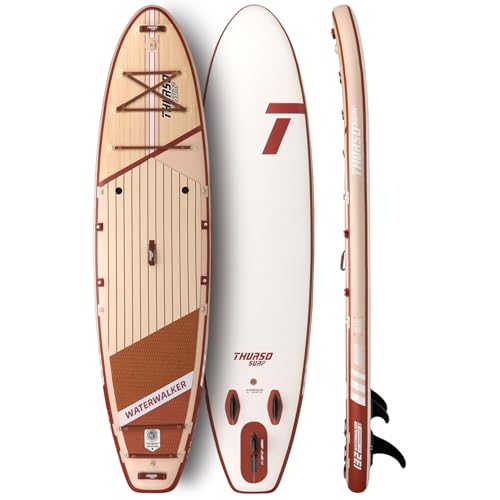
Thurso Surf Waterwalker 132 Paddle Board
At 132 inches long with a wide deck, this board suits taller paddlers who outgrow shorter all-around boards. Double-layer rail construction adds stiffness along the sides. Owners report solid tracking on flat lakes and coastal bays with light chop.
Pros
- Longer deck fits taller riders
- Reinforced double-layer rails
- Comes with a repair kit and pump
Cons
- Longer profile is harder to store
- Tracks less nimbly than shorter boards

Atoll 11’0″ Inflatable Stand Up Paddle Board
Longer outings favor this board’s tapered nose, which helps maintain glide across flat water. A raised standing area near the center keeps footing dry compared to flush decks. Bungee storage at both ends holds extra water and gear for full-day trips.
Pros
- Tapered nose improves glide over distance
- Bungee storage at nose and tail
- Includes a repair kit and gauge pump
Cons
- Less maneuverable than shorter all-around boards
- Takes longer to inflate at recommended PSI

SereneLife Inflatable Stand Up Paddle Board SLSUPB50
Extra D-rings along the rails make it easy to mount rod holders or additional tie-down straps. A wider stance improves balance when casting or reaching for gear. A removable fin setup lets paddlers adjust for shallow fishing spots.
Pros
- Extra D-rings for fishing accessories
- Wide stance improves casting balance
- Removable fin for shallow water
Cons
- Lower capacity than touring-focused boards
- No dedicated rod holder included

Gili Sports Adventure 11′ Inflatable SUP
A 34-inch width gives two paddlers room to sit or kneel without crowding the deck. Front and rear bungee zones keep gear separate from passenger space. Owners note the extra width adds stability but reduces top-end speed compared to narrower boards.
Pros
- 34-inch width fits two riders
- Separate bungee zones front and rear
- High rated capacity for tandem loads
Cons
- Extra width slows paddling speed
- Bulkier to carry solo
How they compare
| # | Model | Length | Best for | Score | Price |
|---|---|---|---|---|---|
| 1 | NIXY Newport Wood Inflatable Paddle Board | 11’6″ | Best overall | 9.4 | Check price |
| 2 | iROCKER All Around 11′ Inflatable SUP | 11’0″ | Best value | 9.1 | Check price |
| 3 | Retrospec Weekender 4 Inflatable Paddle Board | 10’6″ | Best budget | 8.8 | Check price |
| 4 | Thurso Surf Waterwalker 132 Paddle Board | 132 inches | Best for taller and heavier riders | 8.6 | Check price |
| 5 | Atoll 11’0″ Inflatable Stand Up Paddle Board | 11’0″ | Best for touring | 8.4 | Check price |
| 6 | SereneLife Inflatable Stand Up Paddle Board SLSUPB50 | 10’6″ | Best for fishing | 8.2 | Check price |
| 7 | Gili Sports Adventure 11′ Inflatable SUP | 11’0″ | Best for tandem paddling | 8.0 | Check price |
Frequently asked questions
What weight capacity should a heavy duty paddleboard have?
Look for at least 300 pounds of rated capacity for solo use with gear, and 400 pounds or more for tandem paddling or fishing setups with extra equipment.
How thick should a heavy duty inflatable SUP be?
Most heavy duty boards use a 6-inch drop-stitch core. Thinner 4 to 4.75-inch cores still work for lighter loads but flex more under extra weight.
Can a heavy duty paddleboard handle two riders?
Yes. Boards like the Gili Sports Adventure, with a 34-inch width and capacity above 400 pounds, are built specifically for tandem loads.
Is a heavy duty paddleboard worth it for casual paddling?
It depends on typical load. Casual solo paddlers without gear may not need the extra capacity, but anyone bringing a cooler, dog or child benefits from the added rigidity.
Which handles rough water better, an inflatable or a hard paddleboard?
Hard boards generally track straighter in chop, but double-layer inflatable boards with high PSI ratings hold up well for most recreational rough-water paddling.
Does higher PSI make a paddleboard more durable?
Higher recommended PSI usually means a firmer core, which reduces flex and improves handling under load, though it does not replace quality rail construction.
How do you carry a heavy duty inflatable paddleboard?
Most come with a backpack-style bag once deflated and rolled. Fully assembled boards are best moved short distances using the built-in center carry handle.
What is the difference between a heavy duty and a standard paddleboard?
Heavy duty boards typically use thicker drop-stitch cores, double-layer rails and higher rated weight capacities. Standard boards prioritize lighter weight and lower cost over load handling.
Final word
NIXY Newport Wood stands out for paddlers who want the highest build quality and capacity in one board. iROCKER All Around delivers similar durability for less, while Retrospec Weekender 4 fits tighter budgets. Matching capacity and width to actual use, whether touring, fishing or tandem paddling, matters more than chasing the single highest number.
Derek Holt
Derek has a background coaching recreational and amateur athletes and has worked the sales floor at specialty fitness retailers. He focuses on equipment durability, ergonomics and realistic use cases rather than marketing claims.