Jump starters built for mechanics and big diesels
NOCO Boost Pro GB150 leads at 3000 peak amps, rated for gas and diesel engines up to 10 litres. Clore Jump-N-Carry JNC660 stays on its charger, so a busy bay never waits for a cooldown. GOOLOO GT4000S pushes 4000 peak amps at stubborn diesel pickups and tractors.
NOCO Boost Pro GB150 belongs in a service truck, with 3000 peak amps and a 10 litre diesel rating. Mobile technicians cover cars, vans and heavy pickups from one pack. Recharging from empty is slow, so a bay jumping twenty vehicles a day is better served by the Clore JNC660.
Peak amps get quoted loudest and mean the least, since that figure lasts a fraction of a second. Cranking amps, cable gauge and jaw size decide whether a cold diesel turns over. We compared engine displacement ratings, conductor size, recharge times and port selection. Owner feedback from shops and roadside technicians filled in the rest.
How to choose
How to read peak amps, cranking amps and engine ratings Peak amps describe a burst lasting a fraction of a second. Cranking amps, listed as 425 on the JNC660, describe sustained output and predict real starting ability. Most useful of all is the engine displacement rating, because the maker has already done that translation. Match the rating to the largest engine you expect to meet. Add margin for winter, since a battery near minus ten loses a large share of its available current.
Lithium vs lead acid for shop and roadside work Lithium packs weigh a few pounds, slide into a tool bag and hold charge for months. Lead acid boosters such as the JNC660 and DXAEJ14 weigh far more, yet they live on a charger and start vehicle after vehicle. Duty cycle decides the answer. Six calls spread across a day suits lithium. Constant jumps in a fixed bay suit a lead acid unit plugged in by the door. Plenty of shops keep one of each.
Clamps, cable gauge and reaching awkward batteries Thin conductors drop voltage exactly when the starter demands it. Number 2 AWG sets the benchmark here, and 68 inches of it reaches a battery hidden behind a wheel well. Compact packs ship with much shorter leads, which leaves the unit balanced on an engine cover. Jaw size matters as well. Side post terminals and corroded posts defeat small clamps, so carry terminal adapters. Wire brush the post first when a clamp refuses to bite.
What matters most on a mobile service call Manual override on the NOCO packs pushes current into a battery the unit cannot detect, common on a vehicle parked for months. USB-C power delivery on the GOOLOO GT4000S refills the pack quickly and runs a scan tool. DEWALT adds a 120 PSI compressor, which earns its weight the first time a dead battery arrives with a soft tyre. Working in a bay with shop air? Skip the compressor and spend on cable length instead.
The best picks, ranked

NOCO Boost Pro GB150 Jump Starter
Rated to 10 litres in both gas and diesel, so one pack covers a four cylinder commuter and a work truck. Heavy jaws and thick cables take repeated starts, and spark proof reverse polarity protection earns its keep in the dark. Manual override forces current into a battery too flat for the unit to detect.
Pros
- Cranks 10 litre diesels that stall smaller lithium packs
- Manual override works below normal detection voltage
- Built in work light offers several brightness modes
Cons
- Refilling from empty takes hours on a standard charger
- Heaviest lithium pack here at about 7 lb
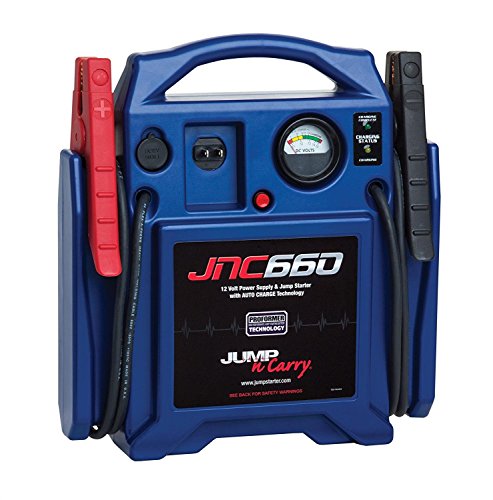
Clore Automotive Jump-N-Carry JNC660 Jump Starter
Lead acid internals sit on a charger between jobs, so the next start never waits for a cooldown. Cables run 68 inches in number 2 gauge, long enough to reach a battery box behind a cab. Industrial clamps bite through corrosion that stops pocket sized jaws.
Pros
- Lives on charge and stays ready between jobs
- Number 2 gauge leads reach awkward battery locations
- Jaws grip corroded posts and side terminals
Cons
- About 18 lb, far heavier than any lithium rival
- No USB output for phones or scan tools
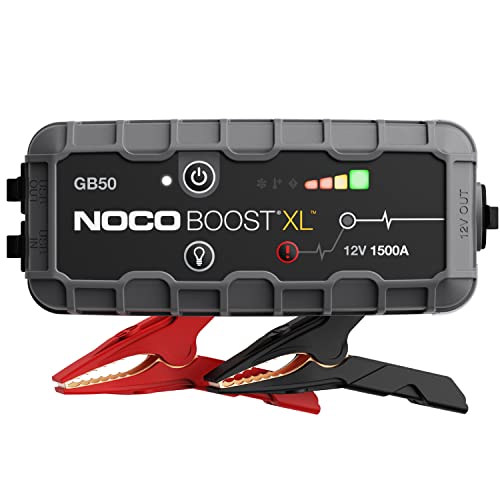
NOCO Boost HD GB70 Jump Starter
Covers gas engines to 8 litres and diesels to 6, which matches most vans and light trucks on a callout list. Weight drops to roughly 5 lb, so it rides in a door pocket rather than the footwell. Clamps and the safety circuit carry over from the GB150.
Pros
- Handles the vast majority of light duty callouts
- Slips into a tool bag or door pocket
- Same reverse polarity protection as the flagship
Cons
- Diesel rating stops at 6 litres
- Leads are shorter than the JNC660 cables

GOOLOO GT4000S Jump Starter
Peak output hits 4000 amps, aimed at diesel pickups, tractors and equipment that defeat 2000 amp packs. USB-C runs both ways, so the unit refills quickly and can feed a scan tool or laptop. Clamp hardware feels lighter than NOCO gear, so inspect the jaws now and then.
Pros
- Highest peak current in this group for stubborn diesels
- USB-C refills far faster than a barrel plug
- Powers shop electronics between starts
Cons
- Clamps and cables feel lighter than the NOCO units
- Case takes more room than its capacity suggests

HULKMAN Alpha 85 Jump Starter
Refilling takes about 90 minutes from a 65 watt supply, which keeps one pack working across a long call list. A colour screen reports charge level, output status and fault codes instead of a row of LEDs. Engine limits sit at 8.5 litres gas and 6 litres diesel.
Pros
- Quickest turnaround of the lithium packs listed
- Screen shows charge level and fault codes clearly
- Clamps go live only on a correct connection
Cons
- Quoted 1.5 hour recharge needs a 65W charger
- Display draws standby power during storage

DEWALT DXAEJ14 Portable Power Station Jump Starter
An onboard compressor reaches 120 PSI, turning one roadside stop into a battery and tyre fix. Lead acid internals supply 1400 peak amps and 700 instant starting amps, enough for cars and half ton trucks. Bulk keeps this one in the van rather than a tool bag.
Pros
- Compressor removes a second tool from the van
- Holds charge between calls when left on a maintainer
- Case survives life in a truck bed
Cons
- 1400 peak amps is the lowest figure here
- Awkward to carry more than a few metres

Schumacher SL1639 Lithium Jump Starter and Power Pack
Backup duty suits this pack best, with 1000 peak amps for cars and small four or six cylinder trucks. Around 2 lb, it lives in a glovebox without stealing usable space. USB output and an LED light cover the other roadside basics.
Pros
- Small enough to stay in a glovebox permanently
- Reverse polarity alarm sounds before output goes live
- Cheapest way to cover a light vehicle fleet
Cons
- Peak output falls short of any large diesel
- Short leads force careful placement on the engine
How they stack up
| # | Model | Peak amps | Best for | Score | Price |
|---|---|---|---|---|---|
| 1 | NOCO Boost Pro GB150 Jump Starter | 3000 | Best overall | 9.4 | Check price |
| 2 | Clore Automotive Jump-N-Carry JNC660 Jump Starter | 1700 | Best for a professional shop | 9.2 | Check price |
| 3 | NOCO Boost HD GB70 Jump Starter | 2000 | Best value | 9.0 | Check price |
| 4 | GOOLOO GT4000S Jump Starter | 4000 | Best for large diesel engines | 8.8 | Check price |
| 5 | HULKMAN Alpha 85 Jump Starter | 2000 | Best for fast recharging | 8.6 | Check price |
| 6 | DEWALT DXAEJ14 Portable Power Station Jump Starter | 1400 | Best with a built-in air compressor | 8.3 | Check price |
| 7 | Schumacher SL1639 Lithium Jump Starter and Power Pack | 1000 | Best budget | 8.0 | Check price |
Good to know
How many amps do I need to jump start a diesel truck?
Shop by displacement rating rather than a peak amp figure. A 6 to 8 litre diesel wants the NOCO GB150 or the GOOLOO GT4000S. Sub freezing starts need that extra margin.
Is a lithium jump starter strong enough for professional use?
Yes for mobile work, where starts are spread through the day and weight matters. Back to back jumps drain the pack faster than it recharges. High volume bays keep a lead acid booster on a charger instead.
NOCO GB150 vs Clore JNC660: which suits a working mechanic?
GB150 wins on portability and engine range, covering 10 litre diesels in about 7 lb. JNC660 wins on duty cycle, 68 inch cables and clamp strength. Many shops run both for that split.
Which jump starter is best for a mobile mechanic?
Coverage per pound points to the NOCO GB70 for daily callouts, with the GB150 reserved for heavy equipment. HULKMAN Alpha 85 fits anyone running a packed schedule, thanks to the 90 minute refill. Roadside work with tyre calls favours the DEWALT DXAEJ14.
Can a jump starter damage vehicle electronics?
Reverse polarity and spark protection block the usual causes. Damage comes from connecting backwards or using an unprotected unit. Follow the manual sequence and ground away from the battery.
How long does a jump starter hold its charge in a truck?
Lithium packs usually stay usable for several months, though cold shortens that window. Lead acid boosters self discharge faster and want a maintainer. Check any unit monthly if it lives in a vehicle.
What does an engine displacement rating actually tell you?
It names the largest engine the maker expects the unit to start, such as 10 litres of diesel on the GB150. Cranking current and internal resistance are already baked into that number. Shop by it first.
Will a jump starter work on a completely dead battery?
Many packs refuse to output anything without detecting battery voltage first. NOCO solves that with a manual override that forces power through. Lacking override, reach for a charger before the booster.
Is a jump starter with an air compressor worth it?
Worth it for roadside work, where a soft tyre is as likely as a flat battery. DEWALT DXAEJ14 covers both at a real weight penalty. Inside a bay with shop air, that compressor is dead weight.
Our pick
Buy the NOCO Boost Pro GB150 for mobile work. 3000 peak amps and a 10 litre diesel rating cover almost every callout from one bag. A fixed bay jumping vehicles all day should take the Clore JNC660 instead, since it charges between jobs and never needs a rest. Keep the Schumacher SL1639 in a personal car as a backup, not as the tool a paying job depends on.
Tony Russo
Tony trained as an automotive technician and spent years in service and parts retail before moving into writing. He focuses on garage tools, car care products and accessories from a hands-on maintenance perspective.