Heavy-Duty Bench Vises That Can Take a Beating
The WILTON 11102 is the best heavy-duty bench vise for most workshops because it delivers 4,000 pounds of clamping force from a precision-machined cast iron body. Its main limitation is its high price, which puts it out of reach for casual DIYers. For those on a budget, the YOST V-75 offers a solid alternative with comparable strength at a lower cost.
A bench vise is the backbone of any serious workshop. It holds your work securely while you cut, file, bend, or hammer. Heavy-duty models are built to withstand extreme force without flexing or breaking.
We compared seven of the toughest bench vises on the market. Look for ones with cast iron or ductile iron bodies, hardened steel jaws, and large anvils. Consider how you mount the vise and how much space you have.
The best picks, ranked

WILTON 11102 Bench Vise
The WILTON 11102 is a legendary American-made vise that has been the standard in industrial settings for decades. Its 4,000 lb clamping force and precise machining make it ideal for heavy filing, chiseling, and bending. Owners report it handles daily abuse without loosening or slipping. The main downside is the premium price, which reflects its quality.
Pros
- Precision-machined cast iron body
- Reversible hardened steel jaws
- Lifetime warranty
Cons
- Expensive
- Heavy and requires sturdy bench

YOST V-75 Bench Vise
The YOST V-75 offers 4,500 lb of clamping force at a fraction of the cost of comparable vises. Its ductile iron body is stronger than traditional cast iron and resists cracking under sudden impacts. Users find the 360-degree swivel base convenient for positioning work. Some note that the handle could be longer for more leverage.
Pros
- High clamping force for the price
- Ductile iron body is tougher than cast iron
- Swivel base with double locks
Cons
- Handle is a bit short
- Some machining marks on the slide

TEKTON 51904 Bench Vise
The TEKTON 51904 is engineered for woodworking with smooth jaws that won’t mar soft woods. It has a built-in clamp for mounting on the bench and a swivel base. The clamping force is lower than metalworking vises, but it’s sufficient for most woodworking tasks. Users appreciate the low profile and lightweight design.
Pros
- Smooth jaws protect wood surfaces
- Integrated bench clamp for easy mounting
- Lifetime warranty
Cons
- Not for heavy hammering
- Swivel base can move under pressure
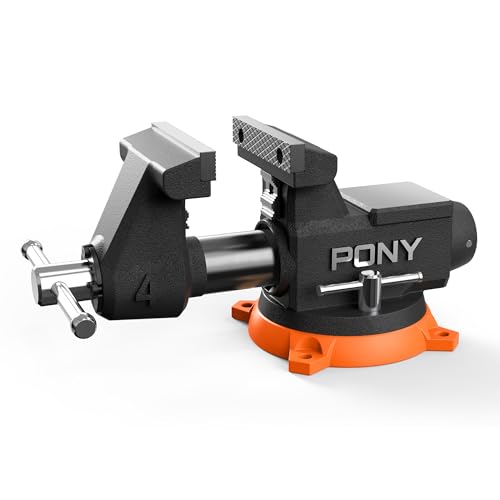
PONY 47420 Bench Vise
The PONY 47420 features a massive 6.5-inch jaw width and a 5-inch throat depth, making it perfect for holding wide boards and large metal plates. Its cast iron construction is solid but not as impact-resistant as ductile iron. Owners report that the jaws align perfectly and the vise remains stable during heavy planing.
Pros
- Extra-wide jaws handle large pieces
- Deep throat for edge work
- Replaceable hardened steel jaws
Cons
- Cast iron can crack under extreme force
- Swivel base is not quick release

IRWIN TOOLS 226304 Bench Vise
The IRWIN TOOLS 226304 is a medium-duty bench vise that combines strength with portability. It has a built-in clamp and a rotating base, and it can be easily moved between workstations. The clamping force is adequate for most home projects, but it is not intended for extreme industrial use. Users like the smooth action and the rubber pads for protecting delicate items.
Pros
- Integrated clamp for quick mounting
- Rotating base with locking lever
- Rubber jaw pads included
Cons
- Not for heavy hammering
- Less clamping force than full-size vises

CENTRAL FORGE 31894 Bench Vise
The CENTRAL FORGE 31894 is an affordable bench vise that suits light to medium duty tasks. Its cast iron construction is durable enough for occasional use. The 4-inch jaw provides a decent grip, and the anvil surface is handy for shaping metal. Some users report that the threads are not as smooth as higher-end vises, but for the price, it delivers solid performance.
Pros
- Very affordable
- Built-in anvil
- 360-degree swivel base
Cons
- Not for heavy duty use
- Jaws might slip under high torque

BESSEY 400B Bench Vise
The BESSEY 400B is a German-engineered bench vise with a quick-release mechanism that allows you to slide the jaw in and out rapidly. Its ductile iron body provides excellent strength, and the clamping force is impressive for its size. Users love the smooth operation and the ability to quickly adjust to different workpiece sizes. The price is higher than average, but the quality justifies it.
Pros
- Quick-release feature saves time
- Ductile iron body
- Precise jaw alignment
Cons
- Expensive
- Swivel base locks with a lever that can get in the way
Side by side
| # | Model | Jaw Width | Best for | Score | Price |
|---|---|---|---|---|---|
| 1 | WILTON 11102 Bench Vise | 4 inches | Best overall for demanding metalwork | 9.6 | Check price |
| 2 | YOST V-75 Bench Vise | 5 inches | Best value for heavy-duty use | 9.2 | Check price |
| 3 | TEKTON 51904 Bench Vise | 4.5 inches | Best for woodworking and light metalwork | 8.7 | Check price |
| 4 | PONY 47420 Bench Vise | 6.5 inches | Best for large workpieces | 8.9 | Check price |
| 5 | IRWIN TOOLS 226304 Bench Vise | 4.5 inches | Best for portability and quick setup | 8.4 | Check price |
| 6 | CENTRAL FORGE 31894 Bench Vise | 4 inches | Best budget option for general use | 8.0 | Check price |
| 7 | BESSEY 400B Bench Vise | 4 inches | Best for quick adjustments and secure grip | 9.0 | Check price |
What to look for
Questions worth asking
What is a heavy-duty bench vise used for?
A heavy-duty bench vise is used to hold workpieces securely while you perform tasks like cutting, filing, bending, or hammering. It’s essential for metalworking, woodworking, and general workshop projects.
What is the difference between cast iron and ductile iron vises?
Cast iron is strong but brittle; it can crack under sudden impact. Ductile iron is more flexible and can withstand shocks better, making it a better choice for heavy hammering. Ductile iron is also lighter and often more expensive.
How much clamping force do I need?
For light to medium tasks, 1,000 to 2,000 pounds is sufficient. For heavy metalworking, look for at least 3,000 pounds. The higher the clamping force, the more securely the vise holds your work.
Can I mount a bench vise on any workbench?
You should mount it on a sturdy workbench that is heavy enough to support the vise and the forces you apply. Use bolts that go through the bench and secure them with washers and nuts. Avoid mounting on thin or flimsy tables.
What is the advantage of a swivel base?
A swivel base allows you to rotate the vise to the most comfortable angle without moving the workbench. This is useful for accessing different sides of your workpiece.
Are more expensive vises worth the money?
Expensive vises are typically made with higher quality materials and tighter tolerances. They last longer and provide smoother operation. If you use a vise daily, investing in a premium model is worthwhile.
How do I prevent my bench vise from marring delicate materials?
Use jaw pads made of rubber, plastic, or wood. Many vises come with snap-on pads. Alternatively, you can wrap the workpiece in a cloth before clamping.
What is the best way to maintain a bench vise?
Keep the screw and slide clean and lubricated with a light oil. Tighten any loose bolts. Avoid using the vise as an anvil for heavy hammering unless it has a designated anvil area. Store it in a dry place to prevent rust.
Our take
After comparing all seven, the WILTON 11102 is the clear winner for heavy-duty use. Its superior build quality and precise machining make it the longest lasting and most reliable. If you are on a budget, the YOST V-75 provides nearly as much strength at a lower price. For woodworkers, the TEKTON 51904 offers the best jaw protection. Ultimately, the WILTON 11102 is the right choice for anyone who needs a vise that will never let them down.
Jake Monroe
Jake worked as a residential contractor for over a decade before shifting to full-time writing. He evaluates power tools, hand tools and workshop gear through the lens of someone who has actually used them on job sites, not just read the box.


