Heavy-Duty Bench Grinders That Can Take a Beating
The top pick is the Jet JBG-8B, an 8-inch grinder with a 1-horsepower motor that delivers smooth starts and low vibration, ideal for professional shops; its main limitation is the hefty price tag.
Bench grinders are workhorses in any workshop, but heavy-duty models are in a league of their own. Whether you are sharpening lathe tools, deburring metal, or reshaping stock, a robust grinder saves time and frustration.
This roundup focuses on machines that can handle continuous use without bogging down. We looked at motor power, wheel size, build quality, and safety features to bring you the best options for serious DIYers and professionals.
What matters most
Our top picks

Jet JBG-8B 8-Inch Bench Grinder
The Jet JBG-8B is a powerhouse with a 1-HP motor that starts smoothly thanks to its capacitor start. It runs quietly and with minimal vibration, making precise work easier. The cast iron base adds stability, and the adjustable tool rests and eye shields are sturdy. Owners report it handles heavy grinding without overheating.
Pros
- Smooth start and low vibration
- Powerful motor for heavy tasks
- Stable cast iron construction
Cons
- Heavy and bulky
- Premium price

DeWalt DW756 6-Inch Bench Grinder
The DeWalt DW756 offers a 5/8-HP induction motor that delivers consistent power and durability. Its 6-inch wheels are ideal for general shop use. The grinder features a 3-year warranty and a reliable design that stands up to daily wear. Users appreciate its quiet operation and easy wheel changes.
Pros
- Reliable induction motor
- Compact and portable
- Backed by 3-year warranty
Cons
- Smaller wheels than others
- No built-in light

Baldor 522 8-Inch Bench Grinder
The Baldor 522 is built like a tank, with a 1-HP motor and cast iron housing that withstands years of abuse. It is a favorite in industrial settings for its reliability and smooth performance. The grinder includes adjustable tool rests and spark deflectors. Owners say it is worth the investment for those who need a machine that never quits.
Pros
- Exceptional build quality
- Slow speed reduces heat buildup
- Smooth and quiet operation
Cons
- Very expensive
- Heavy to mount
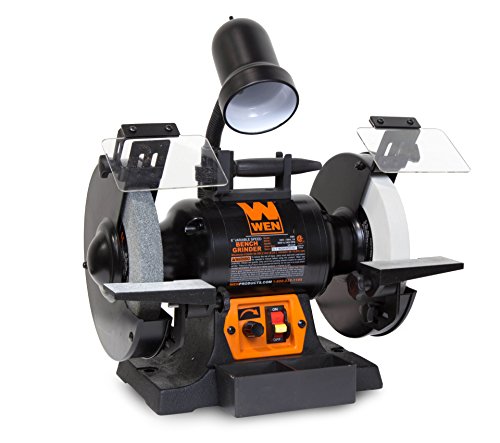
WEN 4288 8-Inch Variable Speed Grinder
The WEN 4288 offers variable speed from 2,000 to 3,400 RPM, allowing you to match speed to the task. Its 5.5-amp motor provides ample power for most jobs. The grinder includes a work light and a built-in quench tray. Users find the speed adjustment useful for sharpening different tools.
Pros
- Variable speed for versatility
- Integrated work light
- Affordable price
Cons
- Not as powerful as others
- Some plastic parts

Metabo 8-Inch Bench Grinder
The Metabo (formerly Hitachi) grinder features a 6.2-amp motor and a robust design. It includes double insulated construction and adjustable spark guards. The grinder runs cool even under load, and its balanced wheels reduce vibration. Owners appreciate the safety features and smooth operation.
Pros
- Double insulated for safety
- Cool operation
- Compact footprint
Cons
- Shorter power cord
- Wheels may need truing
Delta 23-197 8-Inch Bench Grinder
The Delta 23-197 offers two speeds (1,725 and 3,450 RPM) to handle different materials. Its 5.8-amp motor is enough for most tasks. The grinder features a cast iron base and adjustable tool rests. Users like the speed options for sharpening high-speed steel versus carbide.
Pros
- Two speed settings
- Stable cast iron base
- Good power for the price
Cons
- Wheel change requires tools
- Some vibration at high speed

Jet JBG-6A 6-Inch Bench Grinder
The Jet JBG-6A is a 6-inch grinder with a 1/2-HP motor that still packs a punch for its size. It offers a cast iron base and adjustable tool rests. This grinder is ideal for small shops where space is limited but durability is required. Owners find it reliable for sharpening and light grinding.
Pros
- Space-saving design
- Solid construction
- Smooth operation
Cons
- Smaller wheels limit capacity
- No extra features
How they stack up
| # | Model | Wheel Size | Best for | Score | Price |
|---|---|---|---|---|---|
| 1 | Jet JBG-8B 8-Inch Bench Grinder | 8 inches | Professional shops and demanding users | 9.4 | Check price |
| 2 | DeWalt DW756 6-Inch Bench Grinder | 6 inches | Versatile mid-size grinding | 9.0 | Check price |
| 3 | Baldor 522 8-Inch Bench Grinder | 8 inches | Industrial-grade longevity | 9.2 | Check price |
| 4 | WEN 4288 8-Inch Variable Speed Grinder | 8 inches | Variable speed control | 8.8 | Check price |
| 5 | Metabo 8-Inch Bench Grinder | 8 inches | Safety and precision | 8.7 | Check price |
| 6 | Delta 23-197 8-Inch Bench Grinder | 8 inches | Dual speed flexibility | 8.5 | Check price |
| 7 | Jet JBG-6A 6-Inch Bench Grinder | 6 inches | Compact heavy-duty use | 8.2 | Check price |
Frequently asked questions
What is a heavy-duty bench grinder?
A heavy-duty bench grinder has a more powerful motor and sturdier construction than standard models. It is designed for continuous use in professional or demanding DIY settings. Typically, it features larger wheels and higher horsepower.
How much power do I need in a bench grinder?
For occasional home use, 1/2 HP may suffice. For regular heavy grinding, look for at least 3/4 HP. Professionals often choose 1 HP or more. More power prevents stalling under load.
What is the ideal wheel size for a bench grinder?
6-inch wheels are fine for light work. 8-inch wheels are common for heavy-duty. Larger wheels offer more surface area and faster material removal. Choose based on your typical tasks.
Should I get a variable speed bench grinder?
Variable speed is beneficial for sharpening different tools. Lower speeds reduce heat, preventing loss of temper in high-speed steel. If you work with various materials, it is worth the extra cost.
Can I use a bench grinder to sharpen drill bits?
Yes, but you need the right wheel and a guide for consistent angles. Many grinders have adjustable tool rests. For precision, consider a dedicated drill bit sharpener or a jig.
How do I maintain a bench grinder?
Regularly check the wheels for cracks and dress them to keep them true. Clean the grinder to remove metal dust. Lubricate moving parts as per the manual. Inspect the power cord for damage.
What safety features should I look for?
Look for spark deflectors, adjustable eye shields, and a stable base. Some models have a built-in work light. Safety switches that prevent accidental start-up are also useful.
Are expensive bench grinders worth it?
For heavy daily use, investing in a high-quality grinder like Baldor or Jet pays off in longevity and performance. For light use, a cheaper model may suffice. Consider your usage frequency.
Can I mount a bench grinder on a workbench?
Yes, most bench grinders have mounting holes. Ensure your workbench is sturdy and the grinder is securely bolted down. Vibration can loosen screws over time.
What is the difference between a bench grinder and a pedestal grinder?
A pedestal grinder is mounted on a floor stand, offering more stability and often larger wheels. Bench grinders sit on a workbench. For heavy-duty industrial use, pedestal grinders are common.
The bottom line
For most serious users, the Jet JBG-8B is the best balance of power, smoothness, and reliability. If budget is a concern, the DeWalt DW756 offers excellent performance at a lower price. For industrial environments that demand ultimate durability, the Baldor 522 is unmatched.
Jake Monroe
Jake worked as a residential contractor for over a decade before shifting to full-time writing. He evaluates power tools, hand tools and workshop gear through the lens of someone who has actually used them on job sites, not just read the box.


