Graphite Pencils Compared by Grade Range and Core Type
Staedtler’s Mars Lumograph 100 leads for its twelve-grade range and break-resistant bonded core. Faber-Castell’s 9000 series suits illustrators who need even tone across long projects, and Tombow’s Mono 100 blends more smoothly for shading. Dixon Ticonderoga covers everyday writing at a lower cost.
Staedtler’s Mars Lumograph 100 fits sketchers who move across many tones in one drawing. Its 6B to 4H range spans deep shading and fine linework in a single tin. Bonded graphite resists the snapping that plagues softer, unbonded cores during sharpening.
Pencil grades are not standardized across brands, so a 2B from one maker can shade darker than a 3B from another. Ratings here come from published grade ranges, core material claims, and owner reports on breakage, smudging, and point retention.
What to look for
What the letters and numbers on a pencil mean H stands for hardness and B stands for blackness, with F sitting between H and HB on the scale. Grades run from 9H, the hardest and lightest, to 9B, the softest and darkest. A middle range like 6B to 4H covers most shading and outlining without extra weight in a case. Writing rarely needs anything past HB or a number 2 equivalent.
Sketching pencils versus everyday writing pencils Soft grades build shadow quickly under light pressure, which is why sketch sets lean toward the B end. Writing stays sharper longer in the HB to 2B range, since harder cores hold a point through daily notes. Dixon Ticonderoga and similar classroom pencils skip grading entirely and standardize on HB. Many people who both draw and take notes keep two separate pencils rather than settle on one compromise grade.
Best graphite pencils for beginners and classrooms General’s Kimberly suits someone still learning how each grade responds to pressure, since a full range set invites testing. Cheaper cores tend to forgive uneven technique better than premium bonded leads early on. Bulk HB multipacks make more sense for classrooms, where cost per pencil outweighs tonal variety. Upgrading to a graded set once shading technique improves is a natural next step.
Why a wide grading range matters for tonal artwork Tonal illustration needs finer separation between values than a standard twelve-pencil tin can offer. Derwent Graphic publishes a twenty grade range across its full product line, though the base tin ships with only twelve. Supplemental pencils bought by individual grade let an artist fill gaps without replacing the whole set. That approach costs more upfront but removes the guesswork between two adjacent grades.
Our top picks

Staedtler Mars Lumograph 100 Graphite Drawing Pencils, Set of 12
Twelve grades share one tin, running from a soft 6B for shading to a hard 4H for detail work. Bonded graphite holds together through repeated sharpening and accidental drops. Cedar barrels sharpen to a clean point with minimal splintering.
Pros
- Wide grade range fits both linework and shading
- Break resistant lead survives repeated sharpening
- Tin case keeps grades organized and protected
Cons
- Tin holds only twelve pencils, not a full grading spectrum
- Lacquered finish shows scratches under heavy use

Faber-Castell 9000 Graphite Pencils, Set of 12
SV bonding keeps each core centered inside the barrel, so line weight stays even from first sharpen to last. Long illustration projects benefit from that consistency more than casual sketching does. Dark green lacquer marks each grade clearly across a crowded desk.
Pros
- Consistent core centering reduces uneven lines
- Grade markings stay legible after heavy handling
- Sustainably sourced cedar wood casing
Cons
- Grade range tops out at 2H, limited for technical drafting
- Grades outside the set are sold individually

Tombow Mono 100 Drawing Pencil, 12-Pack
Graphite lays down smoothly enough to blend soft transitions with a stump or a finger. Low dust output keeps paper cleaner through long shading sessions. Glossy black barrels with gold imprints resist fading inside a pencil case.
Pros
- Smooth core blends easily for tonal shading
- Low dust output keeps drawings cleaner
- Grade imprint resists rubbing off with use
Cons
- Softer grades wear down faster than bonded leads
- Standard set covers only twelve grades

Derwent Graphic Drawing Pencils, Set of 12
Twenty grades exist across Derwent’s full line, spanning deep 9B to hard 9H. Artists who separate tonal values into small steps get more room to work with than a standard twelve-pencil tin allows. A water resistant coating protects the barrel during outdoor sketching sessions.
Pros
- Widest published grade range among common sets
- Water resistant coating holds up outdoors
- Thick core reduces breakage during sharpening
Cons
- Full 9B to 9H range requires buying beyond the base tin
- Matte finish shows fingerprints more than lacquered barrels
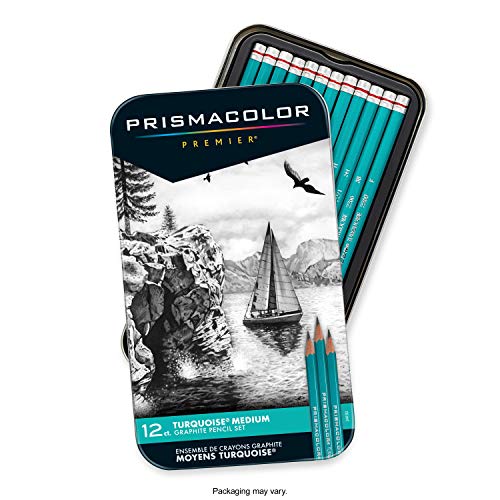
Prismacolor Turquoise Graphite Drawing Pencils, Set of 12
A ten grade spread covers most sketching needs without the markup that comes with imported European brands. Moisture resistant graphite holds up better than uncoated leads in humid studios. Hexagonal barrels resist rolling off a slanted drawing table.
Pros
- Ten grade range covers most sketching needs
- Moisture resistant core performs well in humid climates
- Lower cost per pencil than premium import sets
Cons
- Lead texture feels grittier than Japanese made cores
- Point retention is shorter under heavy pressure

Dixon Ticonderoga Wood-Cased Pencils, HB #2, Pack of 12
One HB grade covers everyday writing and note taking rather than tonal shading. Incense cedar sharpens smoothly with far fewer breaks than softer barrels. Bulk multipacks keep classrooms and offices stocked at a low cost per pencil.
Pros
- Bulk multipacks lower the cost per pencil
- Incense cedar sharpens cleanly with standard sharpeners
- Latex free eraser tip suits sensitive users
Cons
- Single HB grade cannot cover shading or fine art
- Eraser wears out before the graphite core does

General’s Kimberly Graphite Drawing Pencils, Set of 12
New artists get a full grade range to experiment with before committing to pricier European sets. Kiln baked graphite lays down evenly even when pressure control is still inconsistent. American made cedar barrels sharpen without much splintering.
Pros
- Full grade range introduces beginners to shading techniques
- Kiln baked core forgives inconsistent pressure
- Priced for practice without discouraging experimentation
Cons
- Grade consistency varies more than premium German brands
- Barrel finish chips more easily when dropped
How they stack up
| # | Model | Grade Range | Best for | Score | Price |
|---|---|---|---|---|---|
| 1 | Staedtler Mars Lumograph 100 Graphite Drawing Pencils, Set of 12 | 6B to 4H, 12 pencils | Best Overall | 9.4 | Check price |
| 2 | Faber-Castell 9000 Graphite Pencils, Set of 12 | 8B to 2H, 12 pencils | Best for Professional Illustrators | 9.3 | Check price |
| 3 | Tombow Mono 100 Drawing Pencil, 12-Pack | 6B to 2H, 12 pencils | Best for Blending and Shading | 9.1 | Check price |
| 4 | Derwent Graphic Drawing Pencils, Set of 12 | 9B to 9H across full line | Best for Wide Grade Selection | 9.0 | Check price |
| 5 | Prismacolor Turquoise Graphite Drawing Pencils, Set of 12 | 4H to 6B, 12 pencils | Best Value | 8.8 | Check price |
| 6 | Dixon Ticonderoga Wood-Cased Pencils, HB #2, Pack of 12 | HB, #2 equivalent | Best Budget | 8.3 | Check price |
| 7 | General’s Kimberly Graphite Drawing Pencils, Set of 12 | 9H to 6B, 12 pencils | Best for Beginners | 8.0 | Check price |
Common questions
What does the B and H mean on a pencil?
H marks hardness and lighter lines, while B marks blackness and softer, darker lines. HB and F sit in the middle of that scale. Most drawing sets label each pencil with a number plus a letter, like 4B or 2H.
How many pencils do you actually need for shading?
Three to five grades usually cover a full sketch, spanning something like 2H, HB, 2B, and 6B. Twelve pencil sets add finer steps between those points. Full twenty grade ranges suit detailed tonal work more than casual sketching.
Is a 2B or HB pencil better for writing?
HB writes lighter and holds a point longer through a full page of notes. 2B lays down darker marks but wears down faster and smudges more easily. Dixon Ticonderoga and most classroom pencils standardize on HB for that reason.
Can graphite pencils be used for blending?
Softer grades like 4B and 6B blend well with a paper stump or a finger. Tombow’s Mono 100 line is built specifically for smooth blending with minimal dust. Harder grades above HB resist blending and keep sharp, defined lines instead.
Which graphite pencil set works best for beginners?
General’s Kimberly gives new artists a full grade range at a lower cost than imported European sets. Kiln baked graphite forgives inconsistent pressure while someone learns shading control. Moving to a premium bonded core set later suits improving technique.
Staedtler Mars Lumograph vs Faber-Castell 9000, which grade range fits sketching better?
Staedtler’s 6B to 4H range leans slightly harder, useful for line heavy sketches. Faber-Castell’s 8B to 2H range leans softer, better for deep shadow work. Both use bonded cores that resist snapping during sharpening.
Do graphite pencils need a special sharpener?
Standard handheld or electric sharpeners work fine for wood cased graphite pencils. Softer grades like 6B sharpen better with a sharp blade to avoid crumbling. A sandpaper block helps shape a fine point for detail work on softer cores.
Is Dixon Ticonderoga considered a graphite pencil?
Yes, Ticonderoga pencils use a standard graphite and clay core rated HB, equivalent to a number 2 pencil. They are built for writing rather than tonal shading. Artists needing multiple grades should choose a dedicated drawing set instead.
What is the best graphite pencil set for professional illustration?
Faber-Castell’s 9000 series holds its centering across long projects thanks to SV bonding technology. That consistency matters more over hundreds of sketches than for a single quick drawing. Illustrators who also need harder grades past 2H should pair it with a supplemental technical pencil.
How is graphite pencil grading different between brands?
No single body standardizes grade labeling, so a 2B from one manufacturer can shade darker than a 3B from another. Comparing published grade ranges within one brand’s lineup gives a more reliable read than comparing across brands. Owner reviews on shading depth help fill in where spec sheets fall short.
Our take
Staedtler’s Mars Lumograph 100 earns the top spot for balancing grade range, break resistant cores, and an organized tin. Illustrators chasing deeper tonal separation should look at Faber-Castell’s 9000 series or Derwent’s full grading line instead. Anyone buying pencils purely for notes and homework gets more value from a Dixon Ticonderoga multipack.
Jake Monroe
Jake worked as a residential contractor for over a decade before shifting to full-time writing. He evaluates power tools, hand tools and workshop gear through the lens of someone who has actually used them on job sites, not just read the box.