Seven Golf Rangefinders Worth Carrying in Your Bag
The Bushnell Tour V6 Shift is the strongest overall pick, combining laser accuracy with a switchable slope mode for practice rounds. The Garmin Approach Z30 suits golfers who want GPS course mapping built into the same device, while the Precision Pro NX10 fits buyers who want dependable laser distance without a premium price.
The Bushnell Tour V6 Shift leads this list for pairing fast laser distance readings with a slope switch that toggles off for tournament play. Its GPS features stay limited compared to a hybrid device like the Garmin Approach Z30. Golfers who want full course mapping or a lower-cost laser-only option should check the alternatives below.
We compared stated accuracy range, slope compensation, tournament-legal switches and extra features like image stabilization or voice output across seven rangefinders rather than ranking by brand alone.
The top picks, ranked

Bushnell Tour V6 Shift
A physical slope switch lets golfers toggle elevation-adjusted distance on for practice rounds and off for tournament play. PinSeeker technology with Visual JOLT vibrates and flashes once the laser locks onto the flag. A compact body fits easily into a cart bag pocket.
Pros
- Slope switch keeps the device tournament legal when needed
- Visual JOLT confirms flag lock without guessing
- Compact size fits easily in a cart bag pocket
Cons
- No GPS course mapping like hybrid devices offer
- Slope feature adds a step golfers must remember to disable

Garmin Approach Z30
Built-in GPS mapping covers over 43,000 preloaded courses alongside the laser rangefinder function. A heads-up display projects distance directly in the viewfinder rather than a separate screen. Combining both systems means fewer devices to carry during a round.
Pros
- Combines laser accuracy with full GPS course mapping
- Heads-up display shows distance without lowering the device
- Preloaded course library needs no separate subscription setup
Cons
- Heavier and bulkier than laser-only rangefinders
- Higher cost than single-function laser devices

Precision Pro NX10
A slope switch toggles elevation-adjusted yardage on and off, matching a feature found on pricier models. Accuracy holds within a yard at ranges most golfers actually use during a round. A compact, rubberized body resists slipping from wet or sweaty hands.
Pros
- Slope switch matches pricier rangefinders at a lower cost
- Accuracy holds steady at typical playing distances
- Rubberized grip resists slipping in wet conditions
Cons
- No GPS mapping or course data
- Fewer extra features than premium hybrid devices

Nikon Coolshot Pro Stabilized
Built-in image stabilization reduces hand shake during the shot, a feature most rangefinders on this list skip entirely. Slope-aware technology adjusts distance for elevation changes between tee and green. A locked-on target indicator confirms when the flag, rather than background trees, is measured.
Pros
- Image stabilization helps steady readings on windy days
- Target lock confirms the flag rather than background objects
- Long maximum range covers par 5 approach shots
Cons
- Higher cost than basic laser-only rangefinders
- Bulkier than compact pocket-sized models
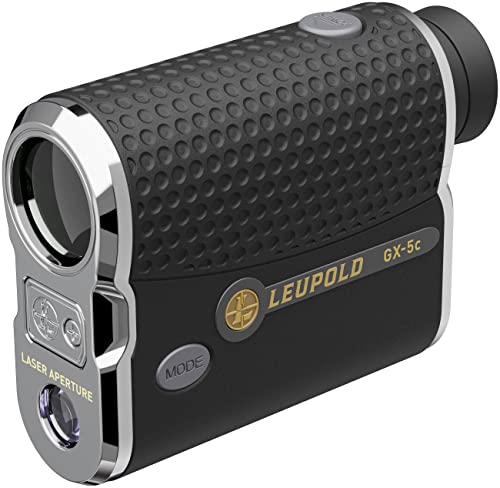
Leupold GX-5i3
True Golf Range technology calculates slope-adjusted distance that switches off completely for tournament rounds, meeting USGA rules either way. A fast pulse laser reduces the wait between aiming and getting a readout. An ergonomic grip holds steady during one-handed use from a cart.
Pros
- Slope compensation switches off cleanly for tournament rules
- Fast pulse laser shortens the wait for a readout
- Ergonomic grip suits one-handed use from a cart
Cons
- Shorter maximum range than some competitors on this list
- No GPS mapping features

Callaway 300 Pro
A straightforward laser design keeps this rangefinder focused on fast, accurate yardage without extra GPS features. A slope switch adds elevation-adjusted distance for practice rounds. An included magnetic cart mount attaches directly to a golf cart bar.
Pros
- Lower cost than premium hybrid or stabilized rangefinders
- Magnetic cart mount adds hands-free convenience
- Compact and lightweight for an easy carry
Cons
- Shorter maximum range than premium laser rangefinders
- No image stabilization or GPS mapping

Voice Caddie SL2
Voice announcement reads distance aloud after each measurement, useful for golfers who prefer not to check a screen mid-swing routine. Slope and non-slope modes switch with a single button for tournament compliance. A rechargeable battery skips the need for replacement batteries common on older models.
Pros
- Voice announcement means no need to check a screen
- Single-button slope switch keeps tournament compliance simple
- Rechargeable battery avoids buying replacements
Cons
- Voice feature can be a distraction on quiet courses
- Rangefinder-only design skips GPS course features
The lineup, side by side
| # | Model | Slope Mode | Best for | Score | Price |
|---|---|---|---|---|---|
| 1 | Bushnell Tour V6 Shift | Switchable on/off | Best Overall | 9.2 | Check price |
| 2 | Garmin Approach Z30 | 43,000-plus preloaded courses | Best GPS Mapping Hybrid | 8.8 | Check price |
| 3 | Precision Pro NX10 | Switchable on/off | Best Value | 8.6 | Check price |
| 4 | Nikon Coolshot Pro Stabilized | Built-in image stabilization | Best Image Stabilization | 8.7 | Check price |
| 5 | Leupold GX-5i3 | True Golf Range, switchable | Best Tournament-Legal Slope Switch | 8.5 | Check price |
| 6 | Callaway 300 Pro | Switchable on/off | Best Budget Laser | 8.2 | Check price |
| 7 | Voice Caddie SL2 | Yes, announces yardage | Best Voice Announcement | 8.4 | Check price |
How to choose
What matters most in a golf rangefinder Accuracy at typical playing distances matters more than maximum range, since most approach shots fall well under 200 yards. Slope compensation adds elevation-adjusted yardage for practice rounds but must switch off for tournament play under USGA rules. Image stabilization and target lock features help on windy days or when trees sit close behind the flag. GPS mapping adds course-wide distances beyond just the flag, at the cost of a bulkier device.
Laser-only versus GPS hybrid devices Bushnell’s Tour V6 Shift, Precision Pro’s NX10 and Callaway’s 300 Pro all focus purely on laser distance to a specific target like the flag. Garmin’s Approach Z30 adds full GPS course mapping on top of its laser function, useful for golfers who also want hazard and layup distances. The hybrid approach costs more and adds bulk, which matters for golfers who prefer a smaller device.
Tournament-legal slope switching Rules generally require slope compensation to switch off during sanctioned tournament play, which is why devices like the Leupold GX-5i3 and Bushnell Tour V6 Shift build in a clear on-off toggle. Checking that a rangefinder’s slope feature switches off completely, not just dims on the display, avoids any rules confusion on tournament day. Casual rounds have no such restriction, so slope mode can stay on for practice.
Added features worth considering Nikon’s Coolshot Pro Stabilized adds image stabilization that steadies the reading on windy days or at longer distances. Voice Caddie’s SL2 announces yardage aloud, which some golfers prefer over glancing at a small screen. Callaway’s 300 Pro keeps things simple with an included magnetic cart mount instead of extra electronic features.
Good to know
What is slope compensation on a golf rangefinder?
Slope compensation adjusts the displayed yardage based on elevation change between the golfer and the target, a feature found on the Bushnell Tour V6 Shift and Precision Pro NX10 among others.
Are slope-adjusted rangefinders legal for tournament play?
Not with slope mode switched on. Devices like the Leupold GX-5i3 and Bushnell Tour V6 Shift include a switch to disable slope so the device meets tournament rules.
What is the difference between a laser and a GPS golf rangefinder?
A laser rangefinder, like the Precision Pro NX10, measures distance to a specific point such as the flag, while a GPS hybrid like the Garmin Approach Z30 also shows preloaded course-wide distances.
How accurate are golf laser rangefinders?
Most quality laser rangefinders, including the Precision Pro NX10 and Nikon Coolshot Pro Stabilized, hold accuracy within a yard at typical playing distances.
Does image stabilization matter for a golf rangefinder?
Image stabilization, found on the Nikon Coolshot Pro Stabilized, helps steady the reading on windy days or at longer distances where hand shake becomes more noticeable.
Can a golf rangefinder lock onto the flag instead of background trees?
Target-lock features, like Bushnell’s PinSeeker with Visual JOLT or Nikon’s locked-on indicator, confirm when the flag itself, rather than a background object, is being measured.
What is the benefit of a voice-announcing rangefinder?
A voice-announcing device like the Voice Caddie SL2 reads the yardage aloud, letting golfers keep their eyes on the course instead of checking a screen.
Do I need GPS mapping if I already use a laser rangefinder?
Not necessarily. GPS mapping on a hybrid device like the Garmin Approach Z30 adds hazard and layup distances across the whole hole, which a laser-only device cannot provide without a visible target.
How far can a golf rangefinder typically measure?
Most rangefinders on this list measure up to 300 to 450 yards to the flag, though real-world accuracy to a small target like a pin usually matters more at shorter, playable distances.
What is a budget-friendly golf rangefinder option?
The Callaway 300 Pro offers a simpler laser design with a slope switch at a lower cost than premium stabilized or hybrid rangefinders.
The bottom line
For most golfers who want reliable laser accuracy with tournament-legal slope switching, the Bushnell Tour V6 Shift is the strongest overall pick. Golfers who want full course mapping alongside laser distance should choose the Garmin Approach Z30 instead, and anyone on a tighter budget should go with the Precision Pro NX10, which matches the core slope feature at a lower cost.
Derek Holt
Derek has a background coaching recreational and amateur athletes and has worked the sales floor at specialty fitness retailers. He focuses on equipment durability, ergonomics and realistic use cases rather than marketing claims.


