Which Golf Rangefinders Actually Work Well Indoors?
The Bushnell Tour V5 Shift leads this group with a fast, reliable lock at short indoor distances. The Precision Pro NX10 offers similar performance for less, and the Nikon Coolshot 20 GII is the simplest budget pick for basic distance checks.
The Bushnell Tour V5 Shift is built for an indoor bay, the Precision Pro NX10 covers the same job for less, and the Nikon Coolshot 20 GII is the simple, dependable budget option. All three lock quickly at the short distances indoor practice involves.
Indoor use exposes weaknesses a course never reveals, since lasers are designed for hundreds of yards and can struggle with close targets, artificial lighting and non reflective surfaces like impact netting. Minimum measuring distance and lock behaviour matter far more than maximum range here. We compared minimum distances, magnification, slope functions and stated accuracy based on specifications, then weighed what regular indoor practisers report about locking onto nets, screens and alignment sticks.
Our top picks

Bushnell Tour V5 Shift Laser Rangefinder
Locking onto targets faster and more decisively than most rivals matters when ranging a net or alignment marker only a few yards away. An external switch toggles slope off, keeping this unit tournament legal for outdoor rounds too. Six times magnification and clear glass make targets easy to identify under artificial bay lighting.
Pros
- Very fast, decisive lock on close targets
- Slope switch keeps it competition legal
- Excellent optical clarity under indoor lighting
Cons
- Higher outlay than most rivals
- No built in GPS or shot tracking features

Precision Pro NX10 Slope Rangefinder
Pulse vibration confirms a stable lock, removing the guesswork about whether you actually ranged the target or something behind it. A magnetic cart mount attaches conveniently to a bay divider instead of sitting in a pocket. Slope switches off, and Precision Pro backs the unit with a lifetime battery replacement programme owners rate highly.
Pros
- Pulse vibration confirms a genuine lock
- Magnetic mount is handy in a practice bay
- Strong value for the feature set
Cons
- Display is less crisp than premium optics
- Magnetic mount does not suit every surface
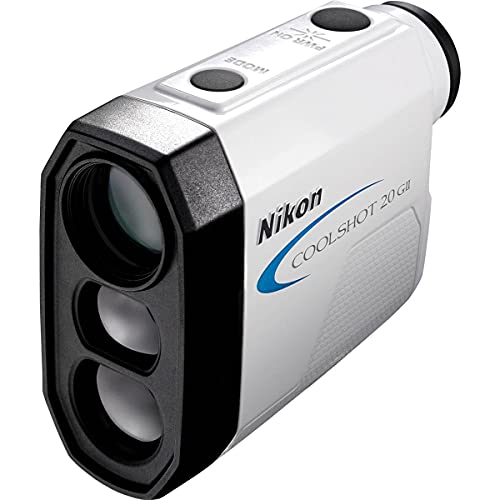
Nikon Coolshot 20 GII Golf Laser Rangefinder
Nikon glass punches above the price point for optical clarity in this small, light body. It does one thing well, measuring line of sight distance quickly, with no slope or connected features to configure. A compact body suits keeping it in a bag permanently, though the small eyepiece takes a moment to settle on close targets.
Pros
- Excellent optics for the outlay
- Very compact and light to carry
- Simple operation with nothing to configure
Cons
- No slope calculation at all
- Small eyepiece is fiddly for glasses wearers

Blue Tees Series 3 Max Rangefinder
A bright, high contrast display stays legible against a dark net or an indoor simulator screen, where dimmer readouts wash out. Slope adjustment, flag lock vibration and a magnetic mount cover the practical features most golfers want. Build quality runs good rather than premium, and the rubberised housing picks up marks over time.
Pros
- Readable display against dark indoor backgrounds
- Vibration confirmation on target lock
- Includes magnetic mount and case
Cons
- Housing marks easily with use
- Optics a step behind premium brands

Callaway 300 Pro Slope Laser Rangefinder
Slope adjusted distance sits front and centre here, showing both the raw and elevation adjusted number so golfers can learn how gradients change club selection. Six times magnification and pin acquisition technology keep locks quick. Indoors the slope function has little to do, so its value depends on how much practice also happens outdoors.
Pros
- Shows raw and slope adjusted numbers together
- Reliable pin acquisition outdoors
- Comfortable ergonomics for repeated use
Cons
- Slope adds little value for indoor practice
- Battery door design is fiddly

TecTecTec ULT-X Golf Rangefinder
Seven times magnification, higher than most rivals here, helps isolate a specific target on a cluttered indoor net or a busy driving range. A tournament legal switch controls slope alongside a reasonably bright display. Higher magnification does amplify hand shake, so a steady hold or a rest noticeably improves lock consistency.
Pros
- Highest magnification here for target isolation
- Switchable slope for competition use
- Good value for the specification
Cons
- Higher magnification magnifies hand shake
- Eye relief is tight for glasses wearers

Garmin Approach Z30 Laser Rangefinder
Pairing with a compatible Garmin golf watch sends ranged distances and shot data into your round history automatically. Green view overlays and a stabilised display help place shots precisely. Ecosystem dependency is the catch here, since much of the value evaporates without an existing Garmin golf watch.
Pros
- Integrates ranged distances into round tracking
- Image stabilisation steadies the view
- Green overlay adds useful context outdoors
Cons
- Best features require a Garmin golf watch
- Higher outlay for the ecosystem benefit
The lineup, side by side
| # | Model | Magnification | Best for | Score | Price |
|---|---|---|---|---|---|
| 1 | Bushnell Tour V5 Shift Laser Rangefinder | 6x | Best overall | 9.4 | Check price |
| 2 | Precision Pro NX10 Slope Rangefinder | 6x | Best value | 9.2 | Check price |
| 3 | Nikon Coolshot 20 GII Golf Laser Rangefinder | 6x | Best budget | 9.0 | Check price |
| 4 | Blue Tees Series 3 Max Rangefinder | 6x | Best display clarity | 8.8 | Check price |
| 5 | Callaway 300 Pro Slope Laser Rangefinder | 6x | Best for slope practice | 8.6 | Check price |
| 6 | TecTecTec ULT-X Golf Rangefinder | 7x | Best magnification | 8.3 | Check price |
| 7 | Garmin Approach Z30 Laser Rangefinder | 6x | Best for connected features | 8.0 | Check price |
Before you buy
Why does indoor use differ from ranging a flag on course? Golf lasers are engineered to bounce a beam off a flag several hundred yards away and return a clean reading. Indoors you typically range something within ten to thirty yards, often a net, screen or alignment aid rather than a reflective prism. Soft netting absorbs the beam rather than reflecting it, and dark simulator screens can give inconsistent returns. What matters most is a short minimum measuring distance, usually around five yards, plus a fast decisive lock and a display bright enough to read against a dark background.
What minimum distance and magnification should you look for? Check the minimum measuring distance before buying, since a device that cannot read closer than ten yards is limited in a small bay. Magnification between six and seven times is standard and helps isolate a specific target, though higher magnification amplifies hand tremor at close range. Lock confirmation, whether by vibration pulse or a visual indicator, distinguishes a reading off your intended target from one off the wall behind it, a genuinely useful feature indoors.
Does slope function matter for indoor practice? Slope functions calculate elevation adjusted distance, useful on undulating courses and irrelevant on a flat indoor floor. Most competition rules prohibit slope during play, which is why good rangefinders include a physical switch or removable faceplate that visibly disables it. If practice stays entirely indoors, slope adds nothing, so save the outlay and choose a simpler model like the Nikon Coolshot 20 GII.
Rangefinder or launch monitor for indoor practice? A rangefinder measures distance to a target and nothing else. If the goal is knowing carry distance for each club, a launch monitor is the correct tool, since it measures ball speed, launch angle and spin to calculate carry. A rangefinder still helps indoors for setting up consistent practice distances, verifying net placement, checking simulator calibration and confirming target spacing. Being clear about which question you are answering avoids buying the wrong device entirely.
Good to know
Do golf rangefinders work indoors?
Yes, provided the minimum measuring distance is short enough, usually around five yards. Soft netting and dark screens can return inconsistent readings, so a fast, confirmed lock matters more indoors.
What is the minimum distance a golf rangefinder can measure?
Most golf lasers read from about five yards. Below that, readings become unreliable. Check this specification specifically if your practice bay is small.
Will a rangefinder tell me my carry distance?
No. It measures distance to a target only. For carry distance per club you need a launch monitor, which measures ball speed, launch angle and spin.
Does slope matter for indoor golf practice?
Not at all, since an indoor floor is flat. Slope is valuable outdoors on undulating courses, and it must be switchable off to remain legal in most competitions.
Can a laser rangefinder lock onto a golf net?
It can, though netting absorbs more of the beam than a solid target. Aiming at a frame, pole or marker gives a more consistent reading than the mesh itself.
Is higher magnification always better for a rangefinder?
Not indoors. Seven times magnification helps isolate distant targets but amplifies hand shake at close range. Six times is the practical sweet spot for most golfers.
Are golf rangefinders safe to point at people?
They emit a low power laser classified as eye safe, but standard practice is never to aim any laser device at a person or an animal.
How long does a golf rangefinder battery last?
A standard lithium cell typically lasts a season or more of regular use. Precision Pro includes a lifetime battery replacement programme, which owners consistently rate as a genuine benefit.
What is the best rangefinder for a home simulator or bay?
The Bushnell Tour V5 Shift and Precision Pro NX10 both lock quickly on close targets and read clearly under artificial lighting, which suits a home bay or simulator setup.
Our pick
The Bushnell Tour V5 Shift is the most dependable choice for indoor and covered practice, since its fast lock and clear optics handle the awkward close targets a bay presents. The Precision Pro NX10 delivers much of that behaviour with vibration confirmation for considerably less. If practice never leaves a flat indoor floor, skip slope entirely and buy the Nikon Coolshot 20 GII.
Derek Holt
Derek has a background coaching recreational and amateur athletes and has worked the sales floor at specialty fitness retailers. He focuses on equipment durability, ergonomics and realistic use cases rather than marketing claims.


