Golf Rangefinders That Nail Yardage Every Time
Bushnell’s Tour V6 Shift tops this list, combining fast pin locking with a slope switch that keeps it tournament legal. Garmin’s Approach Z82 adds a green overlay and GPS layout data for players who want more. Precision Pro’s NX10 Slope delivers most of that experience for considerably less.
Bushnell’s Tour V6 Shift is the rangefinder most bags should carry, thanks to jolt confirmation and a visible slope switch. Garmin’s Approach Z82 suits players who want course layout data alongside distance, while Precision Pro’s NX10 Slope is the sensible saving for a similar feature set.
Rangefinders are hard to separate on paper, since every listing claims one yard accuracy and every one delivers it on a static target. What actually differs is how quickly and reliably a unit locks the flag rather than the trees behind it, how readable its display stays against a bright sky, and whether the slope function switches off visibly enough to satisfy a tournament committee. We compared magnification, stated ranges and accuracy, lock confirmation methods and display technology, then weighed those against owner reports of shaky hands, cold weather battery drain and fogged lenses on early morning rounds.
The best picks, ranked

Bushnell Tour V6 Shift Laser Rangefinder
Bushnell’s PinSeeker with visual jolt gives a short vibration when the flag locks, removing doubt about whether the beam caught the pin or the tree line behind it. A Shift toggle disables slope with an external indicator officials can see, so the same unit works in competition. Optics stay bright and the magnetic mount sticks reliably to a cart frame.
Pros
- Vibration confirmation removes lock doubt
- Slope switch is visibly tournament legal
- Bright clear optics in low light
Cons
- Costs more than most rivals
- No GPS course data
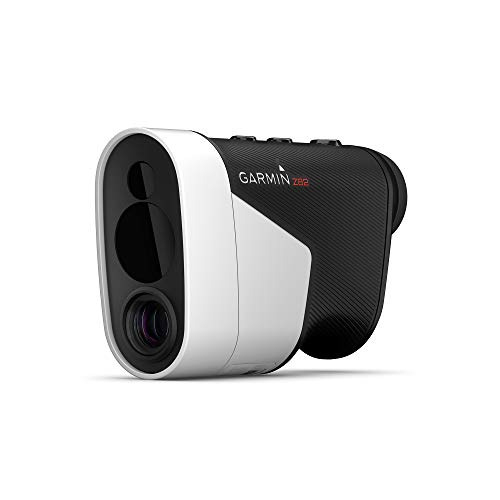
Garmin Approach Z82 Golf Laser Range Finder
The Z82 overlays a green outline and hazard distances onto the laser view, showing the shape of the green and the carry over a bunker in the same look. Image stabilisation genuinely helps if your hands shake on a cold morning. All that capability comes at a high outlay and needs charging rather than a coin cell.
Pros
- Green shape and hazards shown in view
- Image stabilisation steadies the picture
- Combines laser and GPS in one device
Cons
- Highest outlay of the group
- Needs charging rather than a spare battery

Precision Pro NX10 Slope Golf Rangefinder
The NX10 covers pulse vibration confirmation, adaptive slope and a magnetic cart mount for considerably less than the premium brands. Its display adjusts brightness to ambient light, which helps on overcast days when black numbers vanish against trees. Optics fall a step behind Bushnell in clarity at longer ranges.
Pros
- Most premium features at mid range outlay
- Display brightness adapts to conditions
- Magnetic mount included
Cons
- Optics less crisp at long range
- Slope indicator is less obvious to officials

Blue Tees Golf Series 3 Max Rangefinder
Blue Tees uses a bright coloured display that stays readable against dark tree lines, where black LCD numbers disappear. Slope switching, flag lock vibration and a magnetic mount all come included, making this a strong all round package. Maximum range falls short of the premium units, which matters mainly on long par fives.
Pros
- Readout stays legible against trees
- Full feature set for the outlay
- Quick locking on nearby flags
Cons
- Shorter maximum range than premium models
- Colour display drains batteries faster
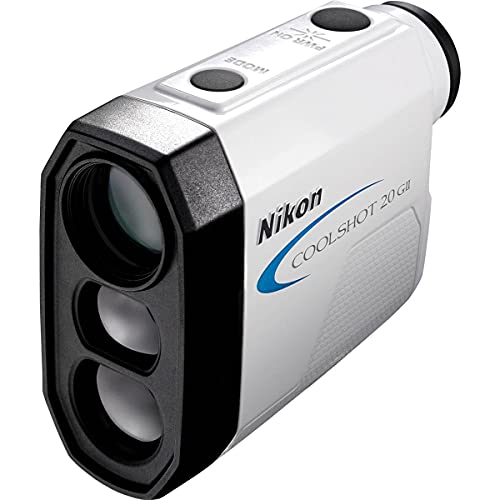
Nikon COOLSHOT 20 GII Golf Rangefinder
Nikon’s smallest golf rangefinder fits comfortably in a trouser pocket, suiting walkers who do not want another item hanging off a bag. Optical quality lives up to the Nikon name, with a clear crisp view. Slope function and vibration confirmation are both absent, so the display reading is the only proof of a flag lock.
Pros
- Excellent optical clarity for the size
- Small enough for a pocket
- Always tournament legal without switching
Cons
- No slope adjustment at all
- No vibration lock confirmation

Callaway 300 Pro Slope Laser Rangefinder
The 300 Pro keeps operation simple with a clear pin acquisition mode and an easy to find slope switch. Optics are decent and the body stays light enough to hold steady. Owners report the lock can hunt a little on distant flags in bright conditions, the main compromise at this level.
Pros
- Straightforward controls for new users
- Light and easy to hold steady
- Slope switch clearly labelled
Cons
- Lock hunts on distant flags in bright light
- No magnetic mount included

TecTecTec VPRO500 Golf Rangefinder
The VPRO500 does distance and nothing else, exactly what many golfers actually need. Light and simple, it stays competition legal since there is no slope function to disable. Its basic monochrome display and slower lock speed mean allowing an extra second on the tee compared with premium units.
Pros
- Lowest outlay for a working laser
- Always tournament legal
- Light and simple to operate
Cons
- Slower to lock than premium units
- Basic display hard to read in flat light
How to choose
What to look for in a golf rangefinder Four factors decide how a rangefinder performs on course: lock confirmation, slope legality, display readability and magnification. Quoted accuracy barely varies between models, since nearly every unit claims within a yard and hits that figure on a static target. What separates a good unit from a frustrating one is whether it locks the flag reliably and whether its display stays legible against trees on an overcast day.
Why slope decides tournament legality Slope adjusted distances account for elevation change and help considerably in practice rounds and casual play, but most competitions do not permit them. Units like the Bushnell Tour V6 Shift solve this with an external switch that visibly shows slope is off, exactly what officials look for. Social golfers benefit from having slope available, while frequent competitors need the disable mechanism to be obvious from outside the device.
Lock confirmation matters more than quoted accuracy Every rangefinder here claims accuracy within a yard, and each achieves it on a static target. The real difference shows up when the unit locks the flag instead of trees twenty yards behind it. Vibration confirmation, sometimes called jolt or pulse, tells you the pin was acquired rather than the background. Without it, you are trusting a number that may be measuring something else entirely.
Rangefinder or GPS watch for your game A laser gives a precise distance to whatever you aim at, including hazards and layup targets, but needs a clear line of sight. GPS watches and handhelds give front, middle and back of green distances instantly on blind shots. Combination units like the Garmin Approach Z82 do both at a price. Owners report most players prefer the laser for approach shots and the GPS for planning off the tee.
How they compare
| # | Model | Magnification | Best for | Score | Price |
|---|---|---|---|---|---|
| 1 | Bushnell Tour V6 Shift Laser Rangefinder | 6x | Best overall | 9.4 | Check price |
| 2 | Garmin Approach Z82 Golf Laser Range Finder | 6x with image stabilisation | Best premium option | 9.2 | Check price |
| 3 | Precision Pro NX10 Slope Golf Rangefinder | 6x | Best value | 9.0 | Check price |
| 4 | Blue Tees Golf Series 3 Max Rangefinder | Bright coloured readout | Best display | 8.8 | Check price |
| 5 | Nikon COOLSHOT 20 GII Golf Rangefinder | 6x | Best compact model | 8.6 | Check price |
| 6 | Callaway 300 Pro Slope Laser Rangefinder | 6x | Best for beginners | 8.3 | Check price |
| 7 | TecTecTec VPRO500 Golf Rangefinder | 6x | Best budget pick | 8.0 | Check price |
Common questions
Are golf rangefinders allowed in competition?
Distance measuring devices are generally permitted, but slope adjusted readings are not. Choose a unit with a clearly visible slope disable switch, such as the Bushnell Tour V6 Shift, or a model without slope at all.
How accurate are golf rangefinders?
Most quote accuracy within one yard, and that holds on a clear target. Errors in practice come from locking the wrong object, which is why vibration confirmation of a flag lock matters more than the quoted figure.
What does slope do on a rangefinder?
It adjusts the measured distance for uphill or downhill elevation, giving a playing distance rather than a straight line one. This is very useful on hilly courses and not permitted in competition.
Rangefinder or GPS watch, which should I buy?
A laser is more precise and works on any target you can see. A GPS watch is faster on blind shots and gives green front and back numbers without aiming. Many players carry both, or a hybrid such as the Garmin Approach Z82.
Why does my rangefinder keep reading the trees?
Because the beam caught the background instead of the flag. Steady the unit against something, use pin seeking mode, and look for the vibration or indicator that confirms a flag lock rather than trusting the first number shown.
Do rangefinders work in rain and fog?
Performance drops noticeably, since moisture scatters the laser. Range shortens and locks take longer. Keeping the lens clean and dry makes more difference than any specification on the box.
How long do rangefinder batteries last?
Coin cell units typically last a full season of regular play. Cold weather shortens that considerably, so carrying a spare battery is worthwhile. Rechargeable models such as the Z82 need charging between rounds.
Is a magnetic cart mount useful?
Very, if you ride. It keeps the unit within reach on the cart frame rather than in a pocket. Walkers get less benefit from it, though it also sticks to some trolley frames.
Best golf rangefinder for beginners?
The Callaway 300 Pro Slope keeps controls simple with a clear pin acquisition mode and an easy to find slope switch. Its light body is easy to hold steady, which matters more for new users than chasing every premium feature.
The bottom line
The Bushnell Tour V6 Shift is the rangefinder we would buy, since jolt confirmation and a visible slope switch address the two things that actually matter on the course and in competition. The Garmin Approach Z82 is worth the extra only if you want course mapping in the same device. The Precision Pro NX10 Slope covers the essentials for players who cannot justify premium outlay.
Derek Holt
Derek has a background coaching recreational and amateur athletes and has worked the sales floor at specialty fitness retailers. He focuses on equipment durability, ergonomics and realistic use cases rather than marketing claims.

