Picking a Gimbal Head for 500mm and 600mm Primes
Wimberley WH-200 Gimbal Tripod Head II leads on arm height and a 100 pound rating, enough for a 600mm f/4 in portrait. ProMediaGear Katana Junior trims weight with a single side arm. Benro GH2 splits pan and tilt friction across two knobs. All three take standard Arca dovetails.
Wimberley WH-200 Gimbal Tripod Head II suits anyone shooting a 500mm or 600mm prime. Its swing arm sits tall enough to clear a long hood in portrait, and the 100 pound rating leaves margin for a gripped body plus a teleconverter. Weight is the cost. At 3.4 pounds it needs serious legs underneath.
Listings for gimbal heads read almost identically, yet arm height and friction quality decide how a lens behaves. We compared published load ratings, head weight, clamp type and base threads across current Amazon listings. Owner reports on knob creep, pan drift and balance range set the final order.
Our top picks

Wimberley WH-200 Gimbal Tripod Head II
Anodized aluminum arms and a tall vertical post clear the hood of a 600mm f/4 rotated to portrait. Rated to 100 pounds, the cradle shrugs off a gripped body with a teleconverter fitted. Owners report pan drag that stays even through a full sweep, with knobs that hold position under load.
Pros
- Swing arm height clears a 600mm hood in portrait
- Handles gripped bodies with a teleconverter attached
- Clamp accepts any standard Arca dovetail plate
Cons
- Heaviest head in this group at 3.4 pounds
- Wants a series 3 tripod or larger below it

ProMediaGear Katana Junior GKJr Gimbal Head
Machined aluminum forms one side arm instead of a full cradle, cutting bulk without flexing under load. Your lens foot mounts on that arm, so switching from landscape to portrait takes a single motion. Photographers running 400mm and 500mm primes stay well inside the 50 pound rating.
Pros
- Almost a pound lighter than a full cradle head
- Lever clamp locks a lens foot in one motion
- Open side leaves focus ring and switches reachable
Cons
- Single arm loads unevenly at extreme tilt angles
- Rated at half the Wimberley capacity

Benro GH2 Aluminum Gimbal Head
Aluminum cradle carries a 55 pound rating, which covers a 500mm f/4 on a gripped body. Pan and tilt each get an independent friction knob, so one axis can stay damped while the other swings free. A safety pin inside the clamp keeps a plate from sliding out if the knob backs off.
Pros
- Independent friction knobs for pan and tilt
- Safety pin blocks accidental plate release
- Adjustment slot fits most lens foot lengths
Cons
- Knobs sit close together and get confused by feel
- Bare aluminum turns cold on winter shoots
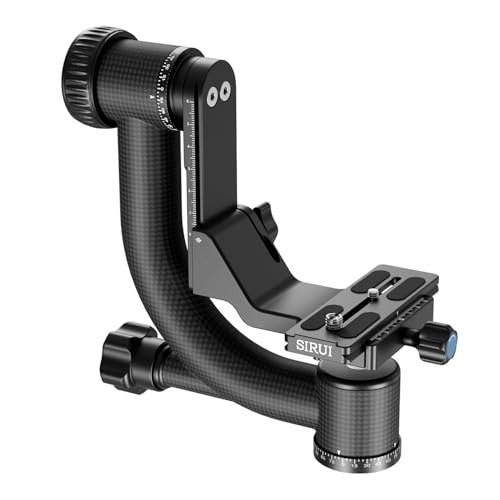
SIRUI PH-20 Carbon Fiber Gimbal Head
Carbon fiber arms bring this head down near 2.4 pounds while holding a 44 pound rating. Bare hands stay warmer on carbon than on aluminum, which counts on frozen mornings. Safari trips and long approach hikes gain the most from the saving.
Pros
- Lightest full cradle here at 2.4 pounds
- Carbon arms stay tolerable in freezing air
- Folded profile packs into a roller bag
Cons
- 44 pound rating trails the aluminum cradles
- Arm height runs short for the longest hoods
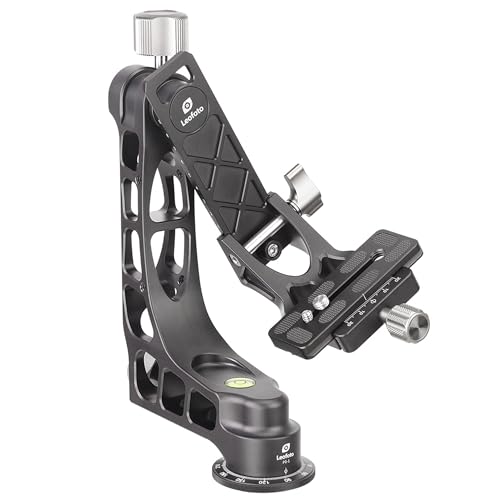
Leofoto PG-1 Gimbal Head
Leofoto rates the PG-1 to 66 pounds on a body near 2.3 pounds, an unusual ratio for aluminum. Engraved degree marks on the pan base let you return to a fixed framing angle for a nest or a perch. Standard Arca dovetails mean lens plates you already own carry straight over.
Pros
- 66 pound rating from a 2.3 pound head
- Degree scale repeats a framing angle exactly
- Works with Arca plates already in your bag
Cons
- Screw clamp is slower to use than a lever
- Pan friction feels coarser than the Wimberley

Wimberley Sidekick SK-100
Rather than replacing a head, the Sidekick drops into the Arca clamp on a ball head you already use. Packed weight lands near 1.1 pounds, which is the whole argument on a long hike. Lenses up to a 400mm f/2.8 balance well, while a 600mm overloads most ball heads below it.
Pros
- Adds gimbal motion without a second full head
- Just over a pound of space in a daypack
- Comes off in seconds for normal ball head work
Cons
- Only as steady as the ball head under it
- Falls short of the largest 600mm primes
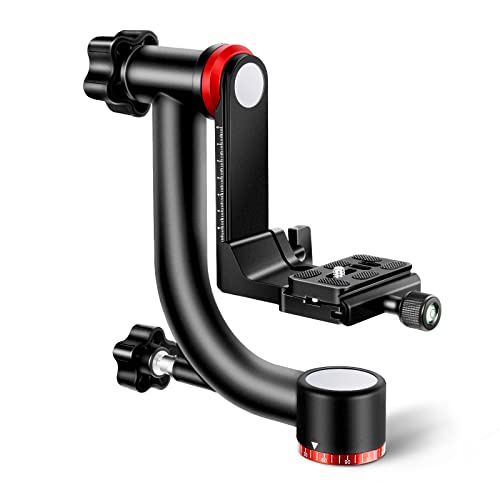
Neewer GM001 Gimbal Head
Aluminum alloy and a 30 pound rating cover a 150-600mm zoom on a mirrorless body. Knurled knobs lock pan and tilt separately, and the base threads onto a standard 3/8 inch stud. Buyers moving up from a ball head get most of the tracking benefit at the smallest commitment.
Pros
- Comfortable with common 150-600mm zooms
- Arca clamp fits third party lens plates
- Two knob layout takes minutes to learn
Cons
- 30 pound rating rules out exotic primes
- Friction ramps less smoothly than premium heads
The lineup, side by side
| # | Model | Load capacity | Best for | Score | Price |
|---|---|---|---|---|---|
| 1 | Wimberley WH-200 Gimbal Tripod Head II | 100 lb | Best overall | 9.4 | Check price |
| 2 | ProMediaGear Katana Junior GKJr Gimbal Head | 50 lb | Best for super telephoto primes | 9.2 | Check price |
| 3 | Benro GH2 Aluminum Gimbal Head | 55 lb | Best value | 9.0 | Check price |
| 4 | SIRUI PH-20 Carbon Fiber Gimbal Head | 44 lb | Best for travel kits | 8.8 | Check price |
| 5 | Leofoto PG-1 Gimbal Head | 66 lb | Best for existing Arca-Swiss kits | 8.6 | Check price |
| 6 | Wimberley Sidekick SK-100 | 1.1 lb | Best for ball head owners | 8.3 | Check price |
| 7 | Neewer GM001 Gimbal Head | 30 lb | Best budget | 8.0 | Check price |
What to look for
What to look for in a gimbal head Load rating comes first. Add your heaviest body, lens and teleconverter together, then leave margin above that figure. Clamp standard decides whether existing lens feet and L brackets carry over, and Arca-Swiss is the near universal answer. Arm height gets ignored most often. A short arm lets a long hood strike the base the moment you rotate to portrait. Friction quality separates good heads from cheap ones, since smooth damping is what keeps a bird centred through a pan.
How much load rating you actually need Real rigs weigh far less than the ratings suggest. A 150-600mm zoom on a mirrorless body lands near 6 pounds, well inside the 30 pound Neewer GM001. Move to a 500mm f/4 with a gripped body and you reach 11 or 12 pounds. Past that point, higher ratings buy stiffness rather than safety, because a rigid cradle flexes less when you stop a fast pan. Balance range deserves equal attention. Short lens feet can run out of adjustment slot before the rig sits neutral, and no capacity figure warns you about that.
Full cradle or side mount Cradles wrap under the lens and carry weight on both sides. That geometry suits the longest primes and rough field handling. Side mount designs such as the Katana Junior and the Sidekick SK-100 hang the lens off a single arm instead. Weight drops, and the focus ring stays clear of metal. Cost is uneven loading at steep tilt angles, where one arm absorbs the whole moment. Anyone working from a vehicle window or a cramped hide usually prefers that narrower footprint.
Best for travel kits and long hikes Carbon saves close to a pound against the Wimberley, which the SIRUI PH-20 shows at 2.4 pounds. Legs carry head weight plus lens weight, so a flimsy travel tripod undoes a good head. Choose legs rated well past your total rig weight and leave the centre column at home. Skip a gimbal altogether if your longest lens is a 70-200mm. That combination balances fine on a decent ball head, and the extra pounds buy nothing.
Questions worth asking
What is a gimbal head used for?
It holds a long lens at its centre of gravity, so the rig stays put when you let go. Wildlife, aviation and field sports shooters rely on that to track motion without fighting lens weight.
Do I need a gimbal head for a 400mm lens?
A 400mm f/5.6 or a 150-600mm zoom sits fine on a strong ball head for short sessions. Past roughly 6 pounds, or across hours of tracking, a gimbal saves both your arms and your framing.
Gimbal head vs ball head: which is better for wildlife?
Gimbals win for panning long glass, because the lens stays neutral at any tilt angle. Ball heads remain better for landscape, macro and any shot you compose once and lock down.
How do you balance a lens on a gimbal head?
Slide the lens foot forward or back until the rig holds any tilt angle with the knobs loose. Then set the vertical arm so the optical axis sits level with the tilt pivot.
How much weight can a gimbal head hold?
Ratings here span 30 pounds on the Neewer GM001 to 100 pounds on the Wimberley WH-200. Field rigs rarely pass 15 pounds, so the larger numbers mostly buy rigidity and margin.
Can a gimbal head mount on a video tripod?
Only where the legs offer a flat 3/8 inch platform. Bowl mounts at 75mm or 100mm need a flat base adapter before any of these heads will sit level.
Is a carbon fiber gimbal head worth it?
Carbon trims about a pound and stays warmer against bare skin. Pick it for hiking and flying, and stay with aluminum if the head lives in a car or a permanent hide.
Which tripod pairs best with a gimbal head?
Look for legs rated at least double your combined head and lens weight, with a flat top plate and no centre column. Series 3 and series 4 carbon legs are the usual match for 500mm and 600mm primes.
Can you use a gimbal head without a lens collar?
Not safely. Mounting through the camera body hangs the entire lens weight off the lens mount, and a gimbal needs the collar foot to find its balance point.
Do gimbal heads work for panning video?
Panning is smooth, but there is no fluid cartridge, so starts and stops look abrupt on playback. Keep a fluid head for video work and use the gimbal for stills.
Our pick
Wimberley WH-200 Gimbal Tripod Head II is the one to buy if a 500mm or 600mm prime is your main lens, because its arm height and 100 pound rating will outlast several camera bodies. Hikers and anyone flying with a kit should take the SIRUI PH-20 and accept 44 pounds of capacity. Already carrying a solid Arca ball head? Add the Sidekick SK-100 and save the bulk of a second head.
Marcus Chen
Marcus covered consumer electronics for enthusiast tech publications for six years before joining ChoiceCrest. He specializes in translating manufacturer spec sheets into plain-language buying advice, with a focus on audio, computing accessories and smart-home gear.