Which Geography Travel Toy Teaches Kids Maps Best?
Educational Insights’ GeoSafari Jr. Talking Globe leads for solo, audio-guided learning, Ravensburger’s XXL Children’s Map of the World Puzzle suits group puzzle nights, and Professor Noggin’s World Geography Trivia Card Game wins for backpack-ready portability. Seven picks span globes, floor puzzles, card games and a placemat for ages three through twelve.
Educational Insights’ GeoSafari Jr. Talking Globe fits preschoolers taking their first steps with maps, since a stylus reads country and capital names aloud on contact. Its plastic shell handles drops better than a paper puzzle would. Detail stays basic, though, so kids past about age eight outgrow its simplified borders quickly.
Age grading, choking-hazard piece size and battery reliance separate these seven picks more than any single spec does. We compared stated age ranges, piece counts, listed materials and recurring owner comments about durability on car rides and at restaurant tables.
Our top picks
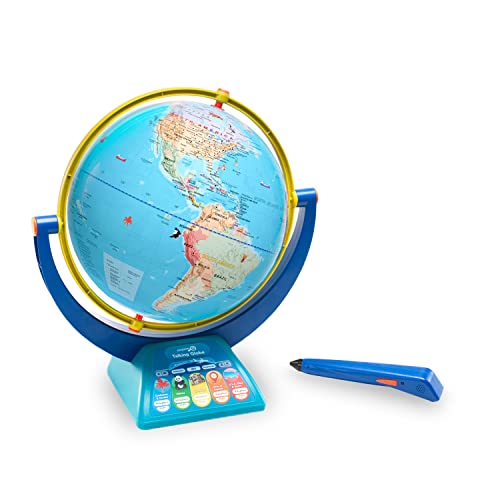
Educational Insights GeoSafari Jr. Talking Globe
A handheld stylus works with an internal sound chip to name countries, capitals and oceans on contact. The globe stands about 8 inches tall on a base built to resist tipping during active play. Kids switch between an explore mode for free browsing and a quiz mode that calls out a country to find.
Pros
- Stylus narrates facts with no screen needed
- Fixed base stays upright through toddler bumps
- Quiz mode drills country and capital recall
Cons
- Opening the battery door needs a small screwdriver
- Border detail is too simplified for kids past about age eight

Ravensburger XXL Children’s Map of the World 200 Piece Puzzle
Two hundred extra-large pieces assemble into a map roughly 39 by 27 inches, printed with continents, oceans and animal illustrations. Softclick piece technology locks neighboring pieces together, so a bumped table doesn’t scatter half the build. Size and piece count suit kids around six working alongside a parent.
Pros
- Finished size works for group puzzle sessions
- Softclick pieces resist accidental separation
- Labeled continents double as a wall-ready map poster
Cons
- Full 200 piece build outlasts a young child’s attention span alone
- No fold line means storage needs a flat box or wall space

Professor Noggin’s World Geography Trivia Card Game
Thirty double-sided cards cover capitals, landmarks and country facts across three difficulty tiers, all packed in a metal tin. Players draw a card and answer questions matched to their own grade band, so siblings of different ages share one round. That tin slides into a glovebox or a backpack side pocket without adding bulk.
Pros
- Metal tin survives car rides and backpack storage
- Three difficulty tiers let mixed-age siblings play together
- Needs no batteries or setup time
Cons
- Younger kids still need an adult reading questions aloud
- Card corners bend if the tin lid stays open

GeoPuzzle World Puzzle, Beginner World
Sixty-eight pieces, each shaped like a single country or region, are cut from thick recycled chipboard sized for small hands. Piece dimensions clear typical choking-hazard concerns for children starting around age three. A cloth drawstring bag keeps the set together between play sessions.
Pros
- Country-shaped pieces suit toddler-sized hands
- Chipboard resists tearing better than thin paper puzzles
- Drawstring bag stops pieces scattering in a car or bag
Cons
- Finished map skips detail that older kids eventually want
- Cloth bag adds little cushioning if the set is dropped

Waypoint Geographic World Map Learning Placemat
A laminated placemat folds flat enough for a diaper bag or backpack pocket, then opens into a full world map printed with country names and flags. Wipeable vinyl handles spilled juice or crayon marks at a restaurant table. No loose pieces means nothing gets left behind on a trip.
Pros
- Folds flat for diaper bags, backpacks or tray tables
- Wipeable surface shrugs off restaurant and car spills
- Zero small pieces to lose while traveling
Cons
- No audio or interactive quiz feature
- Rough handling can crease the laminate over time

Melissa & Doug USA Map Floor Puzzle
Fifty-one pieces assemble into a full United States map, with each state cut and labeled as its own piece. A wooden storage tray holds a completed puzzle intact for repeat play. State-by-state shapes build regional geography knowledge before kids move on to world maps.
Pros
- State-shaped pieces build US geography specifically
- Wooden tray works double duty as a puzzle frame
- Piece size suits kids past the toddler choking-hazard stage
Cons
- Covers only the United States, not world geography
- Wooden tray adds bulk next to bagged puzzle sets
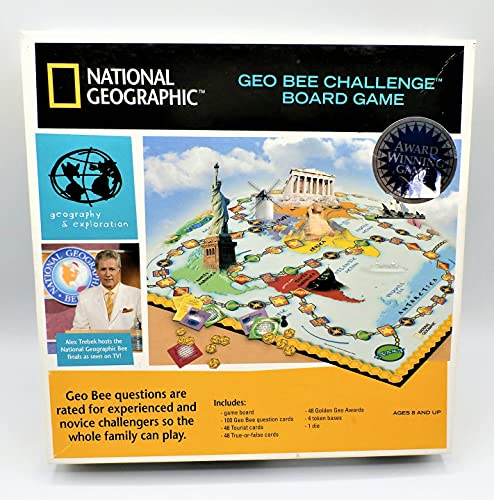
National Geographic Bee Board Game by University Games
Licensed from the National Geographic Bee competition, players move around a map-based board answering questions pulled from an included card deck. Rounds seat up to six, fitting family game night or a classroom setting. A built-in answer key lets kids self-check without an adult moderating.
Pros
- Answer key cuts down on needed adult supervision
- Question difficulty scales for older kids and adults together
- Board format keeps several players engaged each round
Cons
- Reading-heavy questions challenge kids under about eight
- A full round runs longer than a quick car-ride game
How to choose
What makes a geography toy actually teach map skills Kids need repeated exposure to shapes, names and spatial relationships before a globe makes sense to them. Talking globes, labeled puzzles and trivia cards each repeat those cues in a different format. Mixing formats, say a globe at home paired with a card game in the car, helps names stick faster than one toy alone, based on recurring owner feedback across these listings.
Globes, puzzles and card games compared Floor puzzles like the Ravensburger XXL map suit group sessions where an adult guides piece placement. Solo exploration favors a globe such as the GeoSafari Jr., since its stylus gives instant audio feedback without a parent nearby. Card games including Professor Noggin’s fit short attention spans and take up almost no shelf space. Board games add a social layer once kids read well enough to handle question cards themselves.
Which piece sizes are safe for toddlers Choking-hazard rules matter most under age four, so pieces should measure at least an inch across, like GeoPuzzle’s country-shaped set. Talking globes sidestep the issue entirely, since there are no loose pieces to swallow. Melissa & Doug’s wooden-tray puzzle suits kids who have aged past small-parts concerns but still need chunky, grippable pieces.
Packing geography toys for car rides and flights Airplane trays and car seats leave little room for a boxed puzzle, so foldable picks like the Waypoint Geographic placemat or a tinned card game travel better than anything boxed. Battery-powered globes add weight and fragility that some families skip for a short trip. Save board games such as National Geographic Bee for hotel stays or extended visits, where table space and time allow a full round.
Side by side
| # | Model | Age range | Best for | Score | Price |
|---|---|---|---|---|---|
| 1 | Educational Insights GeoSafari Jr. Talking Globe | 3 to 8 years | Best overall | 9.4 | Check price |
| 2 | Ravensburger XXL Children’s Map of the World 200 Piece Puzzle | 200 | Best value | 9.1 | Check price |
| 3 | Professor Noggin’s World Geography Trivia Card Game | 30 double-sided cards | Best budget | 8.8 | Check price |
| 4 | GeoPuzzle World Puzzle, Beginner World | 68 | Best for toddler-safe pieces | 8.5 | Check price |
| 5 | Waypoint Geographic World Map Learning Placemat | Approx 12 x 17 inches | Best for travel-size packaging | 8.3 | Check price |
| 6 | Melissa & Doug USA Map Floor Puzzle | 51 | Best for USA map focus | 8.1 | Check price |
| 7 | National Geographic Bee Board Game by University Games | 2 to 6 | Best for family game night | 8.0 | Check price |
Common questions
What age is right for a geography toy or travel set?
Talking globes and large-piece puzzles suit kids from around age three, based on stated age grades. Reading-heavy games like National Geographic Bee work better once kids reach about eight.
Are talking globes better than puzzles for teaching geography?
Neither replaces the other. A talking globe like the GeoSafari Jr. gives instant audio feedback during solo play, while a puzzle such as the Ravensburger world map builds spatial recognition piece by piece.
Which geography toys are safe for toddlers?
Look for pieces at least an inch across, like GeoPuzzle’s country-shaped set, or toys with no loose parts at all, such as a talking globe or a foldable placemat.
What’s the best geography toy for long car rides?
Professor Noggin’s tin card game and the Waypoint Geographic placemat both pack flat with nothing loose to lose, which beats a boxed puzzle for backseat use.
Is a world map puzzle or a USA map puzzle better to start with?
Families focused on state names and regions tend to start with the Melissa & Doug USA Map Puzzle, while a broader continent-and-country introduction points toward the Ravensburger world map.
Can siblings of different ages play the same geography game together?
Professor Noggin’s card game builds in three difficulty tiers by grade band, so it suits mixed-age siblings better than a single-level board game does.
Do geography toys need batteries?
Only the talking globe in this lineup runs on batteries, three AA cells inside the GeoSafari Jr. Puzzles, card games and the placemat need no power source.
What’s the difference between a geography puzzle and a learning placemat?
A puzzle like the GeoPuzzle beginner set has separate pieces that can be lost or need storage space. The Waypoint Geographic placemat is one foldable sheet, trading assembly time for easier travel packing.
How many pieces should a geography puzzle for a 6 year old have?
Ravensburger’s XXL World Map runs 200 extra-large pieces, sized for a six year old working with an adult rather than solo.
Final word
Educational Insights’ GeoSafari Jr. Talking Globe wins for kids starting to learn countries and capitals, since its stylus-driven quiz mode and drop-resistant base handle daily use. Choose the Ravensburger XXL World Map Puzzle instead for group puzzle nights, or lean on Professor Noggin’s tin card game and the Waypoint Geographic placemat when packing for a road trip.
Rachel Simmons
Rachel previously worked in child-product retail and brings a practical, detail-first eye to gear reviews, focusing on safety standards, ease of use and the fine print that matters most for new caregivers.


