Puzzle, Globe, or Talking Globe: Best Geography Starter Kit
Melissa and Doug’s World Map Wooden Puzzle tops this comparison, since self-correcting wooden pieces teach continent shapes without adult help. Learning Resources’ Puzzle Globe follows for hands-on assembly into a full sphere. Educational Insights’ GeoSafari Talking Globe rounds out the top three with stylus-triggered audio facts for independent play.
Melissa and Doug’s World Map Wooden Puzzle leads this comparison for a first geography kit, roughly ages four to seven. Self-correcting wooden pieces teach continent shapes without an adult stepping in. Individual country pieces run too small for a toddler’s grip, so older siblings get more from it.
Puzzles, globes, and talking toys each teach a different piece of geography, so no single format covers everything. We compared continent and country detail, stated age ranges, battery dependence, and how owners describe piece durability after repeated play. Kits promising more detail than their age range could handle dropped lower here.
What matters most
What to look for in a geography starter kit Format decides how a child engages, and geography toys split into three types. Map puzzles lean on shape memory. Globes add three-dimensional position. Talking toys add audio recall through touch. Printed age range matters more than an ad suggests, since piece count and grip needs vary widely. Battery needs quietly decide whether a toy still works after two years on a shelf.
Puzzle map or globe first A flat puzzle teaches shape and relative position with almost no setup. A globe adds the idea that the world curves around a sphere, which paper cannot show. Most households start with a puzzle around age four, then add a globe once a child asks where a place sits relative to home. Running both side by side reinforces the same facts from two angles.
Matching the kit to age: preschool through grade school Preschoolers do best with large wooden pieces and a routed tray limiting where a piece can go, like the World Map and USA Map puzzles here. Grade schoolers handle smaller detail, so a talking globe or raised relief globe holds attention longer. Waiting too long past the stated age range means a toy gets solved once, then shelved. An illuminated globe with a night view suits an older child working on school projects.
Battery powered or manual: what survives siblings Wooden puzzles and manual globes need no power and rarely fail outright, though small pieces do go missing over years of handling. Talking globes and illuminated globes depend on batteries or an outlet, and a dead unit turns silent and dark until someone replaces the source. Owners report manual toys pass down to a second child more often than electronic ones. Weigh how many children will use the kit before choosing a battery-dependent option.
The best picks, ranked
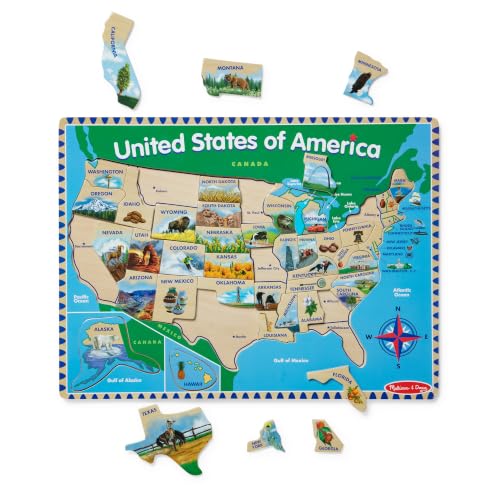
Melissa and Doug World Map Wooden Puzzle
Wooden country pieces lift from a routed tray, color-coded by continent for quick visual grouping. Each piece only seats in its own spot, so a child learns placement without correction. A printed guide adds flags and capitals for major countries once the tray itself feels solved.
Pros
- Self-correcting shapes stop misplaced countries
- Continent color-coding speeds up map memory
- Wooden tray doubles as long-term storage
Cons
- Country pieces run small for a toddler’s grip
- Guide skips detail on smaller nations

Learning Resources Puzzle Globe
Seven continent-shaped pieces slot into an ocean-colored bed to build a full sphere. Assembly teaches shape and relative position before any fact gets read aloud. No batteries and a compact size make it an easy first globe for a shelf or car trip.
Pros
- Hands-on assembly builds shape memory before facts
- Runs without batteries or charging
- Compact size travels easily between rooms
Cons
- Assembled globe sits smaller than a desk globe
- Skips country and capital detail
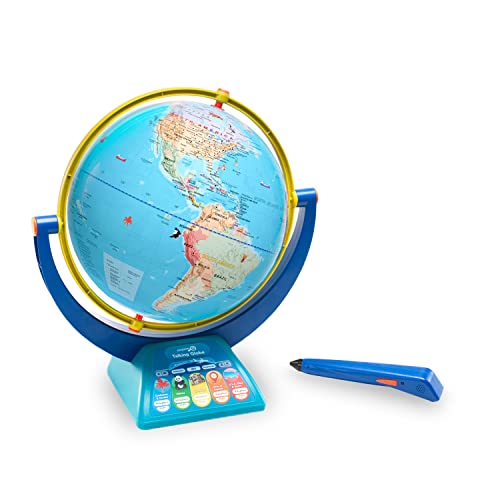
Educational Insights GeoSafari Talking Globe
A handheld stylus taps countries, oceans, and capitals to trigger recorded facts through a built-in speaker. Quiz mode reverses the process, naming a place and waiting for a correct touch. Two AA batteries run the electronics, and volume stays fixed.
Pros
- Quiz mode checks recall without an adult present
- Speaker announces facts on contact
- Sturdy stand suits a desk or shelf
Cons
- Fixed volume gets loud in a shared room
- Batteries drain faster with quiz mode running
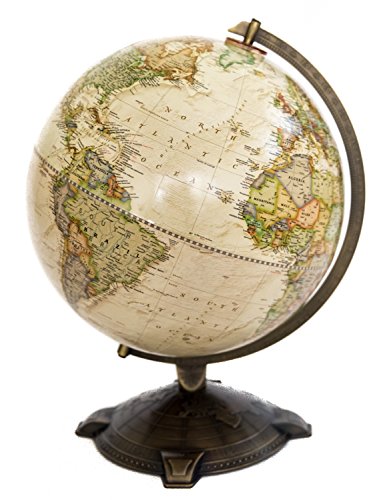
National Geographic Explorer Globe
A flipped switch swaps the daytime political map for a glow-in-the-dark constellation view once the room darkens. A metal meridian arc holds the sphere steady on a weighted base. Political boundaries reflect data current at printing, and older siblings get more from the star chart.
Pros
- Two views extend use past geography lessons
- Weighted base stops the sphere from tipping
- Illumination doubles as a soft nightlight
Cons
- Needs a nearby outlet, not battery powered
- Younger children need help reading small labels

Replogle Explorer 12-Inch Desktop Globe
Raised relief lets a finger feel mountain ranges instead of only seeing them printed flat. Current political boundaries cover countries, capitals, and major cities at a scale small hands can read. No batteries or switches mean it works the same on day one and year five.
Pros
- Raised relief adds a tactile layer beyond flat print
- Full color political detail suits school reports
- Zero ongoing running cost without batteries
Cons
- Small text on countries challenges younger readers
- Base takes permanent desk space
Melissa and Doug USA Map Wooden Puzzle
Forty five wooden state pieces lift from a tray shaped like the continental United States. Each piece carries a printed state name, so recognition builds before spelling does. Regional color-coding matches the World Map Puzzle from the same range for a two-piece home set.
Pros
- Printed state names support recognition before reading fluency
- Matches the World Map Puzzle for a paired set
- Wooden pieces resist daily wear
Cons
- Smaller states like Rhode Island need close handling
- Skips capital or landmark detail

Ravensburger Map of the World XXL 100 Piece Puzzle
One hundred extra-large cardboard pieces assemble into an illustrated world map dotted with animals per continent. Bigger pieces suit a child still building jigsaw stamina, and the finished map works as a bedroom poster. Detail stops at the continent level rather than naming countries.
Pros
- Large pieces suit a child newer to puzzles
- Illustrated animals add context beyond a plain map
- Finished size works as a display poster
Cons
- Cardboard wears faster than the wooden picks here
- Skips individual country labels
The lineup, side by side
| # | Model | Age range | Best for | Score | Price |
|---|---|---|---|---|---|
| 1 | Melissa and Doug World Map Wooden Puzzle | About 4 to 7 years | Best overall | 9.4 | Check price |
| 2 | Learning Resources Puzzle Globe | About 5 to 8 years | Best hands-on globe for beginners | 9.1 | Check price |
| 3 | Educational Insights GeoSafari Talking Globe | About 5 to 10 years | Best interactive talking globe | 8.9 | Check price |
| 4 | National Geographic Explorer Globe | About 8 years and up | Best illuminated globe | 8.6 | Check price |
| 5 | Replogle Explorer 12-Inch Desktop Globe | About 8 years and up | Best desktop reference globe | 8.4 | Check price |
| 6 | Melissa and Doug USA Map Wooden Puzzle | About 5 to 8 years | Best for US geography | 8.2 | Check price |
| 7 | Ravensburger Map of the World XXL 100 Piece Puzzle | About 6 to 10 years | Best budget | 8.0 | Check price |
Questions worth asking
What age should a child start learning geography with toys?
Wooden puzzle maps with large pieces suit children from about four, once shape matching is established. Globes and talking toys ask for more reading and listening, so five and up fits most of them better. Watch the age range printed on the box rather than a general rule.
Is a globe or a puzzle better for teaching geography to kids?
Neither replaces the other, since each teaches something different. A puzzle map builds shape and position on a flat surface. A globe adds the fact that the world is round, which flat paper cannot show. Many families start with a puzzle, then add a globe once that idea is ready to introduce.
Which geography toy teaches country capitals?
Educational Insights’ GeoSafari Talking Globe announces a capital when the stylus touches its country. Melissa and Doug’s World Map Wooden Puzzle includes a printed guide with capitals for major countries, though smaller nations get less detail. Replogle’s Explorer 12-Inch Desktop Globe prints capital cities directly on the surface for reading practice.
Are talking globes accurate and up to date?
Political boundaries shift over time, and any printed or recorded globe reflects data current at manufacture. Educational Insights’ GeoSafari Talking Globe and National Geographic’s Explorer Globe both follow standard atlas data from their production date. Treat a country that recently changed borders or names as an exception worth checking separately.
Can a world map puzzle teach a preschooler continents?
Yes, continent-level recognition is exactly what color-coded pieces are built for. Melissa and Doug’s World Map Wooden Puzzle groups countries by continent color before a child reads a single name. Full country-level recall usually follows later, closer to grade school age.
What is the best geography toy for a homeschool unit?
Replogle’s Explorer 12-Inch Desktop Globe suits report writing and reference use thanks to raised relief detail and a current political map. National Geographic’s Explorer Globe adds a constellation view for a unit pairing geography with basic astronomy. Pick the reference globe when country and capital detail matters most for the assignment.
Do wooden geography puzzles hold up better than cardboard ones?
Generally yes, based on the materials involved. Melissa and Doug’s wooden puzzles use solid wood pieces and a routed tray that resist warping and heavy handling. Ravensburger’s Map of the World XXL Puzzle uses cardboard, which costs less but wears faster at the folds and corners over repeated assembly.
Which geography toy works best for siblings of different ages?
Melissa and Doug’s World Map and USA Map Wooden Puzzles share the same format and color-coding, so an older and younger sibling can each use one at their own pace. Learning Resources’ Puzzle Globe assembles quickly enough for a younger child to join in with help. Talking globes suit solo play more than shared sessions, since only one stylus reads at a time.
Our pick
Melissa and Doug’s World Map Wooden Puzzle takes the top spot because self-correcting wooden pieces teach continent shapes without constant adult help, and the tray survives years of handling. Families past that early stage should look at Replogle’s Explorer 12-Inch Desktop Globe for raised relief detail and country-level reference. Households wanting hands-off audio facts get more from Educational Insights’ GeoSafari Talking Globe, provided fresh batteries stay on hand.
Rachel Simmons
Rachel previously worked in child-product retail and brings a practical, detail-first eye to gear reviews, focusing on safety standards, ease of use and the fine print that matters most for new caregivers.


