Which Generator Transfer Switch Fits Your Panel?
Reliance Controls 31410CRK Pro/Tran leads: ten switched circuits at 30 amps, plus two watt meters reading each generator leg. Generac 6853 HomeLink suits 50 amp generators and a later automatic upgrade. Siemens ECSBPK02 interlock keeps every panel circuit live without adding an enclosure.
Reliance Controls 31410CRK Pro/Tran fits a typical house running a 30 amp portable generator. Ten switched circuits cover furnace, fridge, well pump and two lighting runs. Watt meters on both legs stop you loading one side while the other idles. Capacity is the ceiling here, so central air conditioning stays off the list.
Amperage, inlet plug and cord all have to match, and one wrong part stalls the whole install. Three routes compete: a switched subpanel, a mechanical interlock on your existing panel, or a collar behind the meter. We compared circuit counts, rated amps, inlet configurations and panel compatibility from manufacturer documentation. Installer feedback on wiring hours and inspection outcomes settled the close calls. Permits and a licensed electrician apply in most jurisdictions.
What we recommend
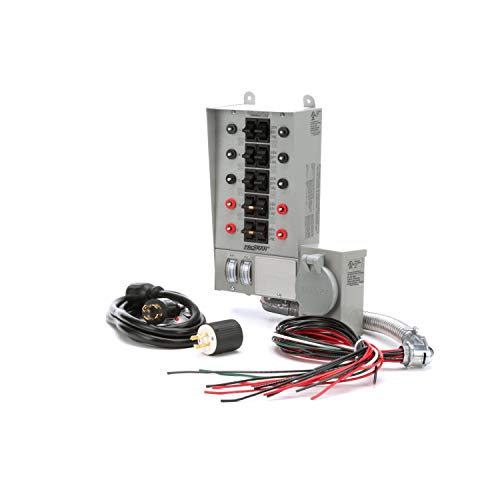
Reliance Controls 31410CRK Pro/Tran 10-Circuit Transfer Switch Kit
Ten circuits flip individually between utility and generator power, so you choose what runs. Two analogue watt meters read each 120 volt leg, which turns load balancing into a glance. Kit contents include a power inlet box and a 10 foot cord, leaving conduit and wire as the only extras.
Pros
- Watt meters expose leg imbalance before a breaker trips
- Inlet box and generator cord ship in the same kit
- Pre-wired conduit whip cuts electrician hours
Cons
- Ten circuits leave central air conditioning unpowered
- Second enclosure needs wall space beside the main panel

Generac 6853 HomeLink 50-Amp Upgradeable Manual Transfer Switch
Fifty amps runs a well pump and a window air conditioner together, which 30 amp panels rarely manage. Circuits get assigned with standard breakers, so the load list can be rearranged years later. Generac built the enclosure to accept an automatic standby conversion without replacing it.
Pros
- Breaker slots can be reassigned as loads change
- Headroom for 240 volt motor loads
- Converts to an automatic system later
Cons
- Capacity goes unused without a 50 amp generator
- Enclosure footprint exceeds 30 amp panels

Connecticut Electric EGS107501G2 EmerGen Switch 10-Circuit
Ten toggles and a 30 amp rating mirror the Reliance layout with a simpler front panel. Status lights, not watt meters, show whether each circuit currently sits on line or generator. Writable labelling strips inside the steel enclosure let you record actual room names.
Pros
- Cord and inlet box arrive in the same carton
- Writable strips make circuits identifiable at night
- Matches metered panels on circuit count
Cons
- Leg balancing stays manual without watt meters
- Steel enclosure belongs indoors or under cover

GenerLink 40-Amp Meter-Mounted Transfer Switch
Mounting behind the electric meter feeds the entire panel, so no circuits get chosen in advance. Built in load management sheds demand as the generator nears its limit. Your utility has to approve the device first, and plenty of providers decline.
Pros
- Skips subpanel wiring and circuit selection
- Any outlet in the house works during an outage
- Installation takes under an hour once approved
Cons
- Utility permission is mandatory and often refused
- Whole panel access makes overloading easy

Siemens ECSBPK02 Generator Standby Power Mechanical Interlock Kit
A sliding steel plate blocks the main and generator breakers from closing together, which is what stops backfeed. Existing panel circuits all stay available, since nothing moves to a subpanel. Fitment is narrow: only listed Siemens and Murray load centres accept the plate.
Pros
- Every household circuit stays usable on generator
- Nothing extra hangs on the wall
- Fewest parts of any option listed
Cons
- Fits only matching Siemens and Murray load centres
- Breaker, inlet box and cord are separate buys

Reliance Controls 306CRK Pro/Tran 6-Circuit Transfer Switch Kit
Six circuits cover the short list a cabin actually needs: well pump, fridge, furnace and lighting. Compact enclosure slips into utility rooms where a ten circuit panel will not sit flat. Packaging matches the larger Pro/Tran, with an L14-30 inlet box and a 10 foot cord.
Pros
- Fits walls that cannot take a 10 circuit panel
- Inlet box and generator cord included
- Short circuit list is easy to memorise
Cons
- Six circuits fill up fast in a family home
- No watt metering on this model

Reliance Controls TF151W Transfer Switch for Furnace
One 15 amp circuit moves between utility and generator, normally a gas furnace or a boiler. Wiring runs appliance to box, then out to an ordinary 120 volt extension cord, so no 240 volt inlet is required. Heat during an outage becomes possible without adding a subpanel.
Pros
- Works with any 120 volt portable generator
- Small box mounts beside the furnace itself
- Simplest safe way to keep heat running
Cons
- Covers a single circuit only
- Cannot run 240 volt appliances at all
How to choose
How a generator transfer switch works Isolation is the entire job. A transfer switch disconnects chosen circuits from the utility before generator power reaches them. Without that break, current climbs back up the service drop and re-energises lines a crew believes are dead. Extension cords dodge the problem but leave hardwired loads such as furnaces and well pumps unpowered. Every option here achieves isolation differently: switched circuits, a mechanical interlock plate, or a collar behind the meter.
Matching amps, inlet plugs and cords Size the switch to the generator outlet, not to the wish list. A 30 amp L14-30 outlet supplies roughly 7500 watts at 240 volts, split across two 120 volt legs. Add running watts for furnace, fridge, well pump and lights, then leave headroom for starting surge, which can triple a motor draw for a second. Balance counts as much as total load, and watt meters on the 31410CRK make imbalance visible. Cord gauge follows from the same amperage, since undersized cable heats up under sustained 30 amp draw.
Switch panel vs interlock kit vs meter collar Panel type usually decides the route. Switched subpanels like the Pro/Tran give labelled circuits and metering, at the cost of wall space and wiring hours. Interlock kits reuse your existing breakers and keep every circuit live, though the plate must be listed for your exact load centre and you manage load yourself. Meter collars such as GenerLink install fastest and skip circuit selection entirely, with utility approval as the gate. Cabin owners with a four item load list often do better with the six circuit 306CRK than any whole panel approach.
Installation, permits and inlet box placement NEC Article 702 covers optional standby systems, and most jurisdictions treat this as permitted work. A licensed electrician handles the panel side, while homeowners can often run conduit and mount the inlet box beforehand to cut labour hours. Site the inlet away from windows, doors and vents, because exhaust must stay outside the building envelope. Cord length dictates generator position: 10 feet pins the unit close to the wall, so many owners move up to 25 feet. Write circuit labels while the panel is open, since nobody recalls the list during a 2am outage.
Compared at a glance
| # | Model | Circuits | Best for | Score | Price |
|---|---|---|---|---|---|
| 1 | Reliance Controls 31410CRK Pro/Tran 10-Circuit Transfer Switch Kit | 10 individually switched | Best overall | 9.4 | Check price |
| 2 | Generac 6853 HomeLink 50-Amp Upgradeable Manual Transfer Switch | 50A, 12500 running watts | Best for large generators | 9.2 | Check price |
| 3 | Connecticut Electric EGS107501G2 EmerGen Switch 10-Circuit | 10 individually switched | Best value | 9.0 | Check price |
| 4 | GenerLink 40-Amp Meter-Mounted Transfer Switch | 40A | Best for whole panel access | 8.8 | Check price |
| 5 | Siemens ECSBPK02 Generator Standby Power Mechanical Interlock Kit | Mechanical interlock plate | Best budget | 8.6 | Check price |
| 6 | Reliance Controls 306CRK Pro/Tran 6-Circuit Transfer Switch Kit | 6 individually switched | Best for cabins and small homes | 8.3 | Check price |
| 7 | Reliance Controls TF151W Transfer Switch for Furnace | 1 circuit | Best for a single essential circuit | 8.0 | Check price |
Good to know
What size transfer switch do I need for my generator?
Match the switch to the generator’s largest outlet. A 30 amp L14-30 generator pairs with a 30 amp switch rated near 7500 watts. Step up to a 50 amp unit like the Generac 6853 only when the generator carries a 50 amp receptacle.
Is an interlock kit as safe as a transfer switch?
Listed for your specific panel and installed correctly, an interlock delivers identical electrical isolation. Difference lies in management, not safety. Every circuit stays live behind an interlock, so you switch off the water heater and range yourself before starting.
Can I install a generator transfer switch myself?
Most areas require a licensed electrician and a permit, because the work reaches into the service panel. Even where DIY is permitted, an inspection protects your insurance position. Mounting the inlet box and running conduit yourself still trims the electrician’s hours.
How many circuits should a transfer switch cover?
Six handles heat, a fridge and lighting in a small house. Ten adds a well pump, sump pump and spare outlet circuits, which covers most family homes. Whole panel access only makes sense with a large generator or strict load discipline.
Why is backfeeding through a dryer outlet dangerous?
A double ended cord energises the panel with nothing isolating the utility, pushing current back through the transformer and stepping it up. Line crews can be electrocuted by that path. Exposed prongs on the cord stay live the whole time too.
Does a manual transfer switch work with any portable generator?
It works whenever the outlet and amperage match the inlet. Check plug configuration first, commonly L14-30 on 30 amp units and L14-50 or SS2-50 on 50 amp units. Inverter generators connect fine provided the receptacle matches.
GenerLink vs a manual transfer switch: which should you buy?
GenerLink installs faster and powers the whole panel, but hinges on utility approval and offers no circuit selection. Manual panels such as the 31410CRK give labelled control plus metering, which keeps a small generator from being overloaded.
Can a transfer switch run central air conditioning?
Rarely on a 30 amp setup, since compressor start surge alone can exceed generator output. A 50 amp switch feeding a large generator can manage a smaller condenser, usually after a soft start kit is fitted.
What is the difference between a manual and an automatic transfer switch?
Manual units need someone to start the generator and throw switches. Automatic switches sense the outage, start a standby unit and transfer within seconds, then hand back when utility power returns. Generac’s 6853 sits between the two, since its enclosure accepts an automatic conversion.
Do I need a transfer switch for an inverter generator?
Yes, whenever the generator feeds anything wired into the house. Inverter models produce cleaner sine wave output, which suits electronics, but they backfeed exactly like conventional sets. Smaller inverter units with only 120 volt outlets pair with a single circuit switch such as the TF151W.
The verdict
Buy the Reliance Controls 31410CRK Pro/Tran for a typical house on a 30 amp portable generator, mainly because its watt meters stop one leg from carrying the whole load. Owners with a 50 amp generator, or plans to add automatic standby later, should take the Generac 6853 HomeLink instead. Where the load centre is a listed Siemens or Murray panel and hardware count matters most, the ECSBPK02 interlock gives the same isolation with nothing added to the wall.
Sierra Daniels
Sierra's background is in landscape design and nursery retail. She focuses on lawn and garden equipment, outdoor furniture and gear durability, weighing published specs against how materials actually hold up outside.
You might also need

Minikey Solar Bird Feeder Camera: Is the AI Bird ID Worth the Subscription?

Refresh Sports Glider Ray Pool Torpedo: A Good Pick for Underwater Pool Play?

Sweet Home Collection Patio Chair Cushions: Enough Padding for Daily Outdoor Use?
