7 Gas Water Heaters That Heat Fast and Last Longer
The Rinnai RU199iN leads for a whole house tankless upgrade, with high flow and condensing efficiency built in. Rheem’s Performance Platinum tank suits a straightforward swap for an existing vented setup. Takagi’s T-H3-DV-N covers smaller homes at a lower cost, still with condensing efficiency and a compact wall mount.
The Rinnai RU199iN carries the flow rate to run several fixtures at once, making it the pick for a whole house tankless swap. Rheem’s Performance Platinum tank is the simpler path if a vented tank already sits in place. Takagi’s T-H3-DV-N covers smaller homes for less, still with condensing efficiency.
Tank models quote capacity in gallons while tankless models quote flow in gallons per minute, so the headline numbers rarely compare directly. Neither figure reveals whether an existing gas line or flue can support the unit. We compared published BTU input, flow rate, efficiency ratings, and venting needs, then flagged where installation limits matter more than the spec sheet. Gas appliance work belongs to a licensed professional, not a weekend project.
Before you buy
Tankless or storage tank, which fits your house A storage tank keeps a fixed volume hot around the clock, giving instant availability with a hard limit once it runs dry. A tankless unit heats on demand with no standing losses and no duration limit, but a firm ceiling on flow at any single moment. Households that shower back to back tend to prefer tankless. Homes with an existing flue and a modest budget usually come out ahead replacing like with like. Installation cost, more than appliance cost, usually decides it.
How to size a tankless unit by flow and temperature rise Tankless capacity gets quoted in gallons per minute at a stated temperature rise, and both numbers matter together. A unit rated at 11 gallons per minute assumes a small rise from warm inlet water. Incoming water can run 40 degrees colder in a northern winter, and the same unit then delivers far less. Add up the flow demand of fixtures you would run at once, check your coldest inlet temperature, and size from that number instead of the headline rating.
Venting, gas supply, and combustion air requirements This is where installations get expensive. Condensing tankless units vent through PVC because their exhaust runs cooler, while atmospheric tanks need a proper metal flue with adequate draft. Many tankless units also need a larger gas line than an old tank required, since peak input runs far higher. Combustion air supply matters too, especially in a sealed utility closet. Ask a licensed installer to assess gas line size, flue routing, and air supply before choosing a model, since those constraints often narrow the field on their own.
Efficiency, maintenance, and expected lifespan Uniform energy factor ratings let you compare running efficiency across models, with condensing tankless units at the top and atmospheric tanks at the bottom. Maintenance differs too: tanks need periodic anode rod checks and flushing to control sediment, while tankless units need descaling on a schedule tied to water hardness. Skipping descaling in hard water areas shortens tankless life significantly. Budget for that servicing when comparing lifetime cost, not just the purchase price.
The top picks, ranked
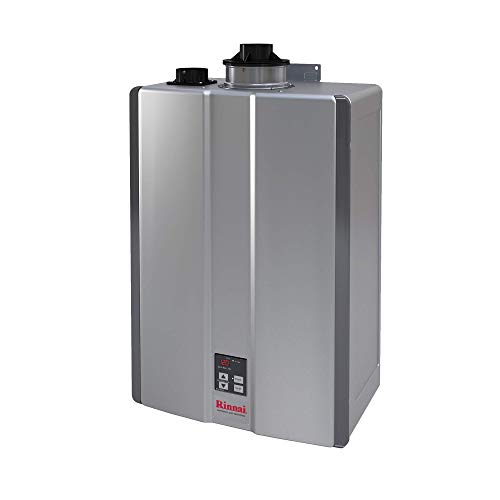
Rinnai RU199iN Tankless Water Heater
This condensing indoor unit outputs enough flow to run two or three fixtures at once in most climates, where cheaper tankless models fall short. Condensing design pulls extra heat from the exhaust, so it vents through PVC instead of metal flue. Check the existing gas line size first, since peak input runs high enough to need an upgrade in older homes.
Pros
- High flow supports multiple fixtures at once
- Condensing design lowers running cost
- Vents through inexpensive PVC pipe
Cons
- Often needs a larger gas line
- Higher upfront and installation cost

Rheem Performance Platinum Natural Gas Water Heater
Swapping this in for an old vented tank means reusing the same footprint and flue, with little disruption. A self-diagnostic control module and a leak-detection shutoff come built in. Standing heat loss keeps it behind tankless on efficiency, but installation stays far simpler and cheaper.
Pros
- Straightforward replacement for an old tank
- Leak detection and automatic shutoff included
- Lower installation cost than tankless
Cons
- Standing losses raise running cost over time
- Hot water runs out under heavy demand

Takagi T-H3-DV-N Tankless Water Heater
Direct vent operation and condensing efficiency come at a lower outlay than the flagship Rinnai, fitting homes with one or two bathrooms. Flow output steps down a notch, which shows if two showers run at once in cold weather. Owners describe the controls as basic but reliable once set.
Pros
- Condensing efficiency at a lower price
- Direct vent simplifies flue routing
- Compact wall mounted footprint
Cons
- Struggles with simultaneous heavy demand in cold inlet water
- Control interface stays basic
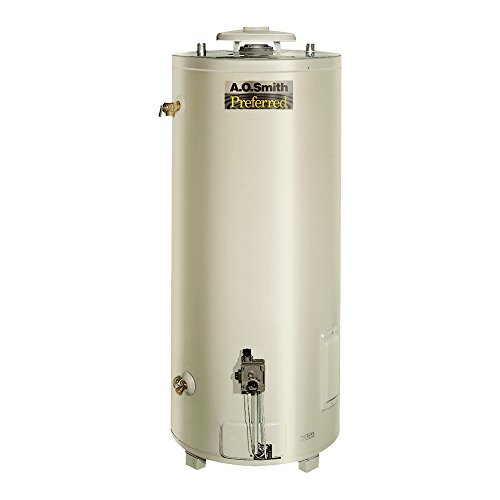
A.O. Smith Signature 100 Natural Gas Water Heater
A 40 gallon tank fits one or two people, or a small household where 50 gallons is more capacity than needed. Installation stays simple thanks to a conventional atmospheric flue. Recovery rate matters here, since a smaller tank only refills fast if burner input keeps pace.
Pros
- Right sized for small households
- Simple, well understood installation
- Replaceable anode rod extends tank life
Cons
- Smaller reserve for back to back showers
- Standing heat loss like every tank model

Noritz NR501-OD Tankless Water Heater
Mounting outdoors sidesteps the venting question entirely, which suits mild climates where hard freezes stay rare. A single bathroom or a workshop sink covers its realistic use case. Cold-region owners need to check the built-in freeze protection and add pipe insulation before relying on it.
Pros
- No flue or venting work required
- Frees up indoor installation space entirely
- Simple install in mild climates
Cons
- Not suited to hard freezing climates
- Lower flow limits it to one fixture

Camplux 5L Outdoor Portable Propane Water Heater
A small propane burner, shower head, and hose pack into a unit light enough to hang from a van or a tree branch. It runs off a standard propane cylinder, aimed at camping, horse washing, and outdoor rinse-offs rather than a house. Water pressure needs stay low enough to work from a small pump and a jerry can.
Pros
- Genuinely portable, with a shower kit included
- Works from a small pump and low pressure
- Runs off standard propane cylinders
Cons
- Outdoor use only, never in enclosed spaces
- Very low flow rate limits it to a quick rinse

Eccotemp L10 Portable Tankless Water Heater
This unit covers the same portable propane brief as the Camplux for less, using simple two-dial controls for gas and water. Cabins, outdoor kitchens, and dog-washing stations are common use cases. Build quality stays basic, and the most frequent owner complaint traces back to weak batteries in the ignition.
Pros
- Low cost for propane hot water anywhere
- Simple manual controls for gas and water
- Higher rated flow than the smallest portable units
Cons
- Ignition performance depends on battery condition
- Not rated for indoor or enclosed use
How they stack up
| # | Model | Type | Best for | Score | Price |
|---|---|---|---|---|---|
| 1 | Rinnai RU199iN Tankless Water Heater | Condensing tankless, indoor | Best overall | 9.4 | Check price |
| 2 | Rheem Performance Platinum Natural Gas Water Heater | Atmospheric vent storage tank | Best tank replacement | 9.2 | Check price |
| 3 | Takagi T-H3-DV-N Tankless Water Heater | Condensing tankless, direct vent | Best value tankless | 9.0 | Check price |
| 4 | A.O. Smith Signature 100 Natural Gas Water Heater | Atmospheric vent storage tank | Best for smaller households | 8.8 | Check price |
| 5 | Noritz NR501-OD Tankless Water Heater | Outdoor tankless | Best for outdoor installation | 8.6 | Check price |
| 6 | Camplux 5L Outdoor Portable Propane Water Heater | Portable propane tankless | Best for camping and off grid | 8.3 | Check price |
| 7 | Eccotemp L10 Portable Tankless Water Heater | Portable propane tankless | Best budget portable | 8.0 | Check price |
Good to know
Is a tankless gas water heater worth it?
It is when hot water demand runs high or extended and your gas line and venting can support one. You get unlimited duration and lower standing losses. Installation costs more up front, and hard water areas need periodic descaling.
What size gas water heater do I need?
For tanks, 40 gallons suits one or two people and 50 gallons covers a typical family. For tankless, add up the flow rate of fixtures you would run at once and check output at your coldest inlet temperature, not the best case rating.
Can I install a gas water heater myself?
Gas appliance work involves fuel connections, combustion air, and flue gas, and most areas regulate it. Use a licensed installer. An incorrectly vented gas appliance can release carbon monoxide into the house.
What is the difference between condensing and non-condensing?
Condensing units pull extra heat from exhaust gases, raising efficiency and allowing PVC venting because the flue gas runs cooler. Non-condensing units exhaust hotter air and need metal venting. Condensing models cost more upfront but generally use less gas.
How long does a gas water heater last?
Storage tanks commonly last eight to twelve years, with anode rod condition and water hardness making a large difference. Tankless units often pass fifteen years when descaled on schedule. Neglected maintenance shortens both.
Do tankless heaters work during a power cut?
Most modern tankless units need mains power for the control board, ignition, and fan, so they stop when power does. Older atmospheric tanks with a standing pilot keep producing hot water, a real advantage they retain.
Why does my tankless unit run cold for a few seconds?
That gap is usually cold water sitting in the pipe between unit and tap, plus the moment the burner takes to fire when flow starts. Low flow fixtures can also fall below the activation threshold. A recirculation setup shortens the wait if your plumbing supports it.
Can I use a portable propane heater indoors?
No. Portable outdoor units like the Camplux and Eccotemp are built for outdoor and well ventilated use, since they produce combustion gases including carbon monoxide. Never run one inside a tent, van, bathroom, or any enclosed space.
Gas vs electric water heater, which costs less to run?
Gas units generally cost less to operate where natural gas prices stay low relative to electricity, and they recover faster after heavy use. Electric models cost less to install and need no venting at all.
The verdict
The Rinnai RU199iN is the target for a whole house tankless conversion, provided the gas line and venting support it. Rheem’s Performance Platinum works out cheaper to install when an existing vented tank already sits in place. Confirm gas sizing and flue routing with a licensed installer before committing to any model.
Jake Monroe
Jake worked as a residential contractor for over a decade before shifting to full-time writing. He evaluates power tools, hand tools and workshop gear through the lens of someone who has actually used them on job sites, not just read the box.