French Press Mug Picks for Commuters and Campers
Bodum Travel Press leads overall: 15 ounces of coffee, a double wall steel body, and a spare sealing lid for the drive. Espro Travel Press filters finer, so silt never reaches the last mouthful. Groups at a trailhead want Stanley’s 48 ounce Classic Stay Hot French Press.
Bodum Travel Press fits most commuters. Fifteen ounces equals a normal mug, and the second sealing lid stops a car cup from sloshing. Its steel mesh does pass fine silt, the standard French press tradeoff. Espro Travel Press fixes the grit; the Stanley Classic handles a group.
Every press mug shares one flaw. Coffee sits on the grounds after you plunge, so it keeps extracting and turns bitter by the second half. We compared filter construction, insulation, capacity, and whether the design isolates the bed of grounds. Owner reports about leaking lids and grounds jammed in lid threads settled the close rankings.
The top picks, ranked

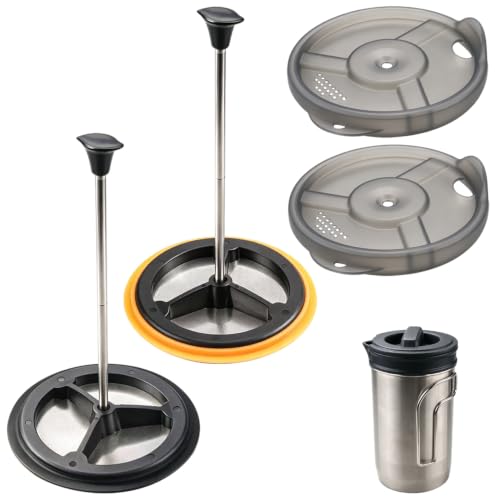
Bodum Travel Press with Extra Lid, 15 Ounce
Bodum drops its plunger mechanism into a double wall stainless body holding 15 ounces. That is a full mug of coffee rather than a token cup, so one brew usually covers the drive. Two lids ship in the box: press through the open one, then swap to the sealing lid before you set off.
Pros
- Fifteen ounces matches a standard mug serving
- Spare lid seals the mug shut for a car journey
- Steel mesh passes coffee oils for a fuller body
Cons
- Fine silt slips past the mesh into the last sip
- Extraction continues on the grounds after plunging

Espro Travel Coffee Press, 12 Ounce
Espro runs a double micro filter fine enough to hold back the silt a single mesh screen passes, so the bottom of the cup tastes like the top. Sealing around the grounds once plunged, that basket also slows extraction and delays bitterness on a long drive. Capacity is the smallest here at 12 ounces, and the basket wants a proper rinse rather than a shake.
Pros
- Sediment free in a way mesh screens never manage
- Sealed basket holds off over extraction
- Handles loose leaf tea without leaving leaf dust
Cons
- Twelve ounces runs short for a full morning
- Filter basket takes real effort to clean

BruTrek OVRLNDR Press, 20 Ounce
A BruStop disk closes over the bed of grounds when the plunger bottoms out, ending extraction mechanically instead of asking you to drink fast. Twenty vacuum insulated ounces cover two mugs or one slow morning. Every component unscrews, which keeps grounds from collecting in threads where most press mugs go stale.
Pros
- Coffee still tastes right an hour after the plunge
- Twenty ounces removes the need for a second brew
- Strips down completely for a thorough wash
Cons
- Wider and heavier than a plain travel mug
- More parts to reassemble each morning

Stanley Classic Stay Hot French Press, 48 Ounce
Think of this as a vacuum flask that brews: 48 ounces of coffee inside 18/8 stainless, pressed once at the trailhead. Three or four people get a full cup with refills left over. Bulk rules out a commute, and Stanley backs the body with a lifetime warranty.
Pros
- Serves three or four people from a single press
- Double wall vacuum holds heat through a cold morning
- Survives truck beds, campsites and rough handling
Cons
- Too tall and wide for a car cup holder
- A batch left on the grounds turns bitter

GSI Outdoors Commuter JavaPress, 15 Ounce
Pack weight drives the whole design, since a BPA free copolyester body lands near seven ounces empty. Descending through the brew, the silicone rimmed plunger wipes the wall and pins more grounds below the screen. Insulation is thin next to vacuum steel, so coffee cools faster once the air turns cold.
Pros
- Light enough to earn a slot in a backpack
- Silicone rim traps grounds a loose screen misses
- Nests inside other GSI camp cookware
Cons
- Copolyester body loses heat quickly in cold air
- Plastic holds coffee odour more than stainless
Stanley Adventure All-in-One Boil + Brew French Press, 32 Ounce
One stainless vessel boils water straight on a camp stove, then becomes the press when grounds go in. Your kit list loses a pot. Two insulated cups nest onto the base for a pair of campers, and 32 ounces makes this camp gear rather than a commuter mug.
Pros
- Replaces a pot and a separate press with one item
- Nesting cups keep the pack compact
- Simple build with almost nothing to break
Cons
- No vacuum wall, so brewed coffee cools quickly
- Exterior blackens over an open flame

Coffee Gator French Press Travel Mug
Coffee Gator covers the essentials: a double wall stainless body, a multi layer steel filter and a screw on travel lid. Its tapered base drops into a standard car cup holder, which several wider press mugs cannot manage. Tolerances sit below Bodum and Espro, so grounds gather in the lid threads unless you rinse them out.
Pros
- Lowest outlay for brewing in the mug you drink from
- Tapered base fits holders that reject wider presses
- Layered mesh stops more grounds than one screen
Cons
- Grounds collect in the screw threads
- Heat retention trails the vacuum insulated models
Side by side
| # | Model | Capacity | Best for | Score | Price |
|---|---|---|---|---|---|
| 1 | Bodum Travel Press with Extra Lid, 15 Ounce | 15 ounces | Best overall | 9.4 | Check price |
| 2 | Espro Travel Coffee Press, 12 Ounce | 12 ounces | Best for grit-free coffee | 9.2 | Check price |
| 3 | BruTrek OVRLNDR Press, 20 Ounce | 20 ounces | Best for stopping over-extraction | 8.9 | Check price |
| 4 | Stanley Classic Stay Hot French Press, 48 Ounce | 48 ounces | Best for sharing outdoors | 8.7 | Check price |
| 5 | GSI Outdoors Commuter JavaPress, 15 Ounce | 15 ounces | Best for backpacking | 8.5 | Check price |
| 6 | Stanley Adventure All-in-One Boil + Brew French Press, 32 Ounce | 32 ounces | Best for camp stoves | 8.2 | Check price |
| 7 | Coffee Gator French Press Travel Mug | Double wall stainless steel | Best budget | 8.0 | Check price |
What to look for
How a press mug differs from a full French press A carafe press exists to be decanted. You plunge, then pour the coffee away from the grounds, and brewing stops there. Mug versions cannot do that, because the grounds stay in the vessel you drink from. Everything else follows from that one fact. Brewing itself is identical: coarse grind, water just off the boil, roughly four minutes of contact. What changes is the clock, which keeps running after the plunge. Two designs attack the problem directly. Espro seals the grounds inside its filter basket, and BruTrek drops a BruStop disk over them.
What to look for in a filter and a grind Sediment in the last mouthful is the complaint owners raise most, and grind causes it more often than the mug. Espresso grind passes any steel mesh as dust. Coarse, even particles from a burr grinder mostly stay under the screen. Filter layers matter next: one mesh screen leaks more than the multi layer stack on the Coffee Gator, and both leak more than Espro’s micro filter. Supermarket pre ground coffee sits between those extremes and works acceptably in a layered filter. Skip a blade grinder if grit bothers you, since it produces both boulders and dust in the same batch.
Insulation, heat and the hour after you plunge Vacuum insulated stainless keeps coffee hot for hours. That is the whole point of the Bodum, Espro, BruTrek and Stanley Classic bodies. Single wall copolyester on the GSI JavaPress trades heat retention for pack weight, a fair swap when you carry it all day. Heat cuts both ways in a press mug, though. Hot liquid sitting on grounds extracts faster, so a well insulated mesh mug turns bitter sooner than a cool one. Insulation plus sealed grounds is the only pairing that protects temperature and taste past half an hour. BruTrek offers exactly that combination.
Best french press mug for commuting, camping or a group Commuters want 12 to 16 ounces, a base that clears a cup holder and a lid that actually seals, which points to the Bodum Travel Press or the Coffee Gator. Backpackers count ounces and take the GSI JavaPress. Car campers cooking on a stove save a pot with the Stanley Adventure boil and brew unit. Groups need the 48 ounce Stanley Classic, poured out into cups early so the batch does not stew. Owning two is common, since no single vessel serves a desk and a campsite equally well. Avoid a mug larger than 20 ounces if you drink alone, because the surplus goes bitter before you reach it.
Questions worth asking
How do you make coffee in a French press mug?
Measure roughly two tablespoons of coarse ground coffee per eight ounces. Pour water just off the boil, stir once, and wait about four minutes. Press the plunger down slowly, then drink within twenty minutes before the grounds push it bitter.
Why is my French press coffee gritty?
Grind size is the usual culprit. Blade grinders and pre ground espresso blends make dust that walks straight through steel mesh. Move to a coarse burr grind, or pick a mug with a micro filter such as the Espro Travel Press.
Can you leave coffee sitting on the grounds in a press mug?
It carries on extracting and turns bitter. Sealed designs slow that down a lot, including the BruTrek BruStop disk and the Espro filter basket. With a plain mesh plunger, aim to finish inside twenty to thirty minutes.
What grind size works best in a travel French press?
Coarse, roughly the texture of sea salt. Fine particles clog mesh, make the plunger hard to push and load the cup with silt. Consistency beats the exact setting, which is why a burr grinder improves press coffee more than a better mug does.
Bodum Travel Press vs Espro Travel Press: which is better?
Bodum gives you 15 ounces, a spare sealing lid and a lower outlay. Espro holds 12 ounces, filters out sediment and seals the grounds off after the plunge. Volume favours Bodum; a clean final mouthful favours Espro.
Are French press mugs dishwasher safe?
Some are, though most makers advise hand washing to protect lid seals and vacuum insulation. Either way, rinse the filter straight after use. Dried coffee oils build up in mesh and threads, go rancid, and are what makes an old press mug taste stale.
Which French press mug works on a camp stove?
Only the Stanley Adventure All-in-One Boil and Brew, which is built to have water boiled in it before grounds go in. Never put a vacuum insulated mug over a flame. Heating a sealed double wall vessel builds pressure between the walls.
How long does coffee stay hot in an insulated press mug?
Vacuum insulated steel bodies hold drinking temperature for several hours, and the 48 ounce Stanley Classic runs longest. Copolyester bodies like the GSI JavaPress fade within an hour outdoors. Preheating with hot water before brewing buys extra time on any of them.
Can you brew loose leaf tea in a French press mug?
Yes, and the fine screens handle it better than coarse ones. Espro’s micro filter catches leaf dust that mesh lets through. Use a separate mug for tea if you brew both, because coffee oils soak into seals and taint delicate leaves.
Is a French press mug better than an AeroPress for travel?
A press mug brews and serves in one vessel with nothing to discard, which suits a car or a desk. An AeroPress needs a separate cup and paper filters, but it packs smaller and makes cleaner coffee. Convenience goes to the press mug.
The verdict
Buy the Bodum Travel Press for daily commuting. Fifteen ounces, a steel body and the spare sealing lid cover what a morning drive actually demands, and nothing about it needs learning. Anyone who keeps tasting silt in the final mouthful should spend more on the Espro Travel Press for its micro filter. Trailheads and campsites with several coffee drinkers call for the 48 ounce Stanley Classic Stay Hot French Press instead.
Dana Whitfield
Dana spent eight years buying and merchandising for a regional kitchenware retailer before moving into editorial work. She has handled thousands of SKUs across cookware, small appliances and kitchen organization, and focuses on the practical differences that matter once a product is actually in daily use.


