Footrests That Make a Long Desk Day Feel Easier
The ErgoFoam Adjustable Tilting Footrest is the strongest all-around pick, combining independent height and tilt control with memory foam cushioning most footrests skip. The Vari Under Desk Footrest suits standing desk users specifically, while the HUANUO Adjustable Angle Footrest fits anyone who wants solid adjustability without a premium price.
The ErgoFoam Adjustable Tilting Footrest stands out because its independent height and tilt controls let it match a wider range of desk and chair setups than fixed-angle footrests, while memory foam cushioning softens pressure points a hard plastic platform would not. Its main limitation is a larger footprint that takes up more floor space than simpler flat footrests.
We compared published adjustment ranges, platform materials, movement mechanisms and base designs across each listing rather than running our own comfort tests.
What matters most
What to look for in a footrest Adjustment range decides how well a footrest matches an individual desk and chair combination, from the Fellowes Standard’s fixed angle to the ErgoFoam’s independent height and tilt controls. Platform material affects comfort directly, with memory foam options like the Everlasting Comfort footrest feeling noticeably softer than plastic or rubberized surfaces. Movement design, whether fixed, tilting or freely rocking, changes how much the foot and ankle move during long periods of use. Base stability keeps the footrest in place, especially important on hard flooring where slipping is more likely.
Fixed versus adjustable footrests A fixed-angle footrest like the Fellowes Standard keeps things simple, with one platform position that works fine for users who do not need to fine-tune height or angle. Adjustable models, including the HUANUO Adjustable Angle Footrest and ErgoFoam, let users match the rest to specific chair heights or desk setups, useful for shared workstations or multiple users. The tradeoff is usually cost and a slightly bulkier design on adjustable models compared to simple fixed platforms.
Cushioning and material choices Memory foam platforms, used on the ErgoFoam and Everlasting Comfort footrests, soften pressure points more than firmer rubber or textured plastic surfaces. Firmer platforms, like the Kensington SoleMate’s contoured design, offer more stability for users who prefer a defined foot position over a plush, shifting surface. Removable, washable covers, found on the HUANUO and Everlasting Comfort models, matter most for anyone using a footrest daily in sock or bare feet.
Footrests for sitting versus standing desks Most footrests here are built with seated use in mind, supporting the foot at an angle that reduces strain while sitting for extended periods. The Vari Under Desk Footrest is designed specifically around standing desk use, with a rocker shape meant to relieve pressure during standing rather than sitting. Anyone switching between sitting and standing throughout the day should consider whether a single footrest needs to serve both positions or if a dedicated standing design works better.
What we recommend
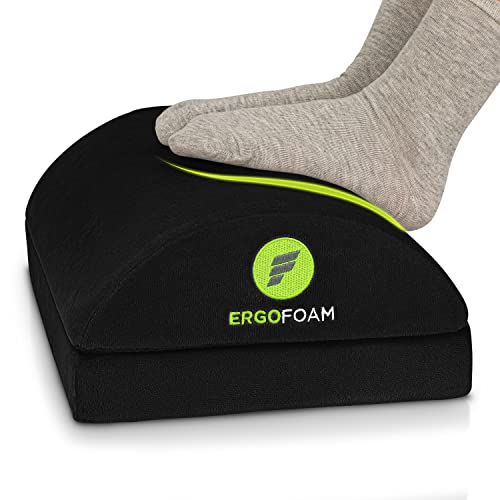
ErgoFoam Adjustable Tilting Footrest
A tilting platform rocks forward and back, encouraging slight ankle movement rather than keeping the foot locked in one static position all day. Memory foam cushioning on the platform surface softens pressure points compared to hard plastic footrests. Height and angle both adjust independently, letting users match the rest to their chair and desk setup.
Pros
- Rocking tilt motion encourages ankle movement during long sitting
- Memory foam cushioning softens pressure compared to hard plastic
- Independent height and angle adjustment fits more desk setups
Cons
- Tilting motion takes some adjustment for users new to the design
- Larger footprint than flat, non-adjustable footrests

HUANUO Adjustable Angle Footrest
This footrest offers angle adjustment and a textured, non-slip surface at a lower cost than premium ergonomic brands. A removable cover allows washing after extended use, a detail missing from many footrests in this price range. Rubber grips on the underside keep the unit from sliding across hard flooring during use.
Pros
- Lower cost than premium ergonomic footrest brands
- Removable, washable cover keeps the surface clean over time
- Rubber underside grips prevent sliding on hard flooring
Cons
- Fewer adjustment positions than the ErgoFoam’s independent controls
- Less cushioning than foam-topped footrests for extended use
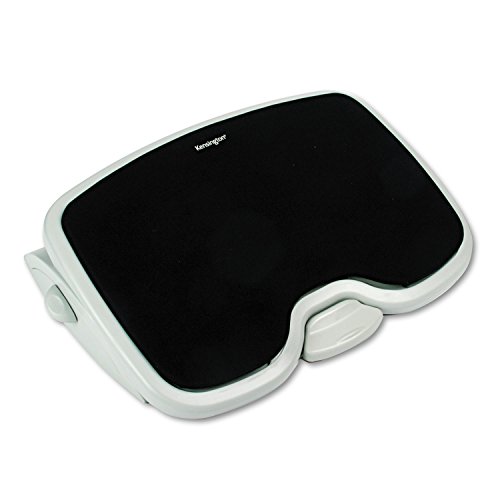
Kensington SoleMate Comfort Footrest
Kensington designs this footrest with a contoured platform that curves slightly to match natural foot position, rather than a flat surface. Three height settings adjust to match different desk and chair heights without needing tools. A rubberized surface adds grip for sock or stocking feet without the footrest sliding during use.
Pros
- Contoured platform matches natural foot position better than flat designs
- Three height settings cover a reasonable range of desk heights
- Rubberized surface grips sock or stocking feet securely
Cons
- Less cushioned than foam-topped footrests for all-day comfort
- Fixed contour shape may not suit every foot size equally well

Humanscale Foot Machine
This footrest uses a freely rocking platform rather than fixed height steps, letting the foot find its own angle throughout the day instead of locking into one position. A weighted base keeps the rocking motion controlled rather than tipping unpredictably under shifting weight. Humanscale builds the unit from a single molded design without separate moving parts that could wear loose over time.
Pros
- Free rocking motion lets the foot find its own angle naturally
- Single molded design avoids parts that loosen over time
- Weighted base keeps rocking controlled under shifting weight
Cons
- Costs more than footrests with simpler fixed height designs
- No adjustable height steps for users who want a fixed position

Fellowes Standard Foot Rest
This footrest keeps a straightforward fixed-angle platform without the tilting or rocking mechanisms found on pricier ergonomic models. A textured surface still adds some grip over a bare flat platform. It suits users who want basic elevation and support without paying for adjustable features they may not use.
Pros
- Lower cost than footrests with tilt or rocking mechanisms
- Textured surface adds grip over a bare flat platform
- Compact footprint fits under most desks without crowding
Cons
- No tilt or rocking motion for ankle movement during the day
- Less cushioning than foam-topped premium footrests

Everlasting Comfort Memory Foam Footrest
A thick memory foam layer covers this footrest’s entire platform, softer underfoot than the firmer plastic or rubber surfaces most footrests use. The foam gradually conforms to foot shape with repeated use, similar to a memory foam pillow adjusting to a sleeper’s head. A removable, washable cover keeps the foam surface clean despite daily use.
Pros
- Thick memory foam is noticeably softer than plastic or rubber platforms
- Foam gradually conforms to foot shape with repeated use
- Removable, washable cover simplifies long-term cleaning
Cons
- No height or angle adjustment compared to ergonomic alternatives
- Foam compresses over time and may need eventual replacement

Vari Under Desk Footrest
Vari designs this footrest specifically for standing desk setups, with a rocking platform meant to relieve pressure during extended standing rather than seated use. The curved rocker shape encourages small weight shifts that reduce fatigue compared to standing flat-footed for hours. Its low profile keeps the footrest from interfering with desk height adjustments on sit-stand setups.
Pros
- Curved rocker shape relieves pressure during extended standing
- Encourages small weight shifts that reduce standing fatigue
- Low profile fits well with height-adjustable sit-stand desks
Cons
- Less useful for users who sit most of the day instead of standing
- Rocking motion may feel unfamiliar without an adjustment period
How they stack up
| # | Model | Adjustment | Best for | Score | Price |
|---|---|---|---|---|---|
| 1 | ErgoFoam Adjustable Tilting Footrest | Independent height and tilt angle | Best Overall | 9.3 | Check price |
| 2 | HUANUO Adjustable Angle Footrest | 3 height and angle positions | Best Value | 8.8 | Check price |
| 3 | Kensington SoleMate Comfort Footrest | 3 height settings | Best for Ergonomic Office Use | 8.7 | Check price |
| 4 | Humanscale Foot Machine | Free rocking motion, no fixed steps | Best Premium Rocking Design | 9.0 | Check price |
| 5 | Fellowes Standard Foot Rest | Fixed angle, no tilt or rock | Best Budget Simple Design | 8.1 | Check price |
| 6 | Everlasting Comfort Memory Foam Footrest | Thick memory foam | Best Soft Cushion | 8.5 | Check price |
| 7 | Vari Under Desk Footrest | Designed for standing desk setups | Best for Standing Desk Users | 8.9 | Check price |
Frequently asked questions
Do footrests actually help with posture at a desk?
Yes, when they keep the knees at roughly a 90 degree angle. A footrest with height adjustment, like the ErgoFoam or HUANUO, helps users at different heights achieve that position.
What is the benefit of a rocking or tilting footrest?
It encourages small ankle movements throughout the day rather than keeping the foot locked in one static position, which models like the Humanscale Foot Machine are built around.
Is memory foam better than plastic for a footrest?
For comfort during long sitting, yes. Memory foam platforms, like the Everlasting Comfort footrest, soften pressure points more than firm plastic surfaces.
Can a footrest be used with a standing desk?
A dedicated design like the Vari Under Desk Footrest works better for standing use than footrests built specifically for seated support.
How many height settings should a footrest have?
Three settings, found on the Kensington SoleMate and HUANUO, usually cover most desk and chair height combinations without being overly complex.
Do footrests slide around on hardwood or tile floors?
Quality footrests include rubber or non-slip grips on the base, like the HUANUO and Kensington SoleMate, to reduce sliding on hard flooring.
Is a fixed footrest good enough for most people?
For users who do not need to fine-tune height or angle, a simple fixed design like the Fellowes Standard covers basic support needs.
Can footrest covers be washed?
Some can. The HUANUO and Everlasting Comfort footrests both use removable, washable covers, unlike footrests with a fixed foam or plastic surface.
Are premium footrests worth the extra cost over basic models?
For daily, all-day use, the added comfort and adjustment range on a model like the ErgoFoam or Humanscale Foot Machine can be worth it over a basic fixed platform.
Our take
The ErgoFoam Adjustable Tilting Footrest earns the top recommendation for most desk workers, since its independent height and tilt adjustment combined with memory foam cushioning covers the widest range of needs. Anyone working primarily at a standing desk should choose the Vari Under Desk Footrest instead, since it addresses standing fatigue in a way seated-focused footrests cannot. Buyers who want solid adjustability without paying premium pricing should skip the higher-end options and pick the HUANUO Adjustable Angle Footrest.
Jake Monroe
Jake worked as a residential contractor for over a decade before shifting to full-time writing. He evaluates power tools, hand tools and workshop gear through the lens of someone who has actually used them on job sites, not just read the box.


