Fish Finders That Actually Show What’s Below the Boat
The Garmin Striker Vivid 7cv leads this comparison with a 7-inch color display, CHIRP sonar and built-in GPS for marking waypoints. The Humminbird Helix 5 suits anglers who want detailed lake mapping, while the Deeper PRO+ 2 fits kayak and shore anglers who need a castable, boat-free option.
The Garmin Striker Vivid 7cv earns the top spot here because its 7-inch display and CHIRP sonar show fish arches and bottom structure more clearly than smaller, lower-resolution screens. Its main limitation is size, since a 7-inch unit needs more mounting space than compact handheld models.
We compared published sonar frequency, screen resolution, GPS features and transducer specs across each unit rather than running our own on-water tests.
What matters most
What to look for in a fish finder Sonar type sets the baseline for accuracy, with CHIRP outperforming older fixed-frequency and dual beam designs at separating individual fish. Display size and resolution decide how easily arches and structure read on the water, especially in bright sunlight. Transducer design and GPS features then narrow the field toward boat-mounted, castable or handheld use.
Boat-mounted versus portable designs Transom-mounted units like the Lowrance HOOK Reveal 5 and Humminbird PiranhaMax 4 need permanent hardware and a boat’s power source. Castable and handheld designs, including the Deeper PRO+ 2 and Venterior VT-FF001, skip the mounting step entirely and work from shore, dock or kayak. Anglers without a boat should start with a portable design rather than adapting a boat-mounted unit.
Why GPS and mapping matter Built-in GPS, found on the Garmin Striker Vivid 7cv and Humminbird Helix 5, lets anglers mark productive spots and return to them on a later trip. Basemap support adds shoreline and depth contour data that a plain waypoint marker lacks. Budget units like the Humminbird PiranhaMax 4 skip GPS entirely, which keeps cost down but removes that return-to-spot convenience.
Matching a fish finder to how you fish Boat anglers covering larger water benefit most from a larger display and CHIRP sonar, as on the Garmin Striker Vivid 7cv. Kayak and shore anglers without mounting options should look at castable units like the Deeper PRO+ 2 instead. Ice anglers can use a flasher-equipped unit like the Garmin Striker 4 across both open water and ice seasons.
The top picks, ranked

Garmin Striker Vivid 7cv
A 7-inch color display with Garmin’s vivid color palette makes fish arches and bottom structure easier to distinguish than standard color scales. CHIRP sonar sweeps a range of frequencies instead of one fixed frequency, sharpening target separation in deeper water. Built-in GPS lets anglers mark productive spots and navigate back to them later.
Pros
- Vivid color palette makes fish and structure easier to read
- CHIRP sonar improves target separation over fixed frequency units
- Built-in GPS marks and returns to waypoints
Cons
- Larger 7-inch display needs more mounting space than compact units
- Costs more than basic fixed-frequency fish finders

Humminbird Helix 5 Chirp GPS G2
Built-in GPS and basemap support let anglers overlay their own routes and waypoints onto standard chart data. A 5-inch display runs smaller than the Striker Vivid but still shows CHIRP sonar returns clearly on calm water. Humminbird’s switchfire sonar mode lets anglers toggle between maximum sensitivity and clearer target separation.
Pros
- Basemap support helps with route planning and navigation
- Switchfire mode adjusts sonar sensitivity on demand
- Tilt and swivel mount simplifies viewing angle adjustment
Cons
- Smaller screen than the Striker Vivid makes fine detail harder to read
- Menu layout has a steeper learning curve than simpler units

Lowrance HOOK Reveal 5
An autotuning sonar feature adjusts sensitivity and range automatically, which suits anglers who do not want to manually dial in settings. A 5-inch display pairs with built-in GPS and preloaded US mapping for inland lakes. The straightforward menu structure keeps common functions within a couple of button presses.
Pros
- Autotuning sonar removes manual setting adjustments
- Preloaded US mapping works without extra purchases
- Simple menu layout suits first-time users
Cons
- Autotuning offers less manual control than advanced anglers may want
- Transom mount transducer is less portable than a castable design
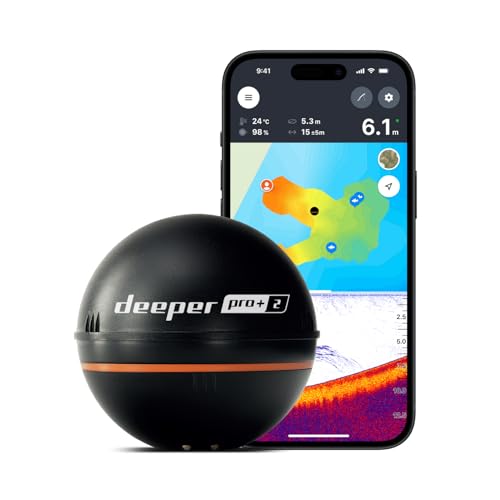
Deeper PRO+ 2 Smart Sonar
This castable sonar ball connects to a smartphone over wifi, which removes the need for a boat, mounting hardware or a separate display. GPS tracking logs where casts land relative to detected fish and structure, building a map over repeated outings. Dual-frequency sonar scans both wide and narrow beams for shallow and deeper water.
Pros
- Works from shore, dock or kayak without a boat mount
- Wifi connection to a smartphone removes the need for a separate display
- GPS logging builds a map of fish activity over time
Cons
- Depends on a charged smartphone to view sonar data
- Wifi range is shorter than a hardwired boat-mounted unit

Garmin Striker 4
A smaller 3.5-inch display keeps the Striker 4 affordable while still delivering CHIRP sonar and basic GPS waypoint marking. It lacks the vivid color palette and basemap features of pricier Garmin units, but covers the core task of finding fish and structure. A built-in flasher mode suits ice fishing in addition to open water.
Pros
- Lower price than larger Garmin Striker models
- Flasher mode adds ice fishing functionality
- CHIRP sonar still outperforms older fixed-frequency units
Cons
- Small 3.5-inch screen limits fine detail versus larger displays
- No basemap or mapping software support

Humminbird PiranhaMax 4
A dual beam sonar covers both a narrow, deep beam and a wider, shallow beam without the cost of full CHIRP technology. The 4.3-inch display keeps the unit compact and simple to mount on small boats or kayaks. It skips GPS entirely, keeping the control layout limited to core sonar functions.
Pros
- Lower cost than CHIRP-equipped fish finders
- Dual beam sonar covers both shallow and deep water
- Compact size fits small boats and kayaks easily
Cons
- No GPS for marking or returning to waypoints
- Less target separation than CHIRP sonar units

Venterior Portable Fish Finder VT-FF001
A wired, throwable transducer and handheld LCD display work independently of any boat power or mounting hardware. Depth readings and fish icons display on a small backlit screen, enough for basic bank or ice fishing use. It runs on standard batteries rather than requiring a boat’s electrical system.
Pros
- Works without any boat power or permanent mounting
- Battery powered, making it fully portable for bank fishing
- Lower price than boat-mounted fish finders
Cons
- Wired transducer is less convenient than wireless castable units
- Screen resolution is lower than boat-mounted color displays
The lineup, side by side
| # | Model | Display | Best for | Score | Price |
|---|---|---|---|---|---|
| 1 | Garmin Striker Vivid 7cv | 7-inch color | Best Overall | 9.1 | Check price |
| 2 | Humminbird Helix 5 Chirp GPS G2 | 5-inch color | Best for Mapping | 8.9 | Check price |
| 3 | Lowrance HOOK Reveal 5 | 5-inch color | Best for Ease of Use | 8.7 | Check price |
| 4 | Deeper PRO+ 2 Smart Sonar | Castable, wifi connected | Best for Kayak and Shore Fishing | 8.6 | Check price |
| 5 | Garmin Striker 4 | 3.5-inch color | Best Budget | 8.3 | Check price |
| 6 | Humminbird PiranhaMax 4 | 4.3-inch color | Best Entry-Level | 8.0 | Check price |
| 7 | Venterior Portable Fish Finder VT-FF001 | LCD, backlit | Best Handheld and Portable | 7.8 | Check price |
Good to know
What is CHIRP sonar and why does it matter?
CHIRP sonar sweeps a range of frequencies instead of one fixed frequency, which the Garmin Striker Vivid 7cv and Humminbird Helix 5 use to separate individual fish more clearly.
Do I need GPS on a fish finder?
GPS is not required but helps anglers mark and return to productive spots, a feature included on the Garmin Striker Vivid 7cv and Deeper PRO+ 2.
Can a fish finder be used without a boat?
Yes. Castable models like the Deeper PRO+ 2 and handheld units like the Venterior VT-FF001 work from shore, dock or kayak without a boat mount.
What is the difference between dual beam and CHIRP sonar?
Dual beam sonar, used on the Humminbird PiranhaMax 4, covers two fixed frequencies, while CHIRP sweeps a continuous range for sharper target separation.
How deep can a fish finder read?
Depth capability varies by model. The Garmin Striker Vivid 7cv reads to roughly 2300 feet in freshwater, far beyond what most inland anglers need.
Are castable fish finders accurate?
Castable units like the Deeper PRO+ 2 use real sonar hardware and GPS, giving accuracy comparable to entry-level boat-mounted units for shore and kayak fishing.
What screen size is best for a fish finder?
A 5 to 7-inch display, as on the Garmin Striker Vivid 7cv and Humminbird Helix 5, shows more detail than the smaller 3.5 to 4.3-inch screens on budget units.
Can a fish finder be used for ice fishing?
Yes. Units with a flasher mode, such as the Garmin Striker 4, support both open water sonar and ice fishing flasher display.
Is a basemap necessary on a fish finder?
A basemap is not required but adds useful shoreline and depth contour context, a feature on the Humminbird Helix 5 that budget units typically omit.
Our pick
Boat owners who want strong all-around performance should choose the Garmin Striker Vivid 7cv for its CHIRP sonar and vivid display. Anglers fishing from a kayak, dock or shoreline without a boat should pick the Deeper PRO+ 2 instead, since its castable design needs no mounting hardware. Anyone on a tight budget who still wants real CHIRP sonar should consider the Garmin Striker 4 over the non-CHIRP entry-level options.
Sierra Daniels
Sierra's background is in landscape design and nursery retail. She focuses on lawn and garden equipment, outdoor furniture and gear durability, weighing published specs against how materials actually hold up outside.