New film cameras worth shooting, 35mm to 120
Pentax 17 leads for shooters who want control, with six focus zones, a 25mm f/3.5 lens and 72 frames per 36-exposure roll. Kodak Ektar H35N covers casual use and adds bulb mode for night frames. Street shooters should take the Lomography LC-A+ and its f/2.8 glass.
Pentax 17 is the film camera most people should buy new. Six zone-focus settings, a 25mm f/3.5 lens and program metering give you real decisions to make. Half frame doubles your shot count to 72 per roll. Enlargements are where it gives ground, because a 17x24mm negative grains up faster than full frame. Casual shooters lose very little by starting with the Kodak Ektar H35N.
Classic SLRs dominate the used market, but light seals, meters and shutters arrive in unknown condition. We limited this list to models still in production and compared lens construction, frame format, focus method, flash power and battery type. Format cost per frame factored in as well. Owner feedback about jammed advance levers and soft scans decided the close calls.
How to pick the right one
What to look for in a film camera Lens material comes first, because glass elements resolve more than moulded plastic. Aperture decides your working light: anything narrower than f/9 needs ISO 400 film or open sun. Focus method changes what you can shoot, since fixed-focus bodies blur close portraits while zone focus reaches arm’s length. Flash power, a tripod thread and a bulb setting together decide whether night photography is even on the table. Battery type is the last check, and it separates cameras that stop working from ones that never can.
Half frame vs full frame 35mm Half-frame bodies such as the Pentax 17 and Ektar H35N split each 35mm frame down the middle. That gives 72 exposures from a 36-shot roll and roughly halves your film and developing outlay per picture. Grain arrives sooner in big prints, so treat half frame as a format for screens, zines and modest enlargements. Full-frame bodies like the Kodak M35 remain safer when gallery-size scans are the goal. Ask your lab how it handles half frame first, because scanning practice varies.
Best film cameras for street and travel Street work rewards a bright lens and fast distance setting. Lomography LC-A+ delivers both through its f/2.8 Minitar 1 and four zone clicks, and the sliding cover removes the lens cap problem. Weight-conscious travellers do better with the Reto Ultra Wide and Slim, which needs no battery and frames a 22mm view. Neither offers autofocus, so pick your zone before raising the camera. Anyone shooting mostly indoors should skip both and take a body with a real flash.
When medium format makes sense Large scans and prints are the reason to jump to 120 film. A 6×6 cm Holga negative holds about four times the area of a 35mm frame, and that shows first in shadow detail. Running costs climb, since each roll yields only 12 square exposures and lab fees for 120 usually sit higher. Metering happens in your head or on a phone app, because there is none in the body. Tape the film back seams before loading, as owners report light leaks there repeatedly.
The top picks, ranked

Pentax 17
Built around a 25mm f/3.5 three-element lens, the 17 sets distance through six focus zones marked by symbol rather than number. Program AE picks shutter and aperture while ISO and exposure compensation stay on the top plate. Owners praise the manual wind lever and crisp scans, though the 17x24mm negative stays half the area of full-frame 35mm.
Pros
- Exposure compensation and manual ISO leave room to experiment
- Yields 72 frames from a 36-exposure roll
- Metal top plate and hand-wind lever suit regular carry
Cons
- Half-frame negatives limit large enlargements
- Zone focusing takes practice under three feet
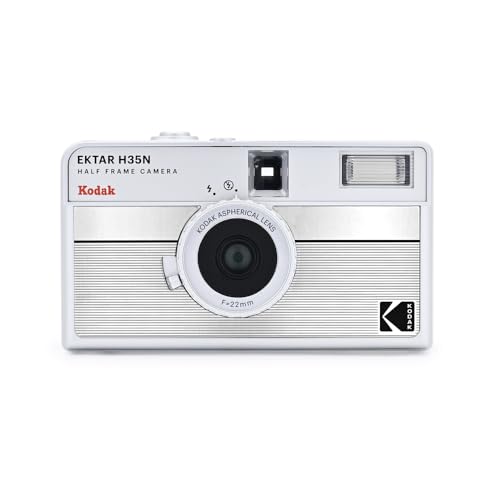
Kodak Ektar H35N
Kodak reworked the original H35 with a coated glass 22mm f/8 lens, a bulb setting and a tripod thread. Long exposures of city lights become possible, which plastic-lens compacts cannot manage at all. One AAA cell powers both the flash and a built-in star filter, and fixed focus holds anything past a metre acceptably sharp.
Pros
- Coated glass holds detail into the frame corners
- Bulb mode and tripod socket open up night shooting
- Star filter throws four-point flare from point lights
Cons
- Anything closer than one metre drifts out of focus
- No aperture or shutter choice apart from bulb

Kodak M35
Load a roll, wind the thumbwheel, flip the flash switch, shoot. Kodak gives the M35 a 31mm fixed-focus lens near f/10, a single shutter speed around 1/120 second, and flash recycling from one AAA cell. Nothing adjusts, which is exactly why it survives backpacks and festival weekends.
Pros
- Around 100 g, so a jacket pocket hides it
- Flash switch stays on until you turn it off
- Reusable back accepts any 35mm cassette
Cons
- Narrow f/10 aperture wants ISO 400 film or sunshine
- Plastic optics soften detail toward the corners

Lomography LC-A+
A 32mm f/2.8 Minitar 1 glass lens gathers roughly two stops more light than any plastic compact here, so interiors and dusk frames hold up. Automatic exposure reads ISO 100 to 1600 and will hold the shutter open in dim rooms. Four zone-focus clicks begin at 0.8 m, and a multiple exposure switch lets you stack frames on purpose.
Pros
- Bright f/2.8 aperture works indoors and after sunset
- Automatic long exposures catch neon and shop windows
- Metal body with a sliding lens cover fits a pocket
Cons
- No flash without adding a hot shoe unit
- Shutter runs on button cells, so spares matter

Holga 120N
Medium format costs far less to enter than most people assume, and the 120N is the proof. Swap the supplied masks for 6×6 cm squares or 6×4.5 cm frames on 120 roll film, then turn the lens ring to one of four pictogram distances. Vignetting and soft corners are part of the look, while bulb mode and a hot shoe make night work possible.
Pros
- Negatives dwarf 35mm, so scans carry far more detail
- Bulb mode, tripod socket and hot shoe cover night shooting
- Runs with no batteries and travels light
Cons
- Film back pops loose unless you tape the seams
- Only 12 square frames come off each roll
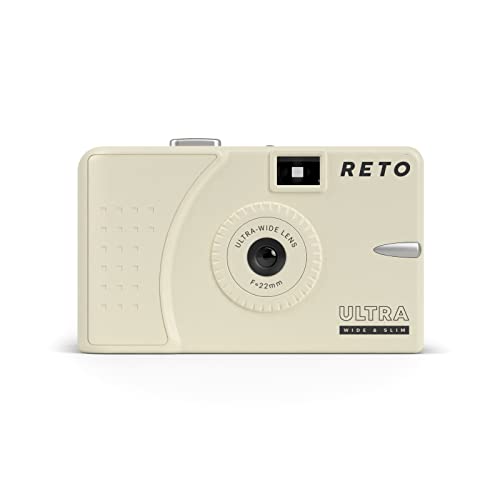
Reto Ultra Wide and Slim
At roughly 80 g and with no battery compartment at all, this is the camera you forget you packed. Its 22mm lens sits at a fixed f/11 and covers wide streets, interiors and group shots through a single 1/125 second shutter. Bright daylight and ISO 400 film are what that simplicity costs you.
Pros
- Ultra-wide view takes in architecture and tight rooms
- Zero batteries means nothing dies mid-trip
- Shirt-pocket size shrugs off knocks in a bag
Cons
- No flash, so indoor frames go dark
- Fixed f/11 struggles under overcast skies

Lomography Simple Use Reloadable Film Camera
Arriving pre-loaded with 27 exposures of Color Negative 400, this one shoots straight out of the box. Coloured gel filters clip over the flash to throw pink or cyan light across a room. Despite the disposable styling, the back opens so any 35mm cassette goes in next.
Pros
- Gel filters create coloured flash effects with no editing
- ISO 400 film plus flash handles indoor events
- Reloading avoids the waste of a single-use body
Cons
- Reloading inside a dark bag takes patience
- Thin plastic shell shows wear quickly
The lineup, side by side
| # | Model | Format | Best for | Score | Price |
|---|---|---|---|---|---|
| 1 | Pentax 17 | Half frame 35mm, 17x24mm | Best overall | 9.4 | Check price |
| 2 | Kodak Ektar H35N | Half frame 35mm | Best value | 9.2 | Check price |
| 3 | Kodak M35 | Full frame 35mm | Best budget | 9.0 | Check price |
| 4 | Lomography LC-A+ | 32mm f/2.8 Minitar 1 glass | Best for street photography | 8.8 | Check price |
| 5 | Holga 120N | 120 roll film | Best for medium format | 8.6 | Check price |
| 6 | Reto Ultra Wide and Slim | 22mm f/11 fixed focus | Best for travel | 8.3 | Check price |
| 7 | Lomography Simple Use Reloadable Film Camera | Color Negative 400, 27 exposures | Best for parties | 8.0 | Check price |
Common questions
Is shooting film still worth it in 2026?
Yes, if the process and the look matter more than volume. Every frame carries a cost, which slows you down and usually sharpens composition. Labs and mail-in developing remain easy to find, and several manufacturers still build new bodies.
What is the best film camera for a beginner?
Kodak M35 or the Ektar H35N. Both strip away every decision except pointing and pressing, and both reload with standard 35mm cassettes. Step up to the Pentax 17 once exposure control starts to feel useful.
How many photos does a half-frame camera take per roll?
Around 72 from a 36-exposure roll, or 48 from a 24-exposure roll. Each shot claims half the usual frame area. Check how your lab scans half frame, since some return two images joined in one file.
Should I buy a new film camera or a used SLR?
Used SLRs bring interchangeable lenses and true manual control, at the risk of tired seals, meters and shutters. New bodies arrive in known condition with a warranty. Buy used only from sellers who confirm the shutter fires accurately at every speed.
Which film speed suits a plastic fixed-aperture camera?
ISO 400 covers most daylight and flash work behind an f/9 or f/10 lens. Overcast days and indoor events call for ISO 800. ISO 100 underexposes badly in cameras with no aperture control.
Can you develop 35mm film at home?
Black and white needs only a daylight tank, developer, fixer and a thermometer. Colour C-41 demands chemistry held near 38 degrees Celsius, which pushes most people toward a lab. Home scanning works with a flatbed or a dedicated film scanner.
Do film cameras need batteries?
Depends on the model. Reto Ultra Wide and Slim and the Holga 120N run on none at all, while the M35 and Ektar H35N take one AAA for the flash. Metering in the Pentax 17 and LC-A+ stops without power.
Pentax 17 vs Kodak Ektar H35N: which should you buy?
Pentax 17 wins on zone focus, exposure compensation and a metal build made for daily carry. H35N makes more sense as a light second camera with bulb mode for night frames. Frame count matches, because both shoot half frame.
Which film camera is best for night and low light?
Lomography LC-A+ handles handheld low light thanks to its f/2.8 lens and automatic long exposures. For static night scenes on a tripod, the Ektar H35N and Holga 120N both offer bulb mode. Fixed-shutter cameras like the Reto cannot do this work.
Can you still buy new 35mm film cameras?
Yes, and production is wider now than it was a decade ago. Pentax builds the 17, Kodak-branded compacts cover the budget end, and Lomography makes several reloadable bodies. Medium format stays alive through the Holga 120N.
Final word
Pentax 17 takes the top spot because a 25mm f/3.5 lens, six focus zones and exposure compensation sit in a body designed to be serviced rather than binned. Documenting nights out is a different brief, and the Kodak Ektar H35N with its bulb mode fits that better while weighing far less. Large prints rule half frame out altogether, so start with the Holga 120N and 120 roll film if scanning big is the plan.
Marcus Chen
Marcus covered consumer electronics for enthusiast tech publications for six years before joining ChoiceCrest. He specializes in translating manufacturer spec sheets into plain-language buying advice, with a focus on audio, computing accessories and smart-home gear.
You might also need

Nintendo Game & Watch: Super Mario Bros Review: Still Worth It as a Collectible?

Doorbell Cameras That Skip the Monthly Subscription

7 Gaming Mice Worth Comparing Before You Buy
