Which faucet water filter actually removes lead?
PUR PLUS PFM400H ranks first, carrying NSF/ANSI 42, 53 and 401 plus a cartridge indicator light. Culligan FM-25 Advanced runs 200 gallons per cartridge, halving replacement trips. Waterdrop WD-FC-01 reaches 320 gallons and suits kitchens where chlorine flavour is the only real complaint.
PUR PLUS PFM400H suits households whose water report flags lead or mercury. Certification spans NSF/ANSI 42, 53 and 401, a range no rival here matches. An indicator light turns red once the cartridge is spent, so changes stop depending on memory. Cartridge life is the catch at roughly 100 gallons, near three months of drinking water. Chasing chlorine taste alone? Cheaper picks here run three times longer between swaps.
Faucet filters look interchangeable on the shelf and behave nothing alike. Certifications differ, rated capacity spans 100 to 320 gallons, and pull-out sprayer taps reject almost every model sold. Ranking rests on published NSF/ANSI listings, stated gallon capacity, flow behaviour and housing material. Owner feedback filled the last gap: drips at the adapter collar after a few months on the tap.
What matters most
What to look for in a faucet water filter Certification is the one claim on the box worth reading closely. NSF/ANSI 42 covers aesthetic problems such as chlorine taste and odour. Standard 53 covers health related contaminants, lead included. Standard 401 adds certain pharmaceutical and pesticide residues. Cartridge capacity comes next, running from about 100 gallons on the PUR and Brita units up to 320 on the Waterdrop and Engdenton. That figure sets how often you are buying replacements. Flow rate is the third factor, because a fine carbon block filters thoroughly and fills a kettle slowly. Check your aerator thread last, though it causes more returns than any other detail.
How to read your water report before buying Most utilities publish an annual water quality report, and it turns this purchase into a matching exercise. Chlorine or chloramine driving the flavour? An NSF/ANSI 42 unit such as the Waterdrop WD-FC-01 handles that and runs six months per cartridge. Lead from older service lines is a different problem, and only a filter listed under standard 53 for lead applies, which leaves the PUR, Culligan and Brita picks. Private wells sit outside all of this. Test a well independently, since faucet filters assume treated municipal water and do nothing about bacteria.
Will a faucet filter fit your tap? Faucet filters thread onto the aerator, so your tap needs a removable one. Pull-out sprayers, pull-down mixers and most touchless taps carry no usable thread, and no adapter fixes that. Thread sizes vary, which is why Culligan and Instapure include adapter rings in the box. A worn thread is the usual source of a slow drip at the collar. Clearance catches people out too. Under a low swan neck tap, a tall housing leaves no room for a glass, and that is where the slim Waterdrop and compact Instapure bodies earn their place. Renters gain a further advantage: everything unscrews and the original aerator goes back.
What faucet water filters will not do Carbon media does not soften water, remove fluoride or handle bacteria, and none of these seven claim otherwise. Hot water must stay out of the cartridge. Heat degrades carbon and can warp plastic housings, so flip the diverter before washing up. Sediment heavy supplies clog a fine block early and cut the stated gallon rating well short. Anyone needing broader treatment should price an under sink reverse osmosis system, accepting plumbing work and a lost cupboard shelf. Where a tap cannot take a mount at all, a pitcher filter stays the practical fallback.
The shortlist, ranked

PUR PLUS Faucet Mount Water Filtration System PFM400H
Three NSF/ANSI standards apply here: 42 for chlorine taste and odour, 53 for lead and mercury, 401 for certain pharmaceutical and pesticide residues. A coloured light tracks throughput and switches to red once the cartridge is finished. Mounting clicks onto a threaded aerator, and a side lever sends unfiltered water through for rinsing dishes.
Pros
- Certified across three NSF/ANSI standards, the widest span here
- Indicator light signals the swap instead of a calendar
- Lever diverts washing-up water around the cartridge
Cons
- Roughly 100 gallons per cartridge, the shortest run of the seven
- Plastic housing sits lighter in the hand than metal rivals

Culligan FM-25 Advanced Faucet Mount Filter
Each cartridge covers 200 gallons, double what the PUR unit manages, so replacement trips halve. Certified reduction runs to chlorine taste and odour under standard 42, plus lead, atrazine, lindane and turbidity under 53. Chrome plating on the housing sits better beside polished or brushed taps than white plastic does.
Pros
- 200 gallons per cartridge, twice the PUR PLUS interval
- Chrome shell matches common kitchen tap finishes
- Thread adapters for standard aerators ship in the box
Cons
- Cartridge use is tracked by hand, with no indicator
- No NSF/ANSI 401 listing for pharmaceutical residues

Brita Basic Faucet Mount Water Filter System SAFF-100
Chlorine taste, odour and lead all sit inside the NSF/ANSI 42 and 53 listings for this unit. Cartridges run about 100 gallons, and supermarkets, pharmacies and hardware chains all stock them, which matters when a filter expires on a Sunday. An electronic light on the housing counts usage and flags the change.
Pros
- Replacement cartridges are stocked almost everywhere
- Twists onto the aerator with no tools
- Compact enough to clear a shallow basin
Cons
- About 100 gallons means changes arrive quickly
- Plastic collar cross-threads if forced onto the tap

Waterdrop WD-FC-01 Faucet Water Filter
Rated capacity reaches 320 gallons, roughly six months of drinking and cooking water for a couple. Certification stops at NSF/ANSI 42, so this targets chlorine flavour rather than lead or pesticides. Slim housing keeps clearance under low mounted taps where wider bodies foul the basin.
Pros
- Longest interval between cartridge swaps of the seven
- Narrow body clears low swan neck taps
- Carbon block cuts chlorine smell from the first pour
Cons
- NSF/ANSI 42 only, with no lead reduction claim
- Change dates rely on a calendar, not an indicator
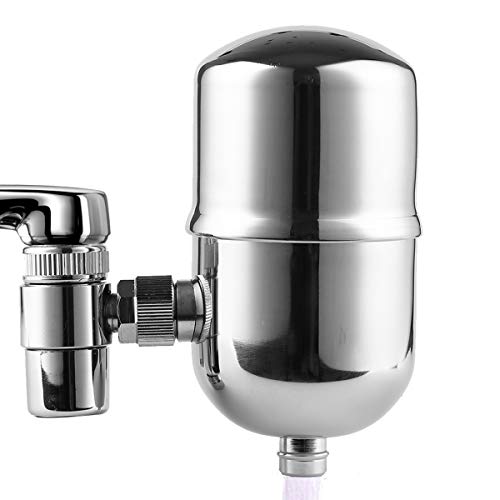
Engdenton Faucet Water Filter
304 stainless steel replaces the plastic shell used almost everywhere in this category, which removes the cracked collar owners report on budget units. Inside sits a fine carbon block listed under NSF/ANSI 42 for chlorine taste and odour. Capacity runs near 320 gallons, so the metal body pays itself back across a long service interval.
Pros
- Stainless shell resists the cracking plastic units suffer
- Around 320 gallons matches the longest interval here
- Extra mass holds the unit steady when the tap swings
Cons
- Weight strains a worn or loose aerator thread
- Taste and odour listing only, with no lead claim

iSpring DF2-CHR Faucet Mount Water Filter
Flow comes first in this design, so filling a stockpot never turns into a two minute wait. Carbon media here targets chlorine, taste and odour rather than a broad contaminant list. A diverter routes unfiltered water to the sink for rinsing and washing up, saving the cartridge for drinking water.
Pros
- Fills kettles and pots faster than fine micron blocks
- Diverter reserves the media for drinking water
- Chrome shell suits polished tap finishes
Cons
- Faster flow means shorter contact time with the carbon
- Lead and pesticide reduction fall outside its scope

Instapure F2 Essentials Faucet Water Filter
Compact dimensions drive this pick, since it clears low swan neck taps that larger housings block. Installation is a twist onto the aerator thread using supplied adapters, and removal leaves no mark behind. Filtration focuses on chlorine taste and odour, making it a flavour upgrade rather than a treatment system.
Pros
- Smallest footprint among these seven filters
- Comes off cleanly when a tenancy ends
- Cartridge swap finishes inside a minute
Cons
- Roughly three months per cartridge despite the narrow scope
- Light plastic body flexes when the tap is knocked
Side by side
| # | Model | Certification | Best for | Score | Price |
|---|---|---|---|---|---|
| 1 | PUR PLUS Faucet Mount Water Filtration System PFM400H | NSF/ANSI 42, 53 and 401 | Best overall | 9.4 | Check price |
| 2 | Culligan FM-25 Advanced Faucet Mount Filter | NSF/ANSI 42 and 53 | Best value | 9.2 | Check price |
| 3 | Brita Basic Faucet Mount Water Filter System SAFF-100 | NSF/ANSI 42 and 53 | Best budget | 9.0 | Check price |
| 4 | Waterdrop WD-FC-01 Faucet Water Filter | NSF/ANSI 42 | Best for long cartridge life | 8.8 | Check price |
| 5 | Engdenton Faucet Water Filter | 304 stainless steel | Best build quality | 8.6 | Check price |
| 6 | iSpring DF2-CHR Faucet Mount Water Filter | Chlorine, taste and odour reduction | Best for strong chlorine taste | 8.3 | Check price |
| 7 | Instapure F2 Essentials Faucet Water Filter | Compact housing for tight clearance | Best for small sinks | 8.0 | Check price |
Good to know
Do faucet water filters remove lead?
Only models certified under NSF/ANSI 53 for lead reduction, which here means the PUR PLUS PFM400H, Culligan FM-25 Advanced and Brita SAFF-100. Filters listed only under standard 42 target taste and odour and make no lead claim.
What is the difference between NSF 42, 53 and 401?
Standard 42 covers aesthetic issues such as chlorine taste and odour. Standard 53 covers health related contaminants including lead and certain pesticides. Standard 401 adds emerging contaminants, among them some pharmaceutical residues.
How often should you change a faucet filter cartridge?
Follow the gallon rating rather than the calendar. PUR and Brita cartridges run about 100 gallons, Culligan reaches 200, and Waterdrop and Engdenton stretch to around 320. Heavy sediment shortens every one of those figures.
Will a faucet water filter fit a pull-out sprayer tap?
No. Pull-out sprayers, pull-down mixers and touchless taps lack a removable threaded aerator, so a mount has nothing to grip. A pitcher or under sink unit covers those kitchens instead.
Do faucet filters reduce water pressure?
Flow drops in filtered mode because water has to cross a carbon block. Fine micron blocks trade speed for contact time, while the iSpring DF2-CHR is built around faster filling.
Faucet filter vs pitcher filter: which is better?
Faucet mounts deliver filtered water on demand and handle cooking volumes without refilling. Pitchers need no tap compatibility at all, which makes them the answer for sprayer taps and rental kitchens.
Can hot water run through a faucet water filter?
No. Heat degrades carbon media and can distort the housing, so switch the diverter to unfiltered before running hot water for dishes.
Do faucet water filters remove fluoride?
Activated carbon does not reduce fluoride, and none of these models claim to. Reverse osmosis or a dedicated activated alumina cartridge is required for that.
Which faucet water filter lasts the longest between changes?
Waterdrop WD-FC-01 and Engdenton both sit around 320 gallons, roughly six months for a couple. Both are certified for taste and odour only, so long life comes at the cost of lead coverage.
Are faucet water filters worth it on treated city water?
They help most where chlorine dominates the flavour or older plumbing raises lead questions. Water that already tastes clean gains little beyond a small improvement in odour.
Final word
Buy the PUR PLUS PFM400H when your water report mentions lead, since nothing else here carries NSF/ANSI 42, 53 and 401 together with a change indicator. Culligan FM-25 Advanced is the smarter pick if certified lead reduction still matters but 100 gallon cartridges feel too frequent. Households whose only complaint is chlorine taste should take the Waterdrop WD-FC-01 and forget about it for six months.
Dana Whitfield
Dana spent eight years buying and merchandising for a regional kitchenware retailer before moving into editorial work. She has handled thousands of SKUs across cookware, small appliances and kitchen organization, and focuses on the practical differences that matter once a product is actually in daily use.