Compact Family Game Sets That Survive Bumpy Car Rides
Hasbro’s Grab and Go Connect 4 leads this lineup with a locking case and fast two-player rounds. UNO’s travel tin covers bigger groups up to ten players, and Melissa & Doug’s magnetic solitaire handles solo play. Case design matters here as much as the game itself.
Hasbro’s Grab and Go Connect 4 suits most family road trips, thanks to a locking case that survives bumps and turns, though it only plays two people at a time. Bigger groups get more use from UNO’s ten-player travel tin, and solo travelers can lean on Melissa & Doug’s magnetic solitaire instead.
Travel games mostly fail through scattered pieces, not weak rules, so case design carries as much weight as gameplay itself. We compared case type, player count, age range, and typical playtime across seven family travel games.
The best picks, ranked

Hasbro Connect 4 Grab and Go
A sliding lid locks the four-in-a-row grid shut, so a sharp turn or plane bump won’t dump the discs. Two players still connect four colored discs in a row, matching the full-size rules exactly. The handheld case fits a glovebox, backpack pocket, or car door pocket without extra padding.
Pros
- Sliding lock keeps discs sealed inside during transit
- Handheld size clears a glovebox or backpack side pocket
- Same connect-four rules as the full-size game, no relearning
Cons
- Caps out at two players, no group option
- Small grid openings can trip up younger kids’ fingers
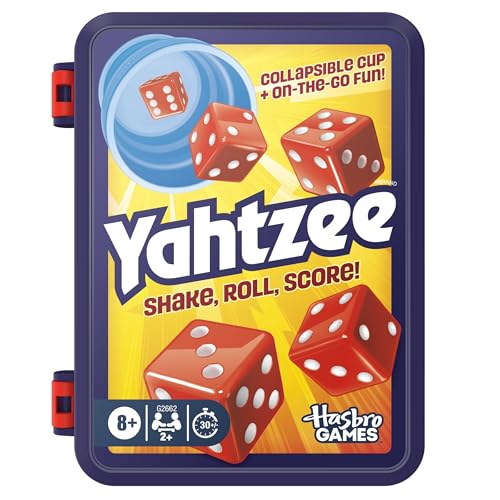
Cardinal Games Travel Yahtzee
Cardinal shrinks the dice cup and scorepad into a pocket case while keeping Yahtzee’s roll-and-score format intact. A hinged lid traps the dice mid-roll, so they can’t bounce off a tray table or car seat. Two to four players fill out score sheets across roughly 20 to 30 minutes.
Pros
- Hinged lid contains dice rolls inside a moving vehicle
- Replacement scorepads extend the game’s usable life
- Seats up to four players for a family game night
Cons
- Scorepad eventually runs out and needs restocking
- Runs longer than the simplest games in this lineup

Winning Moves Travel Scrabble
Recessed grooves hold every tile in place across a folding board sized for a full Scrabble set. Players can close the case mid-game and reopen it later without losing the board layout. Standard Scrabble scoring applies, so returning players skip the rules refresher.
Pros
- Recessed tile grooves prevent letters from sliding in transit
- Closing the case mid-game preserves the current board state
- Familiar Scrabble scoring needs no new rules to learn
Cons
- Runs 45 to 60 minutes, longer than most travel games here
- Tile size can challenge smaller hands

Buffalo Games Travel Sorry!
Pegs snap into fixed slots instead of rolling free like loose Sorry! pawns, so a bump won’t scatter the board. The folding case opens flat and doubles as the game board itself. Move-and-bump rules stay simple enough for kids just joining family game night.
Pros
- Snap-in pegs resist scattering better than loose pawns
- Lowest minimum age in this lineup at 6 and up
- Simple move-and-bump rules need little explanation
Cons
- Card deck runs small and easy to misplace
- Offers less strategy depth than the dice or word games here

Mattel UNO Card Game
A metal tin replaces UNO’s cardboard box, sliding easily into a glovebox or backpack side pocket. Cards and rules match the standard deck exactly, just resized for travel. Two to ten players can join, the widest range of any game in this set.
Pros
- Scales up to 10 players, the widest count here
- Metal tin outlasts cardboard boxes over repeated trips
- Quick 15 to 30 minute rounds suit short waits
Cons
- Tin can dent under rough handling
- Cards wear and bend faster than plastic-cased games

Melissa & Doug Travel Magnetic Solitaire
Magnetic pegs stay fixed to a small board, built for solo play when a second player isn’t around. Closing the folding case locks in the current layout during a drive. One player is all it needs, filling gaps other games leave when a group falls short.
Pros
- Magnetic pegs resist shifting through bumps and turns
- Covers solo play when other games need a second person
- Case snaps shut mid-game without losing the layout
Cons
- Single-player format doesn’t add a group option
- Offers less replay variety than card or dice games

Hasbro Travel Guess Who
Sliding tabs replace Guess Who’s flip-down panels, cutting the moving parts likely to break in a bag. Two players trade yes-or-no questions to guess each other’s mystery character. A smaller character roster than the full-size board speeds up each round.
Pros
- Sliding tabs cut moving parts versus flip-down panels
- Short 10 to 15 minute rounds suit brief travel stops
- Yes-or-no format keeps it accessible for younger kids
Cons
- Limited to two players only
- Smaller character set than the full-size original
Before you buy
What to look for in a travel game Loose pieces cause most travel game failures, not confusing rules. Locking cases, snap-in pegs, and magnetic boards each solve that problem differently across this lineup. Metal tins, like UNO’s, hold up to repeated trips better than folding cardboard. Playtime spans widely too, from Guess Who’s 10-minute rounds to Scrabble’s hour-long games, so matching a game to trip length matters as much as its anti-spill design.
Best picks by age range Travel Sorry! and Travel Guess Who both start at age 6, with rules simple enough that new players skip the instructions. Travel Scrabble and Travel Yahtzee require reading or scorekeeping, so both list age 8 and up. UNO’s tin sits in between at age 7. Mixed-age families often need one game from each end of that range to keep every traveler included.
How many players each game supports UNO’s travel tin scales from two up to ten players, the widest range in this set and the default for larger gatherings. Connect 4 and Guess Who cap out at two, built for one-on-one matchups during a long drive. Melissa & Doug’s magnetic solitaire covers the opposite need, working solo when no second player has joined yet.
Matching playtime to your trip Short stops call for games under 15 minutes, like Guess Who or Connect 4, that finish before a rest area break ends. Sorry! and UNO both run closer to 30 minutes, fitting a longer car leg or a flight delay. Scrabble’s 45-to-60-minute games suit a full flight or an evening at a rental, not a quick errand. Yahtzee lands in the middle, with rounds typically closing out in 20 to 30 minutes.
The lineup, side by side
| # | Model | Players | Best for | Score | Price |
|---|---|---|---|---|---|
| 1 | Hasbro Connect 4 Grab and Go | 2 | Best overall | 9.4 | Check price |
| 2 | Cardinal Games Travel Yahtzee | 2-4 | Best classic dice game | 9.1 | Check price |
| 3 | Winning Moves Travel Scrabble | 2-4 | Best for word game fans | 8.9 | Check price |
| 4 | Buffalo Games Travel Sorry! | 2-4 | Best for young kids | 8.6 | Check price |
| 5 | Mattel UNO Card Game | 2-10 | Best for larger groups | 8.4 | Check price |
| 6 | Melissa & Doug Travel Magnetic Solitaire | 1 | Best for solo play | 8.2 | Check price |
| 7 | Hasbro Travel Guess Who | 2 | Best for quick rounds | 8.0 | Check price |
Questions worth asking
What is the best travel game for a family road trip?
It depends on group size. UNO’s travel tin fits up to ten players and suits ages seven and up, while Connect 4 and Guess Who work best for one-on-one matchups. Families spanning several ages often bring two or three different games to cover everyone.
How do travel games keep pieces from spilling?
Most rely on locking cases, snap-in pegs, or magnets to hold pieces during a moving vehicle. Hasbro’s Grab and Go Connect 4 uses a sliding lock, and Melissa & Doug’s solitaire holds pegs with magnets. Standard board games without these features scatter far more easily on a bumpy ride.
What age range fits a travel board game?
Simpler games like Travel Sorry! and Travel Guess Who start at age 6. Games needing reading or scorekeeping, such as Travel Scrabble and Travel Yahtzee, list age 8 and up. UNO’s travel tin sits at age 7. Match the range to the youngest player joining.
Can a travel game handle more than two players?
Yes, though the max varies. UNO’s tin scales to ten players, the highest count here, while Yahtzee and Scrabble both support two to four. Connect 4 and Guess Who are built strictly for two players and don’t scale beyond that.
UNO travel tin vs Travel Yahtzee: which fits a bigger group?
UNO wins on group size, supporting up to ten players against Yahtzee’s four-player cap. Yahtzee’s dice-and-scorecard format suits smaller, slower-paced rounds, while UNO’s card rounds move faster and scale to a full table. Pick UNO for reunions or camp groups, Yahtzee for a quieter foursome.
Are travel game rules different from the full-size version?
Rules generally match the standard game exactly, just packed into a smaller case with anti-spill features. Travel Scrabble uses standard Scrabble scoring, and Travel Yahtzee keeps the same dice and scorecard format. Piece size and case design change, not the actual gameplay.
Which travel game works best for one player?
Melissa & Doug’s Travel Magnetic Solitaire is built for solo play, using magnetic pegs on a small folding board. It fills the gap when a second player hasn’t arrived yet. Most other games in a typical family set need at least two people to start.
How long does a round of a travel game usually take?
Playtime varies by type. Quick picks like Travel Guess Who and Travel Sorry! run 10 to 30 minutes. Travel Scrabble runs longest, closer to 45 to 60 minutes for a full game, making it better suited to a flight than a rest stop.
Do travel games fit inside a car glovebox?
Most do, including Connect 4’s Grab and Go case and UNO’s metal tin. Travel Scrabble’s folding board runs a bit larger because of its full tile set, though it still clears most glove compartments.
Final word
Hasbro’s Grab and Go Connect 4 fits most family road trips, pairing a locking case with rules nobody needs to relearn. Larger groups or reunions do better with UNO’s ten-player travel tin, and solo travelers should reach for Melissa & Doug’s magnetic solitaire instead. Save Travel Scrabble for flights or overnight stays, since its hour-long rounds don’t suit a quick rest-stop break.
Rachel Simmons
Rachel previously worked in child-product retail and brings a practical, detail-first eye to gear reviews, focusing on safety standards, ease of use and the fine print that matters most for new caregivers.


