Escape Proof Harnesses for Dogs That Back Out of Everything
The Chai’s Choice Escape Proof Vest Harness holds up best across sizes for dogs with a known history of backing out. Downtown Pet Supply Escape Proof Step-In Harness suits owners who want a faster, easier daily put-on, and 2 Hounds Design Freedom No-Pull Harness fits dogs that both pull and attempt to slip free.
The Chai’s Choice Escape Proof Vest Harness leads here, because its multiple adjustment points and wraparound design make it noticeably harder for a dog to wriggle out of compared to a basic step-in harness. The extra straps take longer to fasten correctly, so owners who need a faster daily routine might prefer a simpler step-in design instead.
We compared strap and buckle configuration, how each brand describes its anti-escape design, martingale or tightening features, and owner feedback on fit consistency across sizes.
How to choose
What Makes a Harness Genuinely Escape Proof No harness is entirely impossible to escape, but designs with more adjustment points and a wraparound fit, like Chai’s Choice, give a dog less slack to work with than a basic two-strap harness. A snug fit matters more than any single feature, since even a well-designed harness fails if sized too loosely. Checking fit regularly, especially after weight changes, keeps the security consistent over time.
Step-In Versus Vest-Style Harnesses Step-in designs like Downtown Pet Supply’s close faster for daily walks but generally offer fewer adjustment points than a full vest. Vest-style harnesses like Chai’s Choice or RUFFWEAR take longer to put on but distribute pressure more evenly and limit loose areas more thoroughly. Dogs with a strong escape history usually do better in a vest-style design despite the extra time to fasten it.
Front-Clip Attachments for Pullers That Also Try to Escape A front leash attachment, found on 2 Hounds Design and Kurgo’s harness, redirects a pulling dog back toward the owner instead of letting momentum build forward. That redirection also makes it harder for a dog to build enough forward force to slip a loosely fitted harness. Dogs that only need escape prevention without a pulling issue can rely on a back-only attachment instead.
Sizing for Small Breeds and Narrow Chests Standard harnesses sized for average chest width can sit too loosely on narrow-chested small breeds like whippets or greyhounds, giving them room to back out. A slimmer cut, like Yizhi Miaow’s, follows a narrower body shape more closely. Measuring chest girth carefully before buying matters more for small or narrow-chested breeds than for average body types.
The top picks, ranked

Chai’s Choice Escape Proof Vest Harness
This vest-style harness wraps fully around the torso with multiple adjustment straps, reducing the loose points a determined dog could use to back out. Reflective stitching adds visibility for walks in low light.
Pros
- Multiple adjustment points reduce loose areas a dog can exploit
- Front and back leash attachment adds training flexibility
- Reflective stitching improves low-light visibility
Cons
- More straps mean a longer process to put on correctly
- Breathable mesh runs warm on very hot days for thick-coated dogs

Downtown Pet Supply Escape Proof Step-In Harness
A dog steps into this harness and a single clasp closes over the back, speeding up the daily routine compared to multi-strap designs. The step-in shape still limits the loose straps that allow backing out.
Pros
- Step-in design speeds up putting it on compared to vest styles
- Padded construction adds comfort for longer walks
- Secure back clasp resists accidental opening
Cons
- Single back attachment offers less pulling control than a front ring
- Less adjustable fit than fully strapped designs
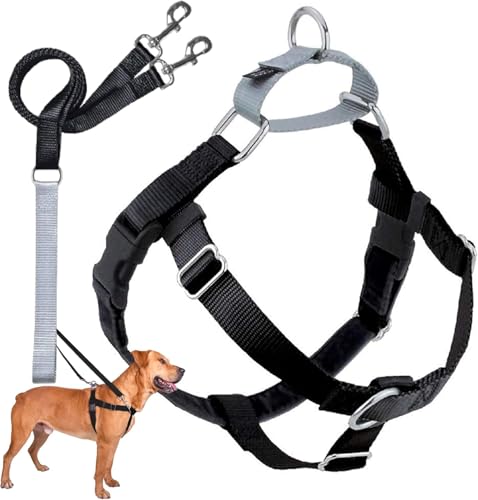
2 Hounds Design Freedom No-Pull Harness
This harness pairs a front leash ring that discourages pulling with a back ring for everyday walks, while the fitted strap design limits the slack a dog needs to back out. A tightening loop option adds extra security for strong pullers.
Pros
- Front ring attachment discourages pulling during walks
- Optional tightening loop adds security for strong pullers
- Dual attachment points suit both training and daily walking
Cons
- Requires careful initial sizing to fit snugly and prevent slipping
- More strap adjustment than a simple step-in design

RUFFWEAR Front Range Harness
RUFFWEAR builds this harness with four points of adjustment for a snugger, more customized fit than a basic two-strap design. The padded chest and belly panels add comfort for dogs that wear a harness most of the day.
Pros
- Four adjustment points allow a snugger, more secure fit
- Padded panels improve comfort during long wear
- Durable stitching holds up well to daily use over years
Cons
- Initial fitting takes more adjustment than step-in styles
- Costs more than basic no-frills harnesses

Kurgo Tru-Fit Smart Harness
Kurgo’s harness doubles as a car safety restraint, with a steel loop that connects to a seatbelt tether sold separately. The snug chest plate design also limits slack that could let a dog back out during walks.
Pros
- Steel loop allows direct use as a car safety restraint
- Snug chest plate reduces slack points for backing out
- Padded straps stay comfortable during extended wear
Cons
- Bulkier chest plate than lighter escape-focused vests
- Car safety tether sold separately adds extra cost

Rabbitgoo No Pull Dog Harness
Rabbitgoo offers multiple adjustment points at a lower price than premium escape-focused brands, covering basic fit security for dogs without an extreme escape history. Reflective strips add some visibility for evening walks.
Pros
- Lower price point than premium escape-proof brands
- Front and back attachment adds training versatility
- Reflective strips improve visibility in low light
Cons
- Less reinforced than dedicated escape-proof designs for determined dogs
- Sizing runs inconsistent across the range, so check measurements carefully
Yizhi Miaow Escape Proof Reflective Vest Harness
This harness is cut slimmer than standard designs, aimed at small or narrow-chested breeds that slip out of harnesses sized for broader chests. Multiple adjustment straps still reduce the slack a smaller dog could use to escape.
Pros
- Slimmer cut fits narrow-chested small breeds better than standard sizing
- Multiple straps reduce slack for smaller dogs prone to slipping out
- Lightweight mesh suits smaller dogs in warm weather
Cons
- Single back attachment limits training control options
- Not sized for medium or large breeds
The lineup, side by side
| # | Model | Closure Type | Best for | Score | Price |
|---|---|---|---|---|---|
| 1 | Chai’s Choice Escape Proof Vest Harness | Multi-strap buckle adjustment | Best Overall | 9.1 | Check price |
| 2 | Downtown Pet Supply Escape Proof Step-In Harness | Step-in with back clasp | Best for Fast, Easy Daily Use | 8.8 | Check price |
| 3 | 2 Hounds Design Freedom No-Pull Harness | Buckle straps with dual rings | Best for Dogs That Pull and Try to Slip Free | 8.9 | Check price |
| 4 | RUFFWEAR Front Range Harness | Four-point buckle adjustment | Best Durable Everyday Harness | 8.7 | Check price |
| 5 | Kurgo Tru-Fit Smart Harness | Buckle straps with steel loop | Best with Seatbelt Attachment | 8.5 | Check price |
| 6 | Rabbitgoo No Pull Dog Harness | Multi-point buckle adjustment | Best Budget Adjustable Pick | 8.3 | Check price |
| 7 | Yizhi Miaow Escape Proof Reflective Vest Harness | Multi-strap buckle adjustment | Best for Small or Narrow-Chested Dogs | 8.2 | Check price |
Questions worth asking
What makes a dog a flight risk for escaping a harness?
Fear, past trauma, high prey drive or simply disliking the harness can all trigger backing out, often during a sudden startle like a loud noise.
How tight should an escape proof harness be?
You should be able to fit two fingers snugly between the harness and the dog’s body, tight enough to prevent slipping but not restrict breathing.
Can a determined dog still escape any harness?
Yes, an extremely determined or panicked dog can sometimes still escape even a well-fitted harness, so a secure leash and collar backup adds extra safety.
Should I use a harness and a collar together for extra security?
Many owners attach the leash to both a harness and a backup collar connection, so if one fails the other still holds.
How do I measure my dog for the right harness size?
Measure chest girth around the widest part of the ribcage and neck circumference, then compare to the brand’s specific size chart rather than guessing.
Will a front-clip harness hurt my dog’s shoulders if they pull a lot?
Occasional use is generally fine, but dogs that pull constantly may benefit from working on loose-leash training alongside using a front-clip harness.
Can puppies wear an escape proof harness?
Yes, many of these harnesses come in smaller size ranges suitable for puppies, though sizing should be rechecked frequently as a puppy grows.
Do escape proof harnesses work for dogs with health issues like tracheal problems?
A well-fitted harness is generally gentler on the trachea than a collar, since it distributes pressure across the chest instead of the neck.
Our take
The Chai’s Choice Escape Proof Vest Harness remains the strongest choice for dogs with a documented history of backing out, thanks to its multiple adjustment points and wraparound fit. Owners who want a faster daily routine for a dog without a serious escape history should choose the Downtown Pet Supply Escape Proof Step-In Harness instead. Dogs that both pull hard and attempt to slip free do better with 2 Hounds Design Freedom No-Pull Harness, since its front attachment addresses both problems at once.
Olivia Hartley
Olivia spent several years working at an animal shelter and a pet-supply retailer before joining the editorial team. She researches pet gear with an emphasis on safety, comfort and the fine print that owners often miss.


