Which Electric Pressure Washer Fits Your Home Cleaning Jobs
Sun Joe’s SPX3000 leads for buyers who want one washer to cover driveways, siding, and cars. Greenworks GPW1704 delivers dependable cleaning at a lower cost. Karcher’s K5 Premium suits anyone who needs sustained pressure for concrete and siding. Every model plugs into standard household power and a garden hose.
Sun Joe’s SPX3000 suits homeowners who want one washer for driveways, siding, and cars, backed by 2030 PSI and 1.76 GPM output. Its plastic fittings feel less durable than the induction-motor build on the Karcher K5 Premium. Owners washing only patio furniture or bikes may prefer the cordless WORX Hydroshot instead.
PSI alone will not predict performance on wood, concrete, or paint, since flow rate and nozzle design carry equal weight. We compared published PSI, GPM, motor type, and included accessories across seven current listings to separate driveway-ready units from lighter patio and car-washing models.
Our top picks

Sun Joe SPX3000
Sun Joe built the SPX3000 around a 14.5-amp motor delivering 2030 PSI and 1.76 GPM, strong enough for siding, decks, and cars without swapping machines. Five tool-free nozzle tips cover fan, jet, and soap settings. A built-in detergent tank stores cleaner for driveway and patio jobs.
Pros
- Handles driveways, siding, and cars with one machine
- Five nozzle tips cover most spray patterns without extra tools
- Light enough to carry around a yard solo
Cons
- Plastic fittings wear faster than metal alternatives
- Detergent tank runs dry quickly on large jobs

Greenworks GPW1704
Greenworks pairs a 13-amp motor with 1700 PSI and 1.2 GPM output, suited to routine patio and car washing. A 35-foot power cord reaches around most driveways without an extension cord. Two spray tips switch between a wide rinse and a concentrated jet.
Pros
- 35-foot cord skips the need for extension cords
- Compact frame stores in a garage corner
- Two-nozzle setup keeps operation simple for beginners
Cons
- Lower PSI struggles against caked-on mud
- Only two nozzle choices limit spray variety

Stanley SHP2150
Stanley’s SHP2150 runs a 14-amp motor at 2150 PSI and 1.4 GPM, priced for first-time pressure washer buyers. An onboard reel keeps the 20-foot hose organized after each use. Wheels let one person roll the unit across a patio without lifting it.
Pros
- Higher PSI than many similarly priced units
- Onboard hose reel keeps storage tidy
- Wheeled base eases movement across concrete
Cons
- Build materials feel lighter duty over time
- Warranty coverage runs shorter than premium brands

Karcher K5 Premium
A water-cooled induction motor drives this Karcher to 2000 PSI and 1.4 GPM, built for repeat driveway and siding cleanup. The included Home Kit adds a surface cleaner attachment for flat concrete. Induction motors run quieter and last longer under repeated use than universal motors.
Pros
- Induction motor rated for a longer service life
- Surface cleaner attachment speeds up driveway jobs
- Runs quieter than universal-motor competitors
Cons
- Heavier unit is harder to carry up stairs
- Costs more than standard universal-motor washers

AR Blue Clean AR390SS
Stainless steel wraps the pump on this AR Blue Clean model, rated for 1900 PSI and 1.5 GPM. Its total stop system shuts the motor off automatically once the trigger releases, cutting wear during rinse breaks. An integrated reel keeps the hose and cord in one housing.
Pros
- Total stop feature saves wear during pauses
- Stainless pump resists rust in humid garages
- Moderate PSI stays gentle on car paint and trim
Cons
- Fewer nozzle options than the Sun Joe SPX3000
- Reel housing adds bulk for storage
WORX WG630 Hydroshot
At 5.7 pounds, the WORX Hydroshot skips the power cord entirely and runs on a rechargeable battery. It draws water from a bucket, rain barrel, or garden hose, useful for patio furniture and small tool cleanup. Output tops out near 320 PSI, well below corded models built for driveways.
Pros
- No power cord needed near water sources
- Fits in a closet or truck bed easily
- Draws water from ponds or barrels in a pinch
Cons
- Battery runtime limits continuous jobs
- PSI too low for driveway or siding stains
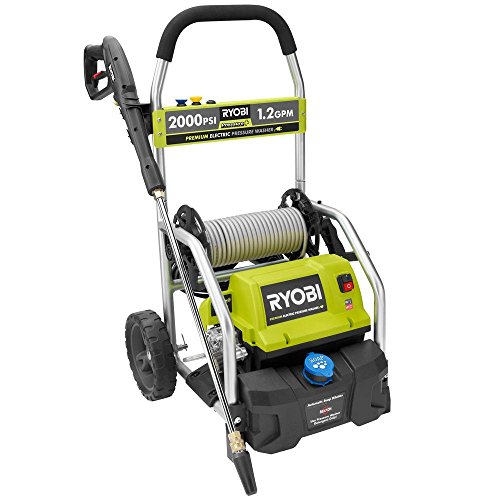
Ryobi RY141900
Ryobi sizes this washer for wood decking and paver patios with a 13-amp motor at 1900 PSI and 1.2 GPM. A turbo nozzle adds a rotating jet that lifts algae and grime without a separate surface cleaner. Onboard storage holds the wand and nozzles between uses.
Pros
- Turbo nozzle speeds up deck and paver cleaning
- Onboard storage keeps accessories together
- Shares parts with the broader Ryobi tool ecosystem
Cons
- Turbo nozzle can etch soft wood if held too close
- GPM trails the Sun Joe SPX3000
The lineup, side by side
| # | Model | Max PSI | Best for | Score | Price |
|---|---|---|---|---|---|
| 1 | Sun Joe SPX3000 | 2030 | Best overall | 9.4 | Check price |
| 2 | Greenworks GPW1704 | 1700 | Best value | 9.1 | Check price |
| 3 | Stanley SHP2150 | 2150 | Best budget | 8.8 | Check price |
| 4 | Karcher K5 Premium | 2000 | Best for driveways | 8.6 | Check price |
| 5 | AR Blue Clean AR390SS | 1900 | Best for car washing | 8.3 | Check price |
| 6 | WORX WG630 Hydroshot | 320 | Best for compact storage | 8.1 | Check price |
| 7 | Ryobi RY141900 | 1900 | Best for patio and deck cleaning | 8.0 | Check price |
How to choose
What to look for in an electric pressure washer PSI and GPM together decide cleaning power, not PSI by itself. Multiplying the two numbers gives a rough cleaning-units figure for comparing washers side by side. Household outlets rated at 15 amps limit most units to a 13 to 15-amp motor. Nozzle variety matters just as much as raw output, since a narrow tip concentrates pressure for stains while a wide fan protects paint and wood.
How much PSI does a driveway need versus a deck? Concrete tolerates 2000 PSI or higher without damage. Wood decking and vinyl siding do better under 1700 to 1900 PSI to avoid gouging. Cars and outdoor furniture call for even less, often under 1900 PSI paired with a wide fan tip. Matching PSI to the surface prevents etching and splintering.
Best pressure washers for apartments and tight storage Renters often lack garage space for a full-size unit. Compact corded models under 20 pounds, or battery units like the WORX WG630 Hydroshot, tuck into a closet. Quieter induction motors, such as the one inside the Karcher K5 Premium, also suit shared walls better than louder universal motors.
Electric or gas: which fits occasional home cleaning? Electric models start instantly, run quieter, and skip fuel or oil changes altogether. Gas washers deliver more PSI for large properties but demand maintenance between seasons. Driveways, patios, and cars around a typical home fall well within what electric units can handle without that upkeep.
Questions worth asking
What PSI is best for cleaning a driveway?
Most concrete driveways clean well between 2000 and 2500 PSI. The Karcher K5 Premium and Stanley SHP2150 both fall in that range without needing gas-engine maintenance.
Can an electric pressure washer clean a car without damaging the paint?
Yes, as long as PSI stays under 1900 and the nozzle is set to a wide fan pattern. The AR Blue Clean AR390SS was built with car washing in mind at 1900 PSI.
How long are the hoses on electric pressure washers?
Most home models ship with a 20-foot hose, and power cords range from 20 to 35 feet. The Greenworks GPW1704 includes a 35-foot cord for extra driveway reach.
Are electric pressure washers strong enough to strip old paint?
Generally not below 2200 PSI, since paint stripping calls for gas washers above 3000 PSI. For siding and decking, an electric model with a turbo nozzle, like the Ryobi RY141900, handles algae and dirt instead.
Which pressure washer is quietest for apartment or townhouse use?
Induction motor designs, such as the Karcher K5 Premium, run quieter than universal motor units. Battery models like the WORX WG630 Hydroshot skip motor hum from a wall outlet entirely.
Do electric pressure washers need a special outlet?
Most run on a standard 120-volt, 15-amp household outlet. A dedicated circuit or ground fault outlet lowers the odds of a tripped breaker mid-job.
Does GPM matter as much as PSI on a pressure washer?
Yes, GPM decides how fast dirt actually rinses away. The Sun Joe SPX3000 pairs high PSI with 1.76 GPM, one of the higher flow rates in this lineup.
Can a cordless pressure washer replace a corded one at home?
For light jobs like patio furniture or bikes, yes, as the WORX WG630 Hydroshot shows. Driveways and siding still call for a corded model’s sustained PSI and runtime.
What is the difference between a 13-amp and 14.5-amp pressure washer motor?
A higher amp draw generally allows more PSI and flow from the same outlet, as seen comparing the Greenworks GPW1704’s 13-amp motor to the Sun Joe SPX3000’s 14.5-amp motor. Both still run on a standard household circuit.
The verdict
Sun Joe’s SPX3000 earns the top recommendation, since 2030 PSI paired with 1.76 GPM covers driveways, siding, and cars without swapping tools. Buyers focused on tight storage or cordless convenience should choose the WORX WG630 Hydroshot instead, even though its 320 PSI limits it to light-duty jobs. Anyone cleaning mostly concrete gets more sustained pressure from the Karcher K5 Premium’s induction motor.
Jake Monroe
Jake worked as a residential contractor for over a decade before shifting to full-time writing. He evaluates power tools, hand tools and workshop gear through the lens of someone who has actually used them on job sites, not just read the box.