5 Electric Bikes Built for Rough Outdoor Trails
Aventon Pace 500.3 leads for comfortable, well supported riding across roads and light trails. Heybike Mars 2.0 handles genuinely rough ground on wide fat tyres, while Velowave Ranger carries the largest battery in this group for the longest days out on the trail.
Aventon Pace 500.3 is the sensible pick for paved paths, gravel and the occasional trail without feeling out of its depth. Heybike Mars 2.0 does better on genuinely rough ground thanks to its fat tyres, and Velowave Ranger carries the biggest battery in this group.
Comparing electric bikes gets tricky because manufacturers quote range on flat ground with a light rider at the lowest assist level, which rarely resembles real riding. Watt hours matter more than headline range, and motor torque shapes hill performance more than the wattage number alone. We compared battery capacity, torque, brake type and what owners report about hills and load to rank the seven below.
How to choose
Compare watt hours, not the advertised range Range claims come from ideal conditions: a light rider, flat ground, and the lowest assist level, which real riding rarely matches. Watt hours are the honest number, calculated as volts multiplied by amp hours. A 720Wh battery like the one in Velowave Ranger genuinely stores more energy than a 374Wh pack, regardless of marketing language. Expect roughly fifteen to twenty five watt hours per mile depending on terrain, wind and how much you pedal.
Why torque beats watts for climbing hills Wattage grabs attention, but torque in newton metres decides whether a bike pulls up a steep gradient or bogs down. A 500W motor with strong torque and sensible gearing can out climb a 750W motor with poor gearing. Mid drive motors use the bike’s own gears and suit steep terrain best, while hub motors, fitted to every bike here, rely on raw power instead.
How tyre width decides where you can ride Four inch fat tyres, fitted to Heybike Mars 2.0 and Velowave Ranger, spread weight so the bike floats over sand, loose gravel and snow instead of sinking. That flotation costs real drag and weight on tarmac. Narrower mountain bike tyres roll faster and lighter but dig into soft ground. Choose based on your worst regular surface, not your best one.
Brakes matter more as bike weight increases An electric bike weighs roughly twice a comparable regular bicycle, and it carries that weight downhill at higher average speeds. Hydraulic disc brakes, fitted to Aventon Pace 500.3 and Velowave Ranger, cope with that far better than mechanical discs, which fade on long descents. Riders tackling hills or carrying cargo should treat hydraulic brakes as close to non negotiable.
The top picks, ranked

Aventon Pace 500.3 Step Through Electric Bike
Torque sensing pedal assist reacts to how hard you push rather than switching on at a fixed speed, so the ride feels close to a normal bicycle even on varied ground. A 614Wh battery and 500W hub motor cover commuting and light trail riding with room to spare. Owners report the finish quality and dealer network beat cheaper direct import bikes.
Pros
- Torque sensing assist feels natural on climbs
- Hydraulic discs give confident stopping with load
- Backed by a real service network
Cons
- Tyres are too narrow for soft sand or mud
- Costs more than direct import rivals with similar specs

Heybike Mars 2.0 Folding Fat Tire Electric Bike
Four inch fat tyres float over gravel, sand and snow where narrow tyres would dig in. Folding lets it fit in a car boot or apartment hallway, useful when riding starts with a drive. Owners describe it as stable and forgiving off road, though lifting it takes real effort given the weight.
Pros
- Fat tyres handle sand, gravel and snow well
- Folds for car transport and small storage
- Large battery for the price band
Cons
- Heavy to lift even when folded
- Fat tyres feel slow and draggy on tarmac
Velowave Ranger Electric Fat Tire Bike
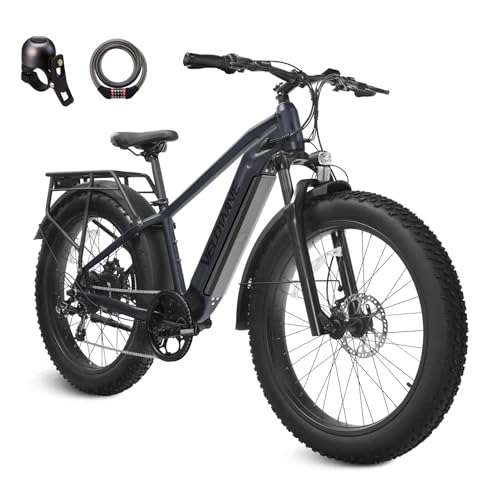
One of the largest batteries in this class targets long days out rather than short commutes. A rigid rear paired with a front suspension fork keeps the mechanicals simple and easy to service. Moderate assist stretches genuinely far, based on owner reports, though full throttle use cuts range as expected.
Pros
- Largest battery capacity here for long rides
- 750W motor climbs confidently with cargo
- Larger 26 inch wheels roll better than 20 inch fat bikes
Cons
- Very heavy, awkward on a car rack
- Basic suspension fork by mountain bike standards

ENGWE Engine Pro Folding Electric Bike
Front and rear suspension take the sting out of rough, broken tracks that would rattle a hardtail. A powerful hub motor pairs with fat tyres for steep and uneven ground. Weight is the trade off, since dual suspension and a fat tyre frame add up fast, though it still folds for transport.
Pros
- Full suspension smooths broken ground
- Strong climbing on steep gradients
- Folds despite the suspension layout
Cons
- Among the heaviest bikes here
- Rear shock is basic and not rebuild friendly

Vivi Electric Mountain Bike
Conventional 26 inch mountain bike geometry keeps this lighter and more familiar than the fat tyre folders. Gravel paths and forest tracks suit it better than technical trails, given the standard tyre width. Riders already used to a normal mountain bike find it the easiest electric bike to adapt to.
Pros
- Rides much like a conventional mountain bike
- Lighter than the fat tyre options
- Simple to service with standard bike parts
Cons
- Smallest battery here, so range is limited
- Mechanical disc brakes need frequent adjustment

Gotrax F5 Folding Electric Bike
Riders who drive to a trailhead or park and ride gain the most from this compact fold, which fits most car boots. Twenty inch wheels stay manoeuvrable on paths without the drag fat tyres add. Maintained trails and paved paths suit it better than genuinely rough terrain, based on owner feedback.
Pros
- Folds small enough for most car boots
- Lighter than fat tyre folding rivals
- Removable battery charges indoors
Cons
- Narrow tyres limit it on loose surfaces
- Modest range on hilly routes

ANCHEER Electric Mountain Bike
Front suspension and a removable battery bring straightforward electric riding within reach at the lowest cost here. Gravel paths, park trails and light outdoor use fit its capability. Daily heavy mileage asks more than this bike delivers, according to owner reports, but casual outdoor riding is well within range.
Pros
- Cheapest entry into electric outdoor riding
- Familiar mountain bike layout
- Battery removes for indoor charging
Cons
- Component quality is basic throughout
- Limited range on hills and headwinds
How they stack up
| # | Model | Motor | Best for | Score | Price |
|---|---|---|---|---|---|
| 1 | Aventon Pace 500.3 Step Through Electric Bike | 500W rear hub, 48V system | Best overall | 9.4 | Check price |
| 2 | Heybike Mars 2.0 Folding Fat Tire Electric Bike | 500W rear hub with peak output higher | Best for rough ground | 9.2 | Check price |
| 3 | Velowave Ranger Electric Fat Tire Bike | 750W rear hub | Best range | 9.0 | Check price |
| 4 | ENGWE Engine Pro Folding Electric Bike | 750W rear hub, high torque | Best for hills | 8.8 | Check price |
| 5 | Vivi Electric Mountain Bike | 500W rear hub | Best value | 8.6 | Check price |
| 6 | Gotrax F5 Folding Electric Bike | 500W rear hub | Best for car transport | 8.3 | Check price |
| 7 | ANCHEER Electric Mountain Bike | 350W to 500W rear hub depending on model | Best budget | 8.0 | Check price |
Frequently asked questions
How far will an electric bike really go on one charge?
Divide battery capacity in watt hours by roughly twenty for a realistic mixed terrain figure. A 720Wh battery gives around thirty five miles at moderate assist, less on hills or with heavy throttle use.
Can electric bikes be ridden in the rain?
Most carry a wet weather rating similar to IPX4, meaning splashes and rain cause no harm. Deep puddles, pressure washing and prolonged storage outdoors are different risks worth avoiding.
What is the difference between a torque sensor and a cadence sensor?
Cadence sensors detect that pedals are turning and apply fixed assist, which can feel abrupt. Torque sensors, fitted to Aventon Pace 500.3, measure pedaling force and scale assist to match, using battery more efficiently.
Do I need a license or insurance for an electric bike?
Rules vary by country and state. Much of the United States treats class one and two bikes capped at twenty miles per hour as needing neither, while faster class three bikes face more path restrictions.
How long do electric bike batteries last?
Typically five hundred to eight hundred full charge cycles before capacity drops noticeably, spanning several years of normal use. Storing the pack around half charge and away from extreme temperatures slows degradation.
Are fat tyres worth it for general outdoor riding?
They earn their keep when sand, snow, loose gravel or mud show up regularly, since narrow tyres sink there. Riders sticking mostly to tarmac or firm paths gain little beyond extra weight and rolling resistance.
Can I carry a passenger or heavy cargo on an electric bike?
Only on models rated for it, and most bikes here list a total load between roughly two hundred fifty and four hundred pounds including the rider. Exceeding that stresses the frame, wheels and brakes.
Do electric bikes still give you exercise?
Yes, on pedal assist. Riders consistently cover more distance and ride more often once assist removes some of the effort, which offsets the reduced work per mile. Throttle only riding provides very little.
Which is better for sand and snow, fat tyres or mountain bike tyres?
Fat tyres like those on Heybike Mars 2.0 spread weight across a wider footprint, which keeps the bike from sinking. Mountain bike tyres roll faster on firm ground but struggle once the surface turns soft.
Final word
Aventon Pace 500.3 rides naturally and comes with proper support, covering most outdoor use short of technical trails. Heybike Mars 2.0 answers sand, snow and loose gravel better, and Velowave Ranger justifies its extra weight when long days out matter more than easy transport.
Derek Holt
Derek has a background coaching recreational and amateur athletes and has worked the sales floor at specialty fitness retailers. He focuses on equipment durability, ergonomics and realistic use cases rather than marketing claims.