Which Robot Building Kits Skip Plastic or Batteries?
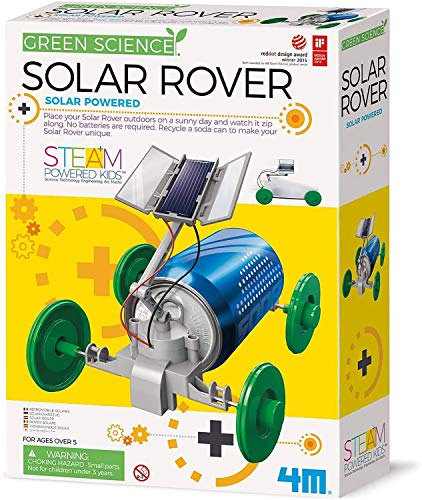
OWI-536’s Solar Ecorobot Kit tops this list, walking entirely on sunlight with no battery needed. A similar solar build comes cheaper in the 4M Kidz Labs Green Science Solar Rover Kit. Beginners on a budget get an easy first build from the Sunnytech DIY Solar Robot Kit. None of these three need a single battery.
Kids who want a robot that never needs a battery should start with the OWI-536 Solar Ecorobot Kit, since a single solar cell drives its entire gear train. It suits builders around age 10 who enjoy watching gears move under sunlight instead of a motor. One tradeoff stands out: this pick saves on batteries, not on plastic, since its housing is still ABS.
Few robot kits sold on Amazon carry a real third-party green certification, so this comparison weighs power source, material choice, and reuse value instead of marketing labels. We checked listed specs, owner feedback on durability, and age recommendations across all seven kits before ranking them.
How to choose
What ‘Eco Friendly’ Really Means for Robot Kits Almost no robot kit sold on Amazon carries a genuine third-party green certification. Buyers should read the label as a description of materials and power source, not an official standard. Solar cells remove disposable batteries from the equation entirely. Cardboard chassis, recycled tin cans, and laser-cut wood cut new plastic use, even when small plastic parts remain in the motor or gears.
Solar Power vs Recycled Material Builds Solar kits like the OWI-536 and the 4M Solar Rover need direct light to move, so they work best outdoors or near a bright window. Kits built around a tin can or wood panels run on battery power or manual assembly instead, so they move indoors any time but keep batteries in the picture. Families chasing zero ongoing battery cost should prioritize solar. Those who want less new plastic in the body should look at cardboard, tin, or wood builds instead.
Matching a Kit to Age and Build Experience None of these seven kits require coding, since gears, solar motors, or simple battery motors replace programmable boards. Kids around age 8 fit best with the 4M Solar Rover, Sunnytech kit, or Kikkerland robot, thanks to straightforward snap assembly. Older kids and teens get more from the OWI-536 or the ROKR Wall-E model, where finer gear alignment or precise wood panel fitting takes patience. First-time builders should try a simpler snap-together kit before tackling the ROKR.
When a Wood or Cardboard Kit Is Not the Right Fit Wood-based kits like the ROKR Wall-E hold up as display pieces but crack under rough handling, making them a poor fit for kids who want an active outdoor toy. Cardboard chassis kits face the same durability tradeoff after repeated folding and unfolding. Families mainly focused on cutting battery waste, rather than plastic content, are often better served by a rechargeable battery kit like the 4M Tin Can Robot than by a fragile cardboard or wood build.
The shortlist, ranked
OWI-536 Solar Ecorobot Kit
A small solar panel drives this kit’s gear train, so it walks and pivots under direct sunlight without any battery. Builders snap the gears together and use a small screwdriver, with no soldering involved. OWI has sold this same design for years, which keeps replacement parts and printed instructions easy to find.
Pros
- Moves indefinitely on sunlight with zero battery replacement cost
- Teaches gear mechanics and solar energy conversion through hands-on assembly
- Long sales history keeps spare parts and manuals easy to source
Cons
- Needs strong direct light, so it stalls on cloudy days or indoors
- ABS plastic housing means this is a battery-free kit, not a low-plastic one
4M Kidz Labs Green Science Solar Rover Kit
Punch-out cardboard panels form most of this rover’s chassis, paired with a small solar motor instead of a plastic shell. Kids fold precut cardboard pieces into the frame before snapping on the solar cell and wheels. Reduced plastic packaging comes standard with 4M’s Green Science line.
Pros
- Cardboard chassis cuts molded plastic compared to fully injected kits
- Solar power removes any ongoing battery purchases
- Costs less than most solar robot kits with a similar build
Cons
- Cardboard folds weaken after repeated indoor and outdoor use
- Rougher surfaces slow this rover down more than plastic-bodied rivals

Sunnytech DIY Solar Robot Kit
Clear plastic gears and a compact solar panel let this kit walk or roll, depending on which configuration a child builds. No batteries ship with it or are needed, since the motor pulls power straight from the panel. Printed instructions guide assembly, and parts snap together with light hand pressure.
Pros
- Lowest entry cost among solar-powered robot kits here
- Multiple build configurations from one parts set
- No batteries to buy or dispose of over time
Cons
- All-plastic construction offers no material advantage over standard kits
- Small parts crack if forced together instead of aligned carefully

Thames & Kosmos EcoMotion
Rather than one fixed robot, this kit builds several small vehicles powered by solar cells, wind, and stored kinetic energy. An included manual explains how each energy source works. Parts stay reusable across builds, so a solar car becomes a wind-powered vehicle without new pieces.
Pros
- Covers three renewable energy concepts in one reusable parts set
- Detailed manual explains the physics behind each build
- Parts rebuild into different models repeatedly
Cons
- Plastic parts dominate the build, so this is not a low-plastic kit
- Costs more than single-design solar kits with less variety
4M Kidz Labs Green Science Tin Can Robot Kit
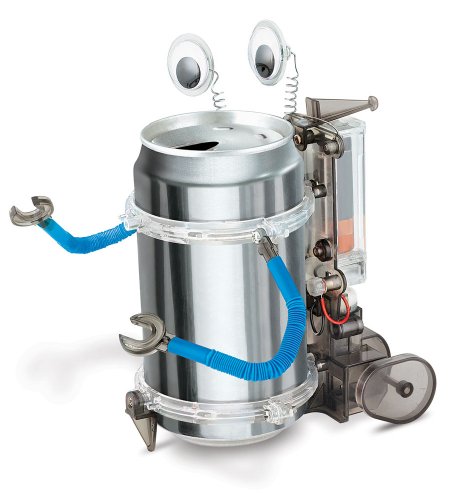
An empty tin can supplied by the family becomes the robot’s body in this kit, paired with a small motor, gears, and included wobbly eyes. Two AA batteries power the motor, so it runs indoors regardless of light. Assembly involves gluing and screwing parts directly onto the can.
Pros
- Reuses a household recyclable instead of adding new plastic body parts
- Works indoors immediately without needing direct sunlight
- Accepts rechargeable AA batteries to cut disposable battery waste
Cons
- Requires the family to supply a clean, undamaged tin can beforehand
- Battery-powered motor means this is not a battery-free build like solar kits

ROKR Wall-E 3D Wooden Puzzle Robot
Laser-cut plywood panels snap together without glue to form a display model of the animated robot. A small motor and single AA battery drive limited movement rather than remote control. Robotime builds the ROKR line around wood construction, though the motor housing stays plastic.
Pros
- Plywood panels replace most of the plastic found in typical kits
- Finished robot doubles as a shelf display, encouraging long-term keeping
- Glue-free construction means sanded panels fit together and can be reassembled
Cons
- Manufacturer labeling recommends age 14 and up due to small, precise pieces
- Wood panels crack under rough handling, so this is not an active-play toy

Kikkerland Solar Robot Kit
A compact solar panel and a handful of snap-fit plastic pieces let younger kids finish this robot in one sitting. It wobbles and moves its arms under bright light rather than driving across a room. Kikkerland sells it as a novelty desktop robot alongside other small solar gadgets.
Pros
- Fast, simple assembly suits younger or first-time builders
- Solar panel powers all movement, so no batteries are needed
- Compact size fits a desk or windowsill for ongoing display
Cons
- Movement stays limited to wobbling in place rather than driving around
- All-plastic body offers no material advantage over standard toys
The lineup, side by side
| # | Model | Power source | Best for | Score | Price |
|---|---|---|---|---|---|
| 1 | OWI-536 Solar Ecorobot Kit | Solar panel only, no batteries | Best overall | 9.4 | Check price |
| 2 | 4M Kidz Labs Green Science Solar Rover Kit | Solar panel only, no batteries | Best value | 9.1 | Check price |
| 3 | Sunnytech DIY Solar Robot Kit | Solar panel only, no batteries | Best budget | 8.8 | Check price |
| 4 | Thames & Kosmos EcoMotion | Solar, wind, and kinetic energy modules | Best for exploring multiple green energy sources | 8.5 | Check price |
| 5 | 4M Kidz Labs Green Science Tin Can Robot Kit | 2x AA batteries, rechargeable compatible | Best for reusing household recyclables | 8.2 | Check price |
| 6 | ROKR Wall-E 3D Wooden Puzzle Robot | 1x AA battery, small motor | Best for wood construction and display value | 8.1 | Check price |
| 7 | Kikkerland Solar Robot Kit | Solar panel only, no batteries | Best for younger beginners | 8.0 | Check price |
Common questions
Are eco friendly robot building kits actually green?
Most lack formal certification, but solar kits remove disposable batteries entirely, and cardboard, tin, or wood bodied kits cut new plastic compared to fully molded designs.
Which solar robot kit is best for kids?
The OWI-536 Solar Ecorobot Kit is the most established option, backed by a long sales history and consistent owner feedback on its gear-driven walking mechanism.
Solar robot kits vs battery powered robot kits: which lasts longer?
Solar kits never need a replacement battery but stop moving without direct light. Battery kits, especially ones accepting rechargeable AA cells, run indoors any time but need periodic recharging.
Can eco friendly robot kits be reused after building?
Wood panel kits like the ROKR Wall-E and modular kits like the Thames & Kosmos EcoMotion are designed for repeated rebuilding or display, unlike single-use foam or sticker toys.
What age is best for solar robot building kits?
Most solar kits list an 8-and-up recommendation, while gear-heavy designs like the OWI-536 suit age 10 and up due to smaller parts and more assembly steps.
Is a wooden robot kit better than a plastic one?
Wood panels cut new plastic in the body, but manufacturers rate wood kits like the ROKR Wall-E for older builders since the pieces are thinner and less tolerant of rough play.
Do solar robot kits work without direct sunlight?
Most stall or crawl under indoor lighting alone. A bright desk lamp or direct window light usually drives the small motor reliably.
Is the 4M Green Science Tin Can Robot Kit worth buying?
It suits families who want to reuse a household recyclable and skip new plastic body parts, though it still runs on AA batteries rather than solar power.
How much assembly time do these robot kits take?
Snap-fit kits like the Kikkerland or Sunnytech models finish in under an hour, while gear-heavy builds like the OWI-536 or wood panel kits like the ROKR Wall-E take longer due to finer parts.
Our take
The OWI-536 Solar Ecorobot Kit remains the strongest overall pick for a genuinely battery-free build with a long track record. Families who want to cut new plastic rather than batteries should choose the 4M Kidz Labs Green Science Tin Can Robot Kit instead, since it reuses a household recyclable and still works indoors without direct sunlight. Builders who want an active outdoor toy rather than a shelf display should skip the ROKR Wall-E.
Rachel Simmons
Rachel previously worked in child-product retail and brings a practical, detail-first eye to gear reviews, focusing on safety standards, ease of use and the fine print that matters most for new caregivers.


