FSC Wood and Soy Ink Replace Plastic in Party Games
Blue Orange Games Kingdomino leads for balancing FSC-certified tiles with fast, replayable rounds. Melissa & Doug’s Wooden Bingo Game seats the biggest party, since eight boards cover a full table. PlanToys Memory Game fits toddlers best, pairing rubberwood pieces with water-based dyes safe for mouthing and handling.
Blue Orange Games Kingdomino tops this list, pairing FSC-certified cardboard tiles with a box that skips the usual plastic insert tray. It suits two to four players chasing a fifteen-minute game night regular, though a full party outgrows it fast. For eight or more guests, Melissa & Doug’s Wooden Bingo Game scales further on FSC wood boards, and households with toddlers get more mileage from PlanToys Memory Game’s rubberwood pieces.
Eco-friendly gets used loosely on toy packaging, so we traced which claims tie to a real certification instead of a marketing label. FSC wood and recycled cardboard both cut virgin material use, but a game still has to survive a six-year-old’s grip. We compared stated materials, player counts, age ranges and packaging against manufacturer listings, then weighed how owners describe durability after repeated play.
What we recommend

Blue Orange Games Kingdomino
Forty-eight domino-style tiles link into kingdoms, printed on FSC-certified cardboard instead of coated plastic stock. Blue Orange drops the molded plastic tray in favor of cardboard dividers for storage. A Spiel des Jahres win backs its replay value years after purchase.
Pros
- FSC certification covers both tiles and outer box
- Rounds run short enough for repeat weeknight play
- No molded plastic tray inside the packaging
Cons
- Cardboard corners soften after years of shuffling
- Table caps out at four players per set

Melissa & Doug Wooden Bingo Game
Eight wooden bingo boards let a full party table play one round without printing extra cards. Melissa & Doug sources the wood from FSC-certified suppliers, and a wooden box replaces the usual plastic tub for storage. Rules stay simple enough to mix grandparents and toddlers at one table.
Pros
- Eight boards seat a full party without extra printing
- Simple rules include a wide range of ages
- Wooden storage box swaps out plastic tubs
Cons
- Offers less strategic depth than tile or card games
- Wooden chips can chip if dropped often

Hape Wooden Domino Set
Hape mills much of its own wood supply, then finishes these twenty-eight dominoes in water-based, non-toxic paint. Pieces ship in a drawstring cloth pouch rather than a plastic blister pack, and rounded edges suit households with younger siblings nearby. Pricing sits below most branded wooden party games.
Pros
- Costs less than most branded wooden party games
- Water-based paint skips solvent-based finishes
- Cloth pouch replaces plastic blister packaging
Cons
- Ships as dominoes only, no scorepad or extras
- Piece count is lighter than a full party set
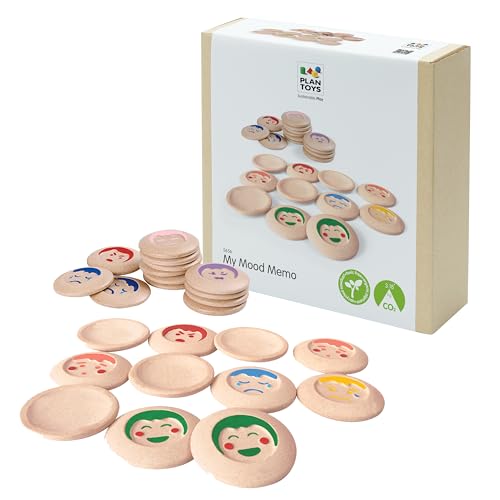
PlanToys Memory Game
PlanToys mills these memory tiles from rubberwood harvested once a tree’s latex-producing years end, turning a reclaimed byproduct into game pieces. Water-based dyes color each tile, a detail that matters once toddlers start mouthing pieces. Thick wood resists warping better than a printed cardboard card.
Pros
- Rubberwood repurposes a reclaimed forestry byproduct
- Water-based dyes suit toddlers who mouth toys
- Thick tiles resist warping better than card stock
Cons
- Matching gameplay gets outgrown by school age
- Adds more travel weight than a card-based game

Uncle Goose Wooden Dominoes
Uncle Goose mills these twenty-eight dominoes from sustainably harvested basswood and prints the pips in soy-based ink instead of solvent ink. Manufacturing happens in Michigan, shortening the supply chain compared with imported sets. Basswood resists chipping better than softer pine, and a muslin bag stands in for a plastic tray.
Pros
- Basswood resists chipping better than softer wood
- Soy-based ink replaces solvent-based printing
- Domestic manufacturing shortens the supply chain
Cons
- Priced above most imported wooden domino sets
- Traditional gameplay offers less party variety

Djeco Little Cooperation Card Game
Djeco prints this cooperative card game on FSC-certified stock and ships it in a cardboard box with no plastic wrap or tray. Players work together against the game rather than each other, a format that suits kids not ready for competitive rules. The compact box packs easier for trips than a boxed board game.
Pros
- Packaging and components stay fully plastic-free
- Cooperative rules suit non-competitive young kids
- Compact box travels well for trips
Cons
- Cards wear faster than wood or plastic pieces
- Cooperative format offers less long-term replay variety

EcoKids Wooden Rainbow Dominoes
EcoKids finishes these dominoes in bright, stacked colors, so the set doubles as a building toy between rounds. Wood comes from sustainably managed sources, per the brand’s stated sourcing policy. Chunky pieces suit family game night when younger and older players share the same round.
Pros
- Chunky pieces work for mixed-age family play
- Doubles as a stacking or building toy
- Drawstring bag keeps packaging plastic-free
Cons
- Color coating adds a step plain wood skips
- Piece count runs smaller than large party sets
What to look for
Reading eco claims on party game packaging FSC certification means a nonprofit audited the forest or paper supply chain against deforestation and labor standards, not just a green-sounding label. Recycled cardboard cuts new pulp demand, but it wears faster than solid wood under repeated shuffling. Water-based dyes and soy-based inks replace solvent inks that off-gas more strongly during manufacturing. Plastic-free packaging usually swaps a molded insert for a cardboard tray or a cloth bag. None of these claims guarantee durability by themselves, so check piece thickness and finish alongside any certification.
Solid wood versus recycled cardboard Solid wood pieces, like Uncle Goose’s basswood dominoes or PlanToys’ rubberwood tiles, resist bending and outlast printed card stock across years of handling. Recycled cardboard, used in Kingdomino’s tiles and Djeco’s cards, costs less to produce and keeps shelf prices lower. Corners on cardboard pieces soften first, typically after a few dozen sessions with kids. Wood costs more upfront but rarely needs replacing, which matters more for a game played weekly than one that comes out twice a year.
Matching player count to your guest list A group of six to eight needs a game built for that headcount, not a two-to-four box stretched thin. Melissa & Doug’s Wooden Bingo Game covers eight players from one set, since bingo scales by adding boards rather than complicating rules. Kingdomino and PlanToys Memory Game cap out around four, suiting a smaller table or a family night more than a full party. Buying two smaller sets rarely plays as smoothly as one game sized for a crowd.
Which pick holds up to repeated play Games in a classroom or toy rotation take more wear than ones played occasionally at home. Thick basswood and rubberwood pieces shrug off drops that would chip a painted cardboard tile. Soy and water-based finishes hold color under handling better than cheap printed coatings, which can flake with heavy use. For a set meant to survive years of birthday parties, wood construction beats card stock even where the box costs more upfront.
How they compare
| # | Model | Players | Best for | Score | Price |
|---|---|---|---|---|---|
| 1 | Blue Orange Games Kingdomino | 2 to 4 | Best overall | 9.4 | Check price |
| 2 | Melissa & Doug Wooden Bingo Game | Up to 8 | Best for large groups/party settings | 9.1 | Check price |
| 3 | Hape Wooden Domino Set | 28 dominoes | Best value/budget | 8.9 | Check price |
| 4 | PlanToys Memory Game | 2 to 4 | Best for young kids | 8.7 | Check price |
| 5 | Uncle Goose Wooden Dominoes | 28 dominoes | Best wooden/durable materials | 8.5 | Check price |
| 6 | Djeco Little Cooperation Card Game | 2 to 4 | Best plastic-free packaging | 8.2 | Check price |
| 7 | EcoKids Wooden Rainbow Dominoes | 28 dominoes | Best for family game night | 8.0 | Check price |
Frequently asked questions
Are wooden board games actually better for the environment?
Wood from FSC-certified forests comes from managed, audited sources, cutting deforestation impact versus unmanaged logging. Wood also outlasts many plastic components, so fewer replacement games reach a landfill. Usage length still matters most, since a durable set played for years beats a quickly discarded one regardless of material.
What does FSC certified mean on a toy or game?
FSC stands for Forest Stewardship Council, a nonprofit certifying forests and supply chains against standards for responsible logging, replanting and labor practices. A labeled product gets tracked from forest to factory under that audit. The standard covers solid wood pieces as well as paper or cardboard, like Kingdomino’s tiles.
How many players do eco-friendly party games support?
Player counts here range from two to eight. Kingdomino and PlanToys Memory Game top out at four, Djeco’s cooperative card game plays two to four, and Melissa & Doug’s Wooden Bingo Game covers up to eight with its included boards, making it the pick for a full table.
What age group do wooden party games suit?
Most sets in this comparison start at age 3. PlanToys Memory Game drops to age 2, thanks to a simple matching format and mouth-safe water-based dyes. Domino sets from Hape, Uncle Goose and EcoKids list a 3-and-up range, since small pieces still pose a choking risk for younger toddlers.
Are eco-friendly games as durable as plastic ones?
Solid wood pieces, like basswood dominoes or rubberwood memory tiles, typically outlast injection-molded plastic under repeated handling, since wood does not crack the way brittle plastic can. Recycled cardboard wears faster than either, softening at the corners with heavy use. Material choice inside the eco category matters as much as the label itself.
Which of these games ship without plastic packaging?
Kingdomino ships without a plastic insert tray, Djeco’s card game uses a cardboard box with no plastic wrap, and Hape and Uncle Goose both use cloth pouches instead of blister packs. Melissa & Doug’s Wooden Bingo Game and EcoKids’ dominoes use a wooden box and a drawstring bag instead of molded plastic trays.
Do eco-friendly wooden games make good gifts?
Wood construction reads as higher quality on unwrapping and tends to survive a toy rotation better than plastic, a reason these sets are popular for birthdays and holidays. Uncle Goose’s basswood dominoes and PlanToys’ rubberwood tiles are often bought as keepsake-style gifts, since solid wood ages into an heirloom look instead of yellowing plastic.
Do water-based dyes wash off or fade quickly?
Water-based dyes and paints, used by PlanToys and Hape, are sealed during manufacturing and hold up to normal handling and occasional wiping. They are not built to survive submersion or heavy scrubbing, so spot clean rather than soak these pieces. Fading happens gradually with years of sun exposure, similar to any painted wood toy.
Which eco-friendly game works best for a large party?
Melissa & Doug’s Wooden Bingo Game is built for a crowd, since eight included boards let a full table play the same round at once. Kingdomino and Djeco’s cooperative card game cap out at four players, better suited to a smaller family night than a full party.
The verdict
Kingdomino suits a mixed adult and older-kid group that wants a fast, FSC-certified strategy game without plastic packaging. Hosting more than six players points to Melissa & Doug’s Wooden Bingo Game instead, since one set seats the whole table. Parents shopping for a toddler should skip strategy entirely and start with PlanToys Memory Game, where rubberwood and water-based dyes matter more than rules depth.
Rachel Simmons
Rachel previously worked in child-product retail and brings a practical, detail-first eye to gear reviews, focusing on safety standards, ease of use and the fine print that matters most for new caregivers.