Bamboo, Silk or Ripstop: Picking a Truly Eco Kite
The HQ Kites Eco Line Simple Flyer Rainbow 33 Inch Kite leads for dependable eco flying. Windy beach days favor the Premier Kites 40 in. Box Kite, whose cellular frame resists collapse in gusts. For biodegradable materials, choose the G&Z Small Silk Eagle Kite, built from silk and bamboo.
Beginners chasing a genuinely eco-labeled kite should start with the HQ Kites Eco Line Simple Flyer Rainbow 33 Inch Kite. It flies within minutes of opening the box, built on HQ’s real Eco Line rather than a green sticker on standard nylon. Its fiberglass spar still won’t decompose, unlike the bamboo frames further down this list.
Eco-friendly kite claims cover everything from biodegradable paper and bamboo builds to ripstop sails with a recycled-content label. That range changes how long a kite survives outdoors and what happens to it afterward. We compared sail material, frame construction, wind range and owner reports on tearing or snapping across seven kites.
What we recommend

HQ Kites Eco Line Simple Flyer Rainbow 33 Inch Kite
HQ builds this diamond kite on its dedicated Eco Line, swapping standard nylon for ripstop polyester. Setup takes minutes since it ships with a spool handle and flying line already attached. Bright rainbow panels stay visible at altitude, helping new flyers track it against open sky.
Pros
- Ships ready to fly with handle and line included
- Ripstop polyester shrugs off small tears better than paper
- Rainbow sail stays visible at altitude for easy tracking
Cons
- Fiberglass spar does not biodegrade like bamboo frames
- Needs steady breeze rather than a light drift

Premier Kites 40 in. Box Kite – Rainbow
Two open cells replace the flat sail found on diamond kites, so this box kite keeps pulling once wind picks up. Premier flexes the 40 inch frame under gusts instead of letting it snap, suiting open beaches and hilltops. Rainbow ripstop panels stay visible even on a long line.
Pros
- Holds steady in gusty, higher wind conditions
- Frame flexes under load instead of snapping
- Flies straight without needing a tail
Cons
- Needs more open space than a flat diamond kite
- Struggles to lift off in light, calm wind

G&Z Small 3D Hand-Crafted Chinese Silk Eagle Kite
Silk panels stretch over a bamboo frame here, hand-assembled rather than machine-cut like the synthetic kites above. Its eagle shape gives the kite a dimensional, 3D profile once airborne instead of a flat sail. Compact sizing suits shorter lines and calmer, closer flying sessions.
Pros
- Silk and bamboo build breaks down fully after disposal
- 3D eagle silhouette stands out against open sky
- Compact size packs down easily for travel
Cons
- Wears faster than ripstop fabric under repeated use
- Not built for strong or gusty wind

HQ Kites Eco Line Stunt Kite Rookie, Rainbow
Dual lines replace the single pull of a diamond kite, letting new flyers practice loops and figure-eights. HQ uses the same ripstop polyester from its Eco Line, so sharp turns and dives don’t tear the sail. Rainbow panels mark each wingtip, making mid-maneuver position easy to read.
Pros
- Dual-line control teaches real stunt maneuvers
- Ripstop build handles sharp dives without tearing
- Wingtip panels stay visible during fast turns
Cons
- Steeper learning curve than single-line kites
- Requires more open flying space to maneuver safely

Generic 10 Pack Authentic Indian Paper Kites with Bridle Line and 400 Meter Kite Line
Tissue paper stretched over bamboo strips forms each patang in this set, the build used at Indian kite festivals. Ten kites arrive per order, so one torn sail or snapped frame does not end a flying session. A 400 meter line and bridle come included, skipping a separate line purchase.
Pros
- Ten kites cost less per kite than one premium build
- Paper and bamboo construction breaks down fully after use
- 400 meter line and bridle included, ready to fly
Cons
- Paper sail tears more easily than ripstop fabric
- Bamboo frame can snap under stronger gusts

G&Z Large Yellow 3D Silk Dragonfly Kite Chinese Handmade Kite
This larger dragonfly scales up G&Z’s silk-on-bamboo build, adding surface area to catch wind at altitude. Bright yellow panels with painted wing detail double as a display piece indoors. Hand-assembled bamboo ribs curve the wings into their insect-like shape.
Pros
- Larger silk panels catch more wind than the small eagle kite
- Painted wing detail doubles as home decor
- Silk and bamboo build biodegrades after its useful life
Cons
- Bulkier frame is harder to pack for travel
- Silk sail needs gentler handling than synthetic fabric
Bhagvandas Paper Kites and Kite Line (Patang and Dori)
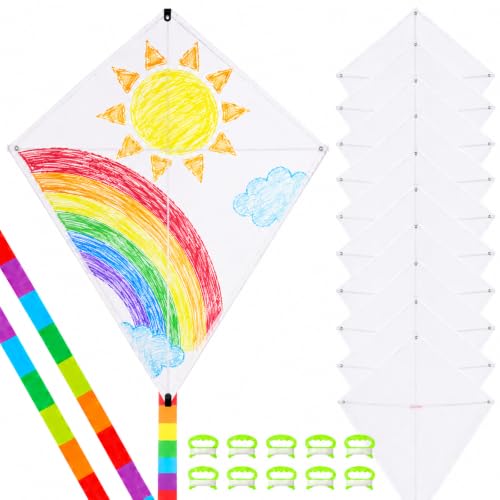
A paper sail pairs with a bamboo strip frame here, the lightest combination on this list. A dori line spool ships bundled in, so a first-time flyer skips a separate line purchase. Low weight lets it launch in lighter wind than the box kite or stunt delta above.
Pros
- Lightest kite here, launches in gentle wind
- Paper and bamboo build biodegrades fully after use
- Line spool included, nothing extra to buy
Cons
- Paper sail wears out faster than fabric options
- Not suited to strong or gusty wind
How they compare
| # | Model | Sail material | Best for | Score | Price |
|---|---|---|---|---|---|
| 1 | HQ Kites Eco Line Simple Flyer Rainbow 33 Inch Kite | Ripstop polyester | Best overall | 9.4 | Check price |
| 2 | Premier Kites 40 in. Box Kite – Rainbow | Ripstop nylon | Best for windy or beach conditions | 9.1 | Check price |
| 3 | G&Z Small 3D Hand-Crafted Chinese Silk Eagle Kite | Silk | Best for natural, biodegradable materials | 8.8 | Check price |
| 4 | HQ Kites Eco Line Stunt Kite Rookie, Rainbow | Ripstop polyester | Best for learning dual-line stunt flying | 8.6 | Check price |
| 5 | Generic 10 Pack Authentic Indian Paper Kites with Bridle Line and 400 Meter Kite Line | Tissue paper | Best value multi-pack | 8.3 | Check price |
| 6 | G&Z Large Yellow 3D Silk Dragonfly Kite Chinese Handmade Kite | Silk | Best for large-wingspan display flying | 8.1 | Check price |
| 7 | Bhagvandas Paper Kites and Kite Line (Patang and Dori) | Paper | Best budget single kite | 8.0 | Check price |
How to choose
What Makes a Kite Actually Eco-Friendly Sail and frame material decide most of a kite’s environmental footprint. Paper and silk sails on a bamboo frame break down naturally once torn or discarded, the path the Bhagvandas kite and both G&Z silk kites follow. Ripstop polyester or nylon resists tearing across storage seasons but does not decompose, even under a brand’s eco-focused line like HQ’s. Durability and biodegradability trade off against each other, so neither material wins outright.
Bamboo and Paper vs Recycled Ripstop Sails Bamboo frames flex under wind pressure instead of snapping, which is why paper patang kites survive repeated festival flying despite thin sails. Silk holds paint and dye more sharply than synthetic fabric, giving the G&Z dragonfly and eagle kites their detailed color work. Ripstop polyester resists tearing across dozens of flights a year, mattering more for frequent flyers than for a single festival outing. How often a kite gets flown, and how it gets disposed of afterward, usually decides which material fits better.
Which Eco Kite Fits Your Flying Skill Level Single-line diamond and box kites need only one input to stay aloft, making the HQ Simple Flyer and Premier Box Kite easier starting points. Dual-line stunt kites like the HQ Eco Line Rookie demand both hands and constant small corrections to hold a pattern. Paper patang kites sit close to single-line kites in difficulty but need a lighter touch, since a hard yank tears the sail. Matching skill level to kite type avoids a frustrating first flight regardless of material.
Matching Wind Conditions to Frame Strength Light, gusty coastal wind favors a flexible cellular frame like the Premier Box Kite, which keeps pulling as wind shifts direction. Calm inland afternoons suit the lighter paper and silk kites, since their frames cannot handle sustained strong gusts. Bamboo strips bend rather than shatter in a sudden gust, though repeated stress over a season weakens the joints faster than a fiberglass spar would. Checking average local wind speed before buying avoids pairing a delicate paper kite with an open, gusty field.
Good to know
What material makes a kite eco-friendly?
Bamboo frames paired with paper or silk sails biodegrade fully after disposal. Recycled-content ripstop polyester, like HQ’s Eco Line, trades that biodegradability for a longer usable life.
Are paper and bamboo kites durable enough for regular use?
They handle occasional flying well but wear faster than ripstop fabric under frequent use. A torn sail on the Bhagvandas kite or the Generic 10 pack is easy to replace since both include a spare-friendly, multi-kite or line-ready setup.
What is the best eco-friendly kite for beginners?
The HQ Kites Eco Line Simple Flyer Rainbow 33 Inch Kite is simplest, since it arrives ready to fly on a single line with handle and spool included.
Can eco-friendly kites handle strong wind?
The Premier Kites 40 in. Box Kite handles gusty wind best here, since its cellular frame flexes instead of collapsing. Paper and silk kites suit light, steady breeze rather than strong gusts.
Are recycled ripstop kites fully biodegradable?
No. Ripstop polyester and nylon sails resist tearing and last longer in storage, but they do not break down like paper, silk or bamboo once discarded.
What is the best eco-friendly kite for young kids?
The HQ Kites Eco Line Simple Flyer Rainbow 33 Inch Kite suits ages five and up with single-line control and a pre-assembled setup. The G&Z Small Silk Eagle Kite works for supervised, closer-range flying given its lighter, more delicate build.
Paper kite vs ripstop kite, which lasts longer?
Ripstop polyester and nylon sails last through more flying seasons and resist tearing better than paper. Paper kites cost less per unit and decompose after their useful life ends, unlike ripstop.
Do eco-friendly kites need a tail to fly straight?
Diamond and delta kites like the HQ Simple Flyer often fly straighter with a tail added. The Premier Box Kite and the silk dragonfly and eagle kites skip one, since their frame shape already provides stability.
How many kites come in the Generic Indian paper kite pack?
Ten patang kites ship per order, along with a 400 meter line and bridle, so a torn sail does not end the session.
Is silk or bamboo better for a display kite?
Silk holds paint and color detail better, which is why the G&Z dragonfly and eagle kites double as home decor. Bamboo gives the frame its flex and shape but adds little visual detail on its own.
Final word
The HQ Kites Eco Line Simple Flyer Rainbow 33 Inch Kite takes the top spot for its ripstop Eco Line build, ready-to-fly setup and single-line control suited to beginners. Flyers chasing gusty beach wind should reach for the Premier Kites 40 in. Box Kite instead, since its cellular frame holds steady where a flat diamond kite would tumble. Anyone prioritizing biodegradable materials over durability gets more satisfaction from the G&Z Small 3D Hand-Crafted Chinese Silk Eagle Kite’s bamboo and silk build.
Rachel Simmons
Rachel previously worked in child-product retail and brings a practical, detail-first eye to gear reviews, focusing on safety standards, ease of use and the fine print that matters most for new caregivers.