Which Drywall Anchors Actually Hold Heavy Shelves?
TOGGLER SnapToggle BB anchors take the top spot for genuine heavy load holding in hollow walls. E-Z Ancor Twist-N-Lock 50 anchors are the value pick for everyday hanging, and TOGGLER Alligator AF6 anchors are the choice for solid masonry and awkward substrates.
TOGGLER SnapToggle BB anchors lead this list on raw holding power. E-Z Ancor Twist-N-Lock 50 anchors handle the everyday hanging jobs at lower cost. TOGGLER Alligator AF6 anchors step in on the walls where neither of the first two applies.
Packaging ratings assume half inch drywall in perfect condition, yet the same anchor in older three eighths inch board holds far less weight. We ranked these on published pull out and shear ratings, hole size and wall thickness requirements, tools needed for installation, and what owners report about long term sag and removal damage.
What we recommend

TOGGLER SnapToggle BB Toggle Bolt Anchor
A steel channel flips behind the drywall while a plastic strap pulls it flat against the back face, spreading load over a wide area instead of crushing the board. Unlike traditional toggle bolts, the bolt itself can be removed and refitted without the toggle dropping into the cavity. A fairly large drilled hole is required.
Pros
- Highest holding power for hollow walls
- Bolt can be removed and refitted repeatedly
- Works across a wide range of wall thicknesses
Cons
- Requires a large drilled hole
- Costs more per anchor than plastic types

E-Z Ancor Twist-N-Lock 50 Drywall Anchors
Self drilling nylon threads straight into drywall with a Phillips driver, so no pilot hole is needed before hanging a picture rail or a small shelf. Everyday loads sit comfortably within the rating. Driving one into a stud or masonry destroys the anchor, since it is strictly a drywall fastener.
Pros
- No pilot hole or drill needed
- Very fast to install in quantity
- Cheap enough to buy a large pack
Cons
- Fails if it hits a stud or metal
- Leaves a large hole when removed

TOGGLER Alligator AF6 Solid Wall Anchor
Drywall, plaster, concrete, block and brick all accept this anchor from the same packet, useful when you are unsure what sits behind the surface. It grips by folding and expanding rather than depending on a specific wall thickness. Loads stay moderate rather than heavy.
Pros
- One anchor works across many wall types
- Grips well in old plaster and lath
- Does not require a specific wall thickness
Cons
- Moderate load rating only
- Needs an exact drill bit size to work properly

E-Z Ancor Toggle Lock Alloy Drywall Anchor
This hybrid design self drills like a standard anchor, then deploys a metal toggle behind the board once the screw is driven. Fast installation meets better holding power than plain nylon, which suits towel rails, mirrors and mid weight shelving. Once deployed, the toggle cannot be recovered from the cavity.
Pros
- Higher load than plain self drilling anchors
- Still installs without a pilot hole
- Metal body resists stripping
Cons
- Toggle is not recoverable once deployed
- Overkill for light picture hanging

Hilitchi Molly Bolt Hollow Drive Wall Anchors
Tightening the screw expands a metal sleeve behind the board, and because that sleeve stays clamped in the wall, the screw can be removed and refitted repeatedly. Wall brackets and coat rails that get unmounted periodically suit this design well. Installation takes longer than self drilling types.
Pros
- Screw can be removed and refitted many times
- Metal sleeve resists crushing the board
- Available in several lengths for wall thickness
Cons
- Slower to install than self drilling anchors
- Very difficult to remove without wall damage
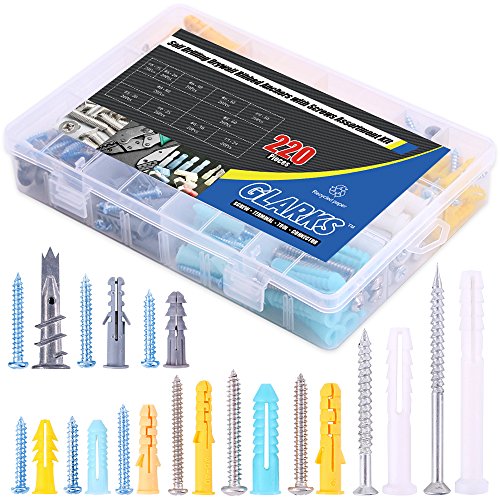
Glarks Self Drilling Drywall Anchor Assortment
A mixed kit of self drilling zinc anchors and matching screws in several sizes reflects how most households actually need a handful of different anchors, not a hundred identical ones. Zinc bodies drive more cleanly into board than plastic equivalents. Quality stays consistent though unremarkable, and the storage case feels flimsy.
Pros
- Covers several sizes in one purchase
- Screws included and correctly matched
- Zinc bodies drive cleanly into board
Cons
- Storage case is flimsy
- Light to medium loads only

Qualihome Ribbed Plastic Drywall Anchor Kit
Classic ribbed plastic expansion anchors ship with matched screws in a large kit for very little outlay. Picture frames, small mirrors and cable clips are exactly what this style is built for. A correctly sized pilot hole matters, since an oversized hole leaves the anchor spinning uselessly.
Pros
- Very cheap in large quantities
- Fine for picture frames and small fittings
- Small hole means easy repair later
Cons
- Spins in the hole if drilled oversize
- Not suitable for anything heavy
Before you buy
Find the stud first, and use an anchor only when you cannot No anchor holds as well as a screw driven into solid timber. Run a stud finder across the wall before reaching for the packet, and check whether the fixing point can shift a few inches onto framing. Televisions, heavy shelving and anything above a bed or sofa matter most here. Anchors exist for the cases where the stud is genuinely in the wrong place, not as a default.
Match the anchor type to the direction of the load Pull out load acts straight away from the wall, which is what a heavy picture on a hook produces. Shear load acts downward along the wall, which is what a shelf bracket produces. Most anchors resist shear far better than pull out, and packaging often quotes that more flattering number. A floating shelf carrying books applies both loads at once, so toggle style anchors that spread load behind the board suit that job best.
Wall thickness and construction change everything Modern half inch drywall is the assumption behind most published ratings. Older homes may have three eighths inch board, plaster over lath, or a plaster skim over blockwork, and each behaves differently. Toggle anchors need a cavity deep enough for the toggle to swing open, ruling them out where insulation sits close behind. Drill a small exploratory hole and probe with a bent wire before committing to an anchor type on an unfamiliar wall.
Think about removal before you install Self drilling anchors leave a hole roughly the size of a pencil, easy to fill and sand. Toggle bolts leave a hole around half an inch that needs a proper patch. Molly bolts are the worst offenders, since the expanded sleeve usually gets punched into the cavity and the damage patched afterward. For temporary fixings, such as in a rented property, the smallest adequate anchor is the right compromise.
Compared at a glance
| # | Model | Type | Best for | Score | Price |
|---|---|---|---|---|---|
| 1 | TOGGLER SnapToggle BB Toggle Bolt Anchor | Metal toggle with strap | Best overall | 9.4 | Check price |
| 2 | E-Z Ancor Twist-N-Lock 50 Drywall Anchors | Self drilling nylon | Best value | 9.2 | Check price |
| 3 | TOGGLER Alligator AF6 Solid Wall Anchor | Folding polypropylene anchor | Best for mixed substrates | 9.0 | Check price |
| 4 | E-Z Ancor Toggle Lock Alloy Drywall Anchor | Self drilling alloy with toggle | Best for medium loads | 8.8 | Check price |
| 5 | Hilitchi Molly Bolt Hollow Drive Wall Anchors | Expanding metal molly bolt | Best for repeated fixing | 8.6 | Check price |
| 6 | Glarks Self Drilling Drywall Anchor Assortment | Self drilling zinc alloy | Best assortment kit | 8.3 | Check price |
| 7 | Qualihome Ribbed Plastic Drywall Anchor Kit | Ribbed plastic expansion | Best budget | 8.0 | Check price |
Good to know
How much weight can a drywall anchor hold?
It depends heavily on type and wall thickness. Plastic expansion anchors handle light picture frames, self drilling nylon types manage around 50 pounds, and quality toggle anchors can hold well over 100 pounds in half inch board.
Which drywall anchor is strongest?
Toggle style anchors such as the TOGGLER SnapToggle, since a metal channel spreads the load across a wide area behind the board instead of concentrating it at the hole edge.
Can you mount a TV on drywall anchors?
Mounting into studs is far safer whenever possible. If that is genuinely impossible, use heavy duty toggle anchors rated well above the combined weight of the television and mount, and follow the mount manufacturer’s guidance closely.
Do drywall anchors work in plaster walls?
Some do. Plaster over lath is brittle and can crack, so choose an anchor rated for plaster such as the TOGGLER Alligator, drill carefully at low speed, and avoid hammering it in.
How do you remove a drywall anchor?
Self drilling types usually unscrew counterclockwise. Toggle and molly anchors normally get pushed into the cavity or cut flush, then the hole is filled and sanded.
Why does an anchor spin instead of tightening?
The hole is oversized, or the board is damaged around it. Move a couple of inches to fresh board, or step up to a toggle anchor that does not depend on friction in the hole.
Do you need a pilot hole for drywall anchors?
Self drilling anchors need no pilot hole in drywall. Plastic expansion anchors, molly bolts and toggle anchors all require a hole matched precisely to the anchor size.
How many anchors should a shelf use?
Spread the load across at least two anchors, and preferably more for anything long or heavy. Total capacity is not simply additive, so allow a generous safety margin over the expected load.
What is the best drywall anchor for heavy shelves?
TOGGLER SnapToggle anchors handle the heaviest realistic shelf loads in hollow walls, since the steel channel spreads weight behind the board rather than at a single point.
The verdict
TOGGLER SnapToggle BB anchors are the ones to reach for whenever real weight is involved, since spreading load behind the board is what stops drywall crumbling around the fixing. E-Z Ancor Twist-N-Lock 50 anchors handle the everyday hanging that makes up most jobs, and a packet of TOGGLER Alligator AF6 anchors covers the older plaster and masonry walls where neither of the others will work.
Jake Monroe
Jake worked as a residential contractor for over a decade before shifting to full-time writing. He evaluates power tools, hand tools and workshop gear through the lens of someone who has actually used them on job sites, not just read the box.