Which Drawing Ink Fits Pen, Brush, or Dip Work?
Speedball Super Black India Ink handles both dip pen and brush work with dependable waterproof coverage. Illustrators wanting denser color often choose Dr. Ph. Martin’s Bombay India Ink instead. Technical pen users should reach for Koh-I-Noor Rapidograph Ink, since thicker formulas clog fine nibs fast.
Speedball Super Black India Ink suits artists moving between dip pens and brush lettering, resisting clogs that trip up thinner nibs. Its main downside is a strong odor right out of the bottle, noticeable in small studios.
Pigment inks behave differently in technical pens than in brushes, so line weight and clog risk vary by tool. We compared viscosity, lightfastness, and waterproofing across seven current formulas before ranking them here.
How to choose
What to look for in a drawing ink Pigment density, waterproofing, and pen compatibility drive most buying decisions. Shellac-based formulas dry fast but gum up technical pens after repeated use. Dye-based inks flow easier through fine nibs, though opacity often suffers in exchange.
Which ink works best for technical pens like Rapidograph? Low-sediment, thin inks avoid clogging the fine wire mechanism inside technical pens. Koh-I-Noor’s Universal Drawing Ink is built specifically for this, keeping line weight steady across long sessions. Standard India inks with shellac or heavy pigment tend to gum up that same mechanism over time.
Best ink for brush lettering and illustration Thicker, pigment-rich inks hold up better under layered brush strokes and cross-hatching. Dr. Ph. Martin’s Bombay ink resists bleeding into fills, unlike thinner technical-pen formulas. Illustrators chasing deep color depth generally prefer this heavier consistency over lighter inks.
Waterproof versus water-reactivating ink Most India inks cure into a permanent, waterproof film that survives watercolor washes layered on top. Sumi ink is the exception, staying water-reactivating even after it dries. Traditional brush painters depend on that trait for soft, reworkable gradients.
Our top picks

Speedball Super Black India Ink
Carbon pigment gives this ink a fully waterproof finish once it cures, holding firm under watercolor washes. It flows evenly from both dip pens and brushes without excessive bleed on standard paper. Illustrators reach for it across linework and fills, thanks to a consistent matte black.
Pros
- Waterproof once fully dry
- Consistent flow from dip pens
- Works under watercolor washes
Cons
- Can clog fine technical pen nibs
- Strong odor when first opened

Higgins Black Magic Waterproof India Ink
Shellac in this formula speeds drying and helps resist smudging on most papers. It costs less per ounce than premium illustration inks, yet still handles dip pen and brush lettering well. Long technical pen sessions aren’t recommended, since shellac residue builds up inside the nib.
Pros
- Fast drying time
- Affordable for the bottle size
- Smudge resistant once cured
Cons
- Shellac content can gum up technical pens
- Thinner pigment than premium options

Koh-I-Noor Rapidograph Universal Drawing Ink
Technical pens like the Rapidograph need thinner ink to avoid clogging, and this dye and pigment blend delivers that. Line weight stays consistent across long drafting sessions on vellum or mylar. Fills look less opaque than brush inks offer, a tradeoff for the thinner formula.
Pros
- Won’t clog technical pen nibs
- Consistent line weight for drafting
- Fast-drying on vellum and mylar
Cons
- Weaker opacity for solid fills
- Not ideal for brush lettering

Dr. Ph. Martin’s Bombay India Ink
Dense pigment sets Bombay India Ink apart from thinner competitors, producing deeper blacks and richer color across the line. Cross-hatching and washes layer cleanly without muddying. Fine nibs sometimes need dilution first, since the base consistency runs thicker than standard inks.
Pros
- Rich, dense pigment for fills
- Available in multiple colors
- Layers cleanly for cross-hatching
Cons
- Thicker viscosity may need dilution for fine nibs
- Pricier than basic black inks
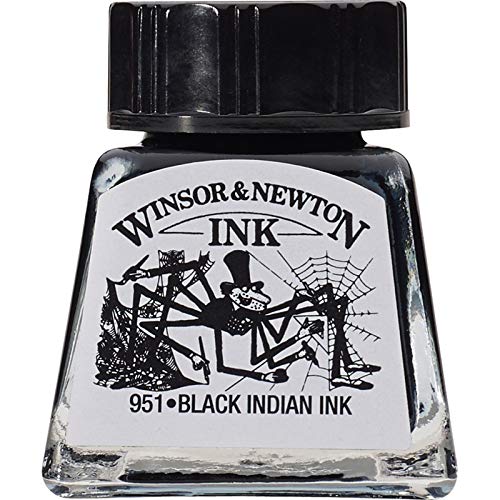
Winsor & Newton Drawing Ink
Framed or sold artwork benefits from this shellac-free formula, which resists fading better than most drawing inks. Flow stays even across both brushes and pens. Drying takes longer than shellac-based alternatives, a fair trade for the added lightfastness.
Pros
- Strong lightfastness for archival work
- Smooth flow across tools
- No shellac buildup in pens
Cons
- Slower drying than shellac-based inks
- Smaller bottle for the price

Daler-Rowney FW Acrylic Artists Ink
Mixed-media artists layering ink over acrylic paint rely on this acrylic-based formula for a permanent bond to paper, canvas, and some plastics. It resists water once cured, even under heavy washes. Tools need prompt rinsing, since dried ink won’t dissolve back out.
Pros
- Bonds to canvas and some plastics
- Fully water-resistant once cured
- Works well in airbrush setups
Cons
- Ruins pens and brushes if left to dry
- Not reversible once set

Yasutomo Sumi Ink
Sumi-e and traditional brush painting call for this carbon soot ink, which produces smooth gradients when diluted with water. Soft brushes suit it better than dip pens, unlike most Western drawing inks. Bottled convenience skips grinding an ink stick by hand before each session.
Pros
- Smooth gradients when diluted
- Traditional sumi-e consistency
- No grinding required, ready to use
Cons
- Not waterproof once dry
- Poor fit for technical or dip pens
The lineup, side by side
| # | Model | Base | Best for | Score | Price |
|---|---|---|---|---|---|
| 1 | Speedball Super Black India Ink | Carbon pigment | Best overall | 9.3 | Check price |
| 2 | Higgins Black Magic Waterproof India Ink | Shellac and pigment | Best value | 8.6 | Check price |
| 3 | Koh-I-Noor Rapidograph Universal Drawing Ink | Dye and pigment blend | Best for technical pens | 8.9 | Check price |
| 4 | Dr. Ph. Martin’s Bombay India Ink | Dye-based pigment | Best for illustration | 9.0 | Check price |
| 5 | Winsor & Newton Drawing Ink | Pigment, shellac-free | Best for lightfastness | 8.8 | Check price |
| 6 | Daler-Rowney FW Acrylic Artists Ink | Acrylic polymer | Best for mixed media | 8.7 | Check price |
| 7 | Yasutomo Sumi Ink | Carbon soot | Best for traditional brush work | 8.5 | Check price |
Questions worth asking
What is the difference between India ink and sumi ink?
India ink usually cures waterproof and permanent, while sumi ink stays water-reactivating even once dry, letting artists rework strokes with a damp brush.
Can drawing ink be used in a fountain pen?
Most India and sumi inks clog fountain pen feeds because of pigment and shellac content, so dedicated fountain pen ink remains the safer pick.
Does drawing ink stay waterproof after it dries?
Pigment and shellac-based formulas generally cure waterproof, though sumi ink and a few dye-based inks stay water-reactivating.
What ink won’t clog a Rapidograph technical pen?
Koh-I-Noor’s Universal Drawing Ink runs thinner than shellac-based options specifically to avoid clogging technical pen nibs.
Which drawing ink is best for beginners using a dip pen?
Speedball Super Black India Ink offers forgiving viscosity and reliable flow, making it a common starting point for new dip pen artists.
Can you mix different brands of drawing ink?
Mixing works within similar bases, like two pigment inks, but combining shellac-based ink with acrylic ink can cause clumping or separation.
How long does a bottle of drawing ink usually last?
A 1 to 2 ounce bottle can last months of regular sketching, since most techniques use only small amounts per session.
Is acrylic ink different from regular India ink?
Yes, acrylic ink like Daler-Rowney FW bonds permanently to canvas and some plastics, while standard India ink stays mostly a paper medium.
What is the best drawing ink for illustration and cross-hatching?
Dr. Ph. Martin’s Bombay India Ink carries denser pigment that layers cleanly across cross-hatching and washes without muddying.
Our take
Speedball Super Black India Ink remains the safest first purchase, since it covers dip pen and brush work without clogging fine nibs. Anyone running a technical pen daily should switch to Koh-I-Noor’s formula instead, avoiding the nib clogs shellac-based inks cause. Illustrators chasing deeper color should budget for Dr. Ph. Martin’s Bombay ink, which justifies its higher price with richer pigment.
Jake Monroe
Jake worked as a residential contractor for over a decade before shifting to full-time writing. He evaluates power tools, hand tools and workshop gear through the lens of someone who has actually used them on job sites, not just read the box.