6 Fetch Balls Dogs Actually Chase Instead of Ignore
The Chuckit! Ultra Ball wins overall for its bounce, buoyancy and launcher fit. The KONG SqueakAir Tennis Ball is the better value pick for dogs driven by squeak, and the West Paw Jive holds up best against determined chewers, based on material specs and owner-reported durability.
Chuckit’s Ultra Ball tops this list because it bounces high, floats and fits standard ball launchers, covering nearly every way people play fetch. KONG’s SqueakAir Tennis Ball is the better value pick for dogs motivated by squeak rather than distance. West Paw’s Jive survives dogs who treat every ball as a chew toy.
Fetch balls look like a trivial purchase until you’ve replaced four in a month or found a shredded tennis ball fragment in the yard. Rubber compound, wall thickness, bounce and buoyancy vary more than the shelf suggests, and abrasive felt is genuinely hard on tooth enamel. We compared material specifications, bounce behavior, buoyancy, launcher fit and what owners report about durability under real chewing pressure.
The shortlist, ranked

Chuckit! Ultra Ball
Natural rubber gives this ball a bounce well beyond a felt tennis ball. It floats, so lake and pool sessions work as well as park throws. Textured rubber makes it easy to grip, and the diameter matches standard Chuckit launchers for long, low-effort throws.
Pros
- Bounces far higher than a standard tennis ball
- Floats for retrieves in water
- Fits Chuckit launchers for extended throwing distance
Cons
- Sustained chewing can eventually puncture it
- Strong rubber odor when new
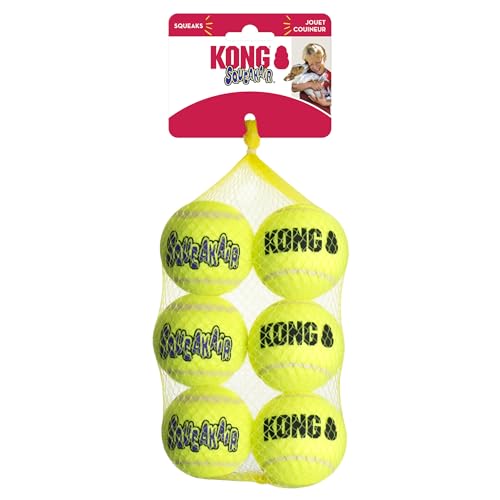
KONG SqueakAir Tennis Ball
KONG replaces the abrasive felt on sports tennis balls with a softer weave that is gentler on tooth enamel. A squeaker inside keeps lower-drive dogs engaged through a full session. Multi-packs make replacing a punctured ball simple.
Pros
- Softer felt reduces wear on tooth enamel
- Squeaker holds attention during longer sessions
- Sold in multi-packs for easy replacement
Cons
- Squeaker stops working once the ball is punctured
- Heavy chewers get through it quickly

West Paw Jive Dog Ball
Zogoflex is a recyclable elastomer tough enough that West Paw guarantees the ball against chew damage. Its irregular bounce sends dogs chasing in unpredictable directions, which keeps play interesting. It floats and goes straight into the dishwasher after a muddy walk.
Pros
- Withstands chewers that destroy rubber and felt balls
- Backed by a manufacturer damage guarantee
- Floats and cleans in the dishwasher
Cons
- Erratic bounce makes long throws less predictable
- Firmer texture that some soft-mouthed dogs avoid

Chuckit! Kick Fetch Ball
Sized like a small football, this ball is built to be kicked rather than thrown, which spares a sore shoulder from repeated pitching. Molded grooves give large dogs something to grip so they can carry it back. Herding breeds that like to chase and drive respond well to the rolling motion.
Pros
- Kickable design removes throwing strain
- Carry grooves suit large dog mouths
- Rolling motion appeals to chase-driven breeds
Cons
- Too large for small breeds to manage
- Foam wears down under repeated chewing

Planet Dog Orbee-Tuff Diamond Plate Ball
A hollow core turns this ball into a treat dispenser once fetch winds down, holding kibble or paste for extended engagement. Orbee-Tuff material floats and bounces despite being softer than pure fetch rubber. Mint scent is built into the material rather than sprayed on.
Pros
- Doubles as a fetch ball and treat puzzle
- Floats and bounces well for a softer material
- Made from non-toxic, recyclable Orbee-Tuff
Cons
- Softer construction wears faster under heavy chewing
- Treat opening needs regular cleaning

Hyper Pet Mini Tennis Balls
Standard tennis balls are genuinely too big for many small breeds to grip, and this scaled-down version fixes that without changing the game. Bright colors stand out against grass, which matters when a ball rolls into a hedge. Multi-packs mean one lost ball is not a crisis.
Pros
- Sized correctly for small breed mouths
- High-visibility colors are easy to spot in grass
- Sold in packs so a lost ball is not costly
Cons
- Felt surface is abrasive on teeth over time
- A choking hazard for larger dogs given the small size

JW Pet iSqueak Ball
A molded rubber ball with a squeaker and a raised bone pattern that gives dogs something to grip. It bounces reliably on hard surfaces and holds up to normal fetch sessions. Young dogs respond to the loud squeak, which keeps interest up during repetitive throws.
Pros
- Loud squeaker keeps young dogs engaged
- Textured surface is easy to pick up
- Reliable bounce on pavement and hard courts
Cons
- Squeaker fails once the ball is punctured
- Does not float reliably in water
How to pick the right one
How to size a fetch ball correctly A ball must be too large to pass behind a dog’s back teeth. That single rule prevents most choking incidents in this category. Deep-chested large breeds have choked on standard tennis balls sized for smaller dogs, so a Labrador or bigger should use a large or extra-large option. A full-size tennis ball, meanwhile, is awkward for a Chihuahua to grip. Check any size chart against your dog’s weight, and round up when you’re between sizes.
Why standard tennis balls wear down teeth Sports tennis balls use an abrasive felt designed to grip a racket, not a dog’s mouth. Veterinary dentists report worn enamel, called blunting, in dogs that carry felt balls constantly. That wear is permanent once it happens. Purpose-built dog balls avoid the problem: KONG’s SqueakAir uses a softer felt, and solid rubber balls skip felt entirely. Occasional fetch with a sports ball rarely causes harm; daily carrying is the real risk.
Bounce, buoyancy and launcher fit Dense rubber bounces far higher than felt, turning a modest throw into a long chase without extra effort. Buoyancy matters more than most owners expect, since a ball that sinks ends a lake or pool session immediately. Launcher compatibility depends on diameter: an oversized ball won’t seat properly, and an undersized one flies unpredictably. Match the ball to your launcher’s specifications before buying multiples.
When to retire a fetch ball Every ball on this list is a toy, not a chew, and no material is indestructible. Inspect each ball before play for splits, punctures or missing chunks. Shredded rubber or felt fragments are a real intestinal obstruction risk if swallowed. Retiring a ball a week early costs far less than an emergency vet visit.
Compared at a glance
| # | Model | Material | Best for | Score | Price |
|---|---|---|---|---|---|
| 1 | Chuckit! Ultra Ball | High-bounce natural rubber | Best overall | 9.4 | Check price |
| 2 | KONG SqueakAir Tennis Ball | Non-abrasive felt over rubber core | Best value | 9.2 | Check price |
| 3 | West Paw Jive Dog Ball | Zogoflex recyclable elastomer | Best for heavy chewers | 9.0 | Check price |
| 4 | Chuckit! Kick Fetch Ball | About 8 inches | Best for large dogs | 8.8 | Check price |
| 5 | Planet Dog Orbee-Tuff Diamond Plate Ball | Orbee-Tuff, non-toxic | Best for treat stuffing | 8.6 | Check price |
| 6 | Hyper Pet Mini Tennis Balls | About 2 inches | Best for small dogs | 8.3 | Check price |
| 7 | JW Pet iSqueak Ball | Molded natural rubber | Best budget | 8.0 | Check price |
Frequently asked questions
Are tennis balls safe for dogs?
For occasional fetch, generally yes. The two real concerns are abrasive felt wearing down tooth enamel with constant carrying, and a large dog compressing a standard ball at the back of the throat. Dog-specific balls with non-abrasive felt or solid rubber avoid both problems.
What size fetch ball does my dog need?
Pick a ball too large to fit fully behind the molars. Small breeds under 20 pounds typically suit a 2-inch ball, medium dogs a 2.5-inch ball, and large or deep-chested breeds need 3 inches or larger. When unsure, size up rather than down.
Which fetch ball lasts longest with aggressive chewers?
West Paw’s Jive is the toughest option here and comes with a damage guarantee. Chuckit’s Ultra Ball holds up well under normal play but will eventually puncture under sustained chewing. No ball is fully chew-proof, so heavy chewers still need supervision and a separate chew toy for downtime.
Do fetch balls float?
Chuckit’s Ultra Ball, West Paw’s Jive and Planet Dog’s Orbee-Tuff ball all float. Felt tennis balls float briefly, then become waterlogged and heavy. Buoyancy is worth prioritizing if you play near water regularly.
How do I clean a dog fetch ball?
Wash rubber balls in warm soapy water and rinse thoroughly. West Paw’s Jive is dishwasher safe on the top rack. Felt balls can be hand-washed but tend to hold moisture and grit, so clean them often since they collect saliva and dirt quickly.
When should I throw away a dog ball?
As soon as it shows splits, punctures, missing chunks or exposed inner material. Broken-off pieces can cause choking or intestinal blockage. Checking a ball at the start of each session takes seconds and prevents most emergencies.
Is a ball launcher worth using?
For high-drive dogs, yes. A launcher throws farther with less effort and lets you retrieve a slobbery ball without touching it. The extra distance also means more repetitive high-speed running, which is harder on joints for puppies and older dogs.
How much fetch is too much for a dog?
Repeated sharp turns at speed strain joints, especially in puppies whose growth plates haven’t closed and in older dogs with existing wear. Keep sessions moderate, watch for limping or reluctance, and ask a veterinarian about appropriate exercise for your dog’s age and breed.
Which fetch ball works best for large or high-energy dogs?
Chuckit’s Kick Fetch Ball is sized for big dogs and built to be kicked rather than thrown, which suits herding breeds that like to chase and drive. Its molded grooves also make it easier for a large mouth to pick up and carry.
Our take
Chuckit’s Ultra Ball is the fetch ball most dogs and owners should start with, since it bounces high, floats and works with a launcher. Switch to West Paw’s Jive if your dog destroys everything, or Hyper Pet’s Mini Tennis Balls if a standard ball is simply too big for their mouth. Whichever you choose, size it so it can’t fit behind the back teeth, and retire it the moment it starts to split.
Olivia Hartley
Olivia spent several years working at an animal shelter and a pet-supply retailer before joining the editorial team. She researches pet gear with an emphasis on safety, comfort and the fine print that owners often miss.


