Digital Voice Recorders for Lectures and Interviews
Sony’s ICD-UX570 tops this list for its stereo mic and direct USB transfer, ideal for lecture halls and interview rooms. The Olympus WS-852 holds the most internal storage for marathon recording sessions. Budget shoppers get solid one-button operation from the Evistr L157 without paying for extra features.
Sony’s ICD-UX570 stands out among current digital voice recorders for lecture halls and interview rooms, pairing a stereo microphone with direct USB plug-in transfer. Its 4GB of internal storage fills up faster than models with expandable memory.
Manufacturers rarely publish real recording distance or battery drain under continuous use, which makes specs alone unreliable. We compared microphone type, internal storage, battery life, and file transfer method across seven current models, weighing owner feedback on build quality alongside published numbers.
How to choose
How Dedicated Recorders Differ From Phone Apps Phone apps compress audio and pause during calls or notifications, risking gaps in a lecture or interview. Dedicated recorders use lighter compression, purpose-built microphones, and storage that isn’t shared with photos or messages. A single AAA or AA cell also outlasts a phone running a background recording app.
Matching Microphone Type to Recording Distance Built-in stereo mics, like the one on the Sony ICD-UX570, work best within a few feet for interviews or personal notes. Multi-microphone arrays, such as the Philips VoiceTracer DVT1160, spread pickup across a conference table for group meetings. Condenser capsules on the Zoom H1n and Tascam DR-05X favor music and ambient detail over close speech.
Storage and Battery Life for All-Day Sessions Internal storage matters most on recorders without a memory card slot to fall back on, so 8GB Olympus and Philips models handle multi-hour lectures better than 4GB Sony models without an added card. Standard AA or AAA batteries let you swap in fresh cells mid-conference, while the rechargeable Evistr L157 needs a nearby USB outlet.
Which Recorder Fits Podcasting, Journalism, or Note Taking Podcasters and musicians usually want 24-bit WAV recording, which points toward the Zoom H1n over MP3-only dictation models. Journalists conducting outdoor interviews benefit from a low-cut filter like the Tascam DR-05X’s to cut wind noise. Students taking quick notes are often better served by one-button operation, such as the Evistr L157, than a menu-heavy multi-mode device.
Our top picks
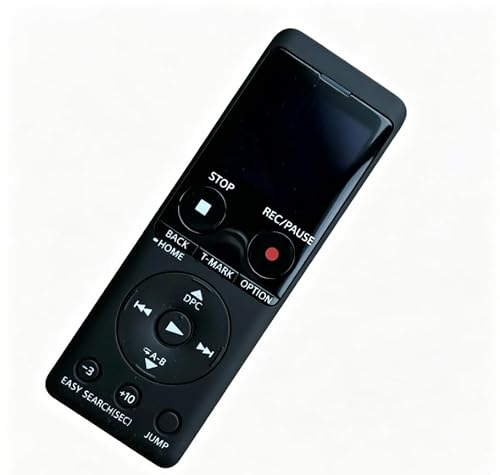
Sony ICD-UX570BLK Digital Voice Recorder
A front-facing stereo microphone sits above the flip-out USB connector on the ICD-UX570, so plugging into a laptop skips cables entirely. Built-in storage holds 4GB, expandable through a microSD slot for longer sessions. Recording quality scales from low-bitrate MP3 up to higher settings for cleaner playback.
Pros
- Flip-out USB connector skips separate transfer cables
- Stereo mic captures clear speech at close range
- Compact body fits a shirt pocket easily
Cons
- 4GB storage fills up fast on multi-hour lectures without a microSD card
- No wireless transfer app for phones or tablets
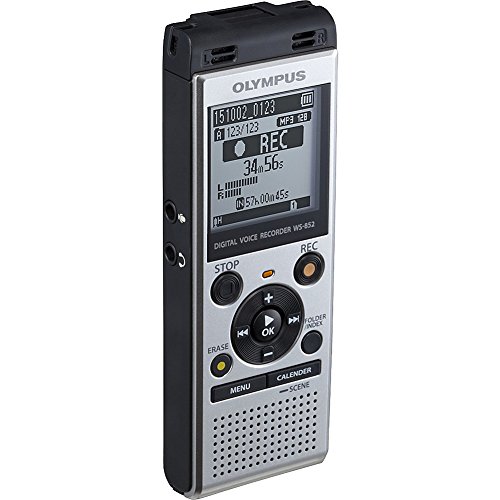
Olympus WS-852 Digital Voice Recorder
Olympus doubled storage on the WS-852 to 8GB, with a microSD slot open for more room. Its stereo microphone sits behind a mesh grille, while a folder system separates lectures from meetings and personal notes. Playback speed adjusts without pitch distortion, useful for reviewing dense material twice.
Pros
- Largest internal storage in this lineup
- Folder system keeps recording types organized
- Variable-speed playback aids transcription work
Cons
- No built-in USB plug, so a cable is required
- Menu navigation takes practice to learn

Zoom H1n Handy Recorder
Zoom skipped internal memory on the H1n, relying instead on a microSD card up to 32GB. An X/Y stereo condenser capsule sits at a 90 degree angle for wide, accurate imaging, and WAV files record up to 24-bit/96kHz alongside MP3. A small built-in speaker allows quick playback checks without headphones.
Pros
- High-resolution WAV recording suits music and podcasts
- Onboard limiter reduces clipping on loud sources
- Tripod mount works with stands or camera rigs
Cons
- No internal storage, so a microSD card is required
- Battery life trails dedicated dictation recorders

Tascam DR-05X Stereo Handheld Recorder
Two omnidirectional condenser microphones handle stereo capture on the DR-05X, recording WAV or MP3 to a microSD card. Connected to a computer, it doubles as a USB audio interface or microphone for calls and streaming. A low-cut filter trims wind rumble and handling noise during outdoor interviews.
Pros
- Doubles as a USB microphone for calls or streaming
- Low-cut filter reduces wind and handling noise
- Overdub function layers new audio onto existing takes
Cons
- No internal storage ships in the box
- Battery compartment door feels flimsy
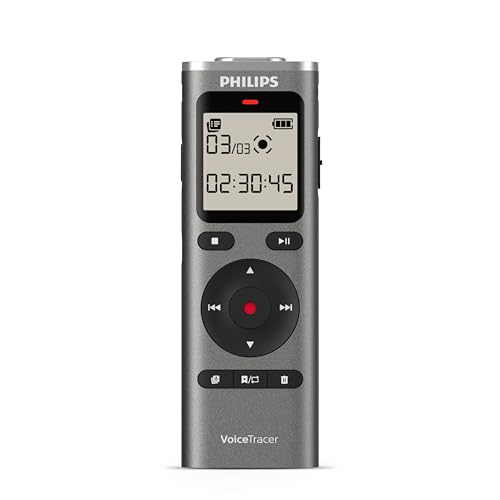
Philips VoiceTracer DVT1160
Three microphones arranged in an array let the DVT1160 pick up speech from multiple directions around a table. It ships with 8GB of internal storage and accepts microSD cards for extra room. A dedicated meeting mode balances volume automatically between speakers seated at different distances.
Pros
- Three-mic array captures speakers around a table
- Preset modes adjust automatically by room type
- Runs on widely available AA batteries
Cons
- Bulkier body than pocket-style recorders
- Costs more than basic single-mic models

Sony ICD-PX470 Digital Voice Recorder
S-Micro Recording circuitry on the ICD-PX470 aims to cut distortion when nearby speakers talk loudly. A microSD slot supplements 4GB of internal memory for extra room, and a built-in USB connector allows direct computer transfer. Battery life stretches to 55 hours on a single AAA cell.
Pros
- Long battery life from one AAA cell
- Built-in USB connector skips separate cables
- Noise cut function reduces background hiss on playback
Cons
- Plastic body feels less durable than metal-bodied models
- Small buttons complicate quick one-handed operation

Evistr L157 Digital Voice Recorder
Fixed 8GB storage on the L157 supports microSD cards up to 32GB for additional space. Pressing a single button starts and stops capture without menu navigation, and files save automatically as MP3. A password lock restricts playback access directly on the device.
Pros
- One-button operation suits quick voice memos
- Password lock adds basic playback security
- Rechargeable battery avoids buying AAA cells
Cons
- Microphone picks up more handling noise than condenser designs
- Build quality trails established camera and audio brands
How they stack up
| # | Model | Internal storage | Best for | Score | Price |
|---|---|---|---|---|---|
| 1 | Sony ICD-UX570BLK Digital Voice Recorder | 4GB, expandable via microSD | Best overall | 9.4 | Check price |
| 2 | Olympus WS-852 Digital Voice Recorder | 8GB, expandable via microSD up to 32GB | Best for long recordings | 9.1 | Check price |
| 3 | Zoom H1n Handy Recorder | MicroSD card required, up to 32GB | Best for musicians and podcasters | 8.9 | Check price |
| 4 | Tascam DR-05X Stereo Handheld Recorder | MicroSD card required, up to 32GB | Best for interviews and journalists | 8.6 | Check price |
| 5 | Philips VoiceTracer DVT1160 | 8GB, expandable via microSD | Best for meetings and lectures | 8.3 | Check price |
| 6 | Sony ICD-PX470 Digital Voice Recorder | 4GB, expandable via microSD | Best value | 8.1 | Check price |
| 7 | Evistr L157 Digital Voice Recorder | 8GB, expandable via microSD up to 32GB | Best budget | 8.0 | Check price |
Good to know
What is the best digital voice recorder for lectures?
Recorders with larger internal storage and adjustable playback speed suit lectures best. The Olympus WS-852 offers 8GB of storage and variable-speed playback without pitch distortion, handy for reviewing dense material later.
Are digital voice recorders better than phone recording apps?
Dedicated recorders draw on storage and battery power that isn’t shared with other apps, so they rarely stop mid recording. Most also include directional microphones built for speech rather than a phone’s general-purpose mic.
Which digital voice recorder is best for interviews?
The Tascam DR-05X suits interviews well, pairing an omnidirectional stereo condenser pair with a low-cut filter that cuts wind and handling noise outdoors.
How much storage do I need on a voice recorder?
8GB of internal storage holds several hundred hours of recording depending on the quality setting. A microSD slot lets most models expand storage without buying a new device.
Can a digital voice recorder capture music, not just speech?
Models with condenser microphones and WAV recording, like the Zoom H1n, capture music with more detail than dictation recorders limited to MP3. Compression on dictation-focused units flattens instrumental detail.
Voice recorder vs the Zoom H1n, what’s the difference?
Standard dictation recorders like the Sony ICD-PX470 prioritize speech clarity and long battery life over audio fidelity. The Zoom H1n instead targets musicians and podcasters with higher-resolution WAV recording and a wider stereo image.
Do digital voice recorders need a microSD card?
Some, including the Olympus WS-852 and Sony ICD-UX570, include internal storage and work without a card. Others, like the Zoom H1n and Tascam DR-05X, require one since they ship without built-in memory.
What is the best budget digital voice recorder?
The Evistr L157 pairs 8GB of storage with one-button recording at a lower cost than camera-brand models, though its microphone picks up more handling noise than condenser designs.
Which recorder works best for meetings with multiple speakers?
The Philips VoiceTracer DVT1160 uses a three-microphone array and a dedicated meeting preset to balance volume between speakers seated at different distances around a table.
Our pick
Sony’s ICD-UX570 remains the strongest all-around pick, pairing a clear stereo mic with a flip-out USB connector that skips cables entirely. Podcasters and musicians should choose the Zoom H1n instead, since its WAV recording and X/Y capsule capture far more detail than any dictation-focused model here. Buyers who record all-day meetings get better mileage from the Philips VoiceTracer DVT1160’s three-mic array.
Marcus Chen
Marcus covered consumer electronics for enthusiast tech publications for six years before joining ChoiceCrest. He specializes in translating manufacturer spec sheets into plain-language buying advice, with a focus on audio, computing accessories and smart-home gear.
You might also need
Nintendo Game & Watch: Super Mario Bros Review: Still Worth It as a Collectible?

Ray-Ban Meta (Gen 2) Wayfarer Smart Glasses: Worth $379 for Clear Lenses?
AlyKets Nikon UC-E6 Replacement USB Cable: Does a $7.95 Cord Work as Well as the Original?
