Digital RV Vent Fans Compared by Airflow and Controls
Fan-Tastic Vent 807350 Endless Breeze ranks first, pairing a 900 CFM motor with a sensor that drops the lid on its own. MaxxAir MaxxFan Deluxe 00-07500K keeps venting under a raised rain shield. Fan-Tastic Vent 807351 adds thermostat control for unattended trips.
Fan-Tastic Vent 807350 Endless Breeze suits owners who park where weather turns fast. Its sensor closes the dome the moment rain lands, then reopens once the lid dries. Outlay sits above a plain manual vent, and the sensor pad needs wiping every few months.
Two fans can share the same 14 inch cutout and behave nothing alike on a wet night. We compared published CFM ratings, speed counts, lid behavior in rain and 12 volt wiring requirements. Owner reports on sensor false trips and motor noise settled the close calls.
How to choose
What to look for in a digital RV vent fan Three things settle most of this decision: airflow in CFM, how many speeds the control offers, and whether the lid can close itself. Higher CFM clears humidity and cooking smoke faster in a long coach. Speed count matters at night, since the lowest setting decides whether you sleep. Lid behavior is the real split, because a dome that stays open is a leak waiting for weather. Battery load rarely tips the scale on 12 volt fans.
Rain sensor or rain shield: which do you need? Sensor models such as the 807350 read moisture on the lid and shut the dome on their own. That protects an unattended rig, though it stops ventilation exactly when humidity climbs. MaxxAir goes the other way, arching a shield over the raised lid so air keeps moving through a shower. Neither approach wins outright. Park somewhere with sudden storms and nobody home, take the sensor; camp in coastal drizzle and the shield earns its keep.
Matching airflow to the size of your rig Roof cutouts have measured 14 by 14 inches on most trailers and motorhomes since the 1990s, so replacement is usually a swap rather than a saw job. Measure anyway on older or custom builds. Vans and short trailers do fine near 400 to 500 CFM. Coaches past 25 feet benefit from the 900 CFM units, especially with a second window cracked to feed air in.
When remotes and thermostats actually earn their place Remotes sound optional until the wall switch sits above the galley and the bed is at the far end. Thermostat control matters most for pets left in a rig, or on travel days when outside temperature swings twenty degrees. Weekend campers who open a vent once and forget it will notice none of this, and the Heng’s or Ventline units serve them fine. One tradeoff deserves attention: ten-speed fans run quieter at their lowest setting than two-speed fans, which matters more than peak CFM to anyone who sleeps light.
The shortlist, ranked
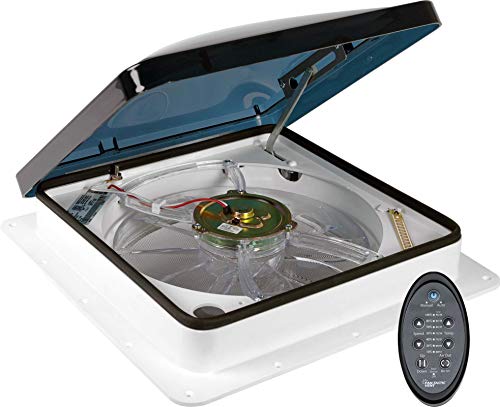
Fan-Tastic Vent 807350 Endless Breeze
A moisture sensor sits in the lid and cuts the motor when rain hits, closing the dome before water reaches the mattress. Airflow peaks near 900 CFM on the top setting. Speed changes happen at a digital wall switch, so nobody climbs onto a wet roof.
Pros
- Sensor closes the dome without anyone watching the sky
- 900 CFM clears cooking smoke from a long coach fast
- Wall switch replaces the crank and pull cord
Cons
- Sensor pad collects road film and needs wiping
- Costs more than a manual lift vent of the same size

MaxxAir MaxxFan Deluxe 00-07500K
Molded shielding arches over the raised lid, so the fan keeps pulling air while a shower passes. Ten speeds cover everything from a quiet overnight trickle to roughly 900 CFM. Flip the direction switch and the same blade draws outside air inward.
Pros
- Ventilates through drizzle instead of shutting down
- Ten speeds trade noise against airflow precisely
- Intake mode pulls cool evening air inside
Cons
- Heavy rain with crosswind still pushes water past the shield
- Domed shield adds height above the roofline
Fan-Tastic Vent 807351 with Thermostat and Rain Sensor
Set a target temperature and the fan starts itself once the cabin climbs past it. Rain sensing carries over from the 807350, so the lid still drops during a shower. Active mode and speed show on a small digital readout beside the switch.
Pros
- Thermostat runs the fan while the rig sits empty
- Auto start and rain sensing work together
- Readout confirms which mode is active
Cons
- Accuracy depends on where the cabin sensor sits
- Adds cost over the plain 807350

Fan-Tastic Vent Ultra Breeze 1250
Thermostat mode and a digital wall switch arrive here without the moisture sensor. Peak airflow stops around 700 CFM, plenty for a single-room trailer or a van build. Raising the lid stays a manual job, so check the forecast before bed.
Pros
- Thermostat mode at a lower outlay than sensor models
- Drops straight into the standard 14 inch cutout
- 700 CFM handles a short trailer without strain
Cons
- An open lid invites water during an overnight storm
- Tops out below the 900 CFM models

MaxxAir MaxxFan 4500K with Remote
Ten speeds answer to a handheld remote, usable from the bed or dinette. Reversible operation matches the Deluxe line, switching between exhaust and intake. Its lid lifts manually under a rain shield, with no moisture sensor involved.
Pros
- Remote reaches the fan from anywhere in the coach
- Lowest speeds run quiet enough for sleeping
- Reverses to intake on cool evenings
Cons
- Remote disappears easily in a cluttered galley
- Lid never closes on its own

Ventline V2094SS-00 RV Roof Vent
Smoke tint on the dome softens midday glare that clear lids pass straight through. Two speeds run off a simple digital switch, which keeps the wiring short. Its footprint matches the 14 inch opening used across most travel trailers.
Pros
- Tinted dome reduces overhead sun in the cabin
- Slots into a standard 14 inch cutout
- Two-speed wiring keeps installation short
Cons
- No remote, thermostat or moisture sensor
- 500 CFM lags behind the ten-speed models

Heng’s 90059-C1 12V RV Roof Vent Fan
Swapping an aging manual vent for this one takes little more than a screwdriver and fresh sealant. A rocker switch runs the 12 volt motor at two speeds. Airflow lands near 400 CFM, which suits a small camper better than a long fifth wheel.
Pros
- Direct replacement for older 14 inch manual vents
- Two-speed rocker keeps operation obvious
- Fewest electronics here to fail later
Cons
- No thermostat, remote or moisture sensor
- 400 CFM falls short in a large motorhome
How they compare
| # | Model | Airflow | Best for | Score | Price |
|---|---|---|---|---|---|
| 1 | Fan-Tastic Vent 807350 Endless Breeze | Up to 900 CFM | Best overall | 9.4 | Check price |
| 2 | MaxxAir MaxxFan Deluxe 00-07500K | Up to 900 CFM | Best for venting during rain | 9.1 | Check price |
| 3 | Fan-Tastic Vent 807351 with Thermostat and Rain Sensor | Up to 900 CFM | Best for hands-off temperature control | 8.9 | Check price |
| 4 | Fan-Tastic Vent Ultra Breeze 1250 | Up to 700 CFM | Best value | 8.7 | Check price |
| 5 | MaxxAir MaxxFan 4500K with Remote | Up to 900 CFM | Best for remote operation | 8.5 | Check price |
| 6 | Ventline V2094SS-00 RV Roof Vent | Approx. 500 CFM | Best for cutting cabin glare | 8.3 | Check price |
| 7 | Heng’s 90059-C1 12V RV Roof Vent Fan | Approx. 400 CFM | Best for a simple replacement swap | 8.0 | Check price |
Good to know
What is the best digital RV vent fan for rain protection?
Fan-Tastic Vent 807350 leads here, since its sensor closes the dome automatically when moisture lands on the lid. That protects an empty rig during a surprise storm.
Can an RV vent fan run while it is raining?
Shield designs like the MaxxFan Deluxe keep running with the lid raised during light rain. Fans without a shield need the lid down, so airflow stops until the weather passes.
What size roof opening do RV vent fans fit?
Most fit the standard 14 by 14 inch cutout used across travel trailers and motorhomes since the 1990s. Older or custom builds occasionally differ, so measure before ordering.
How many CFM does an RV vent fan need?
Vans and short trailers work well around 400 to 500 CFM. Coaches longer than 25 feet clear air faster with a 900 CFM unit running on high.
Do RV vent fans reverse for intake and exhaust?
MaxxAir models switch direction, pulling cool air in during the evening and exhausting heat during the day. Basic two-speed vents exhaust only.
Is a remote worth it on an RV roof vent fan?
Yes when the wall switch sits far from the bed or dinette. Owners in compact vans, where every switch is within reach, gain little from one.
What does the thermostat do on a Fan-Tastic vent?
It starts the fan once cabin temperature passes a set point and stops it when the cabin cools. That keeps air moving on travel days without manual adjustment.
Fan-Tastic vs MaxxAir: which should you buy?
Pick Fan-Tastic for automatic rain shutoff and thermostat options. Pick MaxxAir when you want airflow to continue through drizzle and reversible intake.
How difficult is it to install an RV roof vent fan yourself?
Most swaps involve removing the old assembly, cleaning the old sealant, setting the new frame in butyl tape and joining two 12 volt wires. Working on the roof safely is the harder part.
Will a roof vent fan drain the RV battery overnight?
These 12 volt fans draw modest current, so a healthy house battery generally runs one all night on a low speed. Higher speeds pull more, which is another argument for a ten-speed control.
The verdict
Fan-Tastic Vent 807350 Endless Breeze earns the default recommendation, because a lid that closes itself protects an empty rig better than any airflow figure. Choose MaxxAir MaxxFan Deluxe 00-07500K instead if you camp in coastal drizzle and want air moving through it. Budget van builds should take the Ultra Breeze 1250 and simply close the lid before bed.
Tony Russo
Tony trained as an automotive technician and spent years in service and parts retail before moving into writing. He focuses on garage tools, car care products and accessories from a hands-on maintenance perspective.